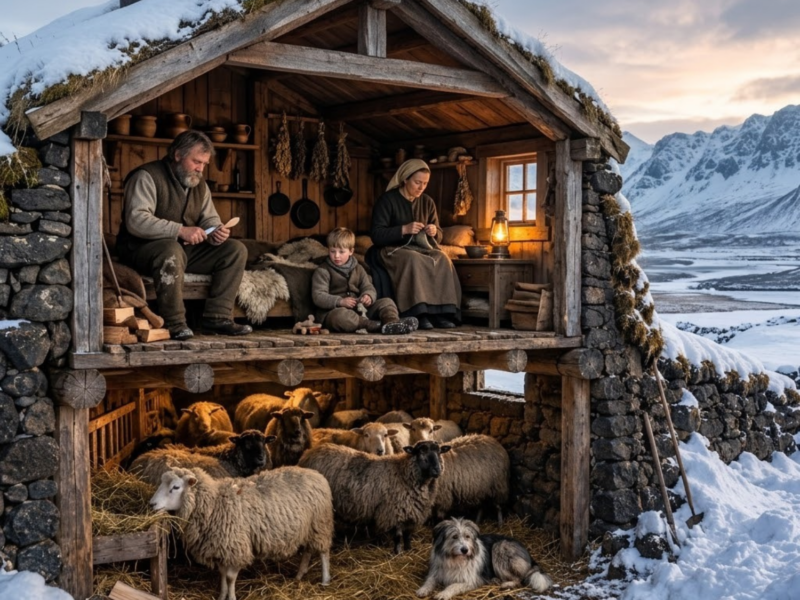
They Mocked Him for Keeping SHEEP Under His Floor — Until Winter Came
The First Frost and the Gathering Storm
For the first few weeks, the radical arrangement seemed nothing short of miraculous. The sheep were entirely shielded from the bitter winds and driving sleet. Einar could drop down through the internal hatch, toss fresh hay to the ewes, and check their water without ever donning his heavy wool coat or fighting his way across the snow-choked yard.
Upstairs, the raised baðstofa remained characteristically brisk, but on particularly freezing evenings, the wooden floorboards radiated a subtle, comforting baseline of warmth that Einar and Sigrid had never experienced before. The sheep were thriving, quiet, and content.
Then, the first true crisis struck.
Following a prolonged spell of heavy, freezing rain and coastal dampness, moisture began to accumulate near the northeast corner of the lower pen. The subterranean air grew heavy, stagnant, and humid. The fresh straw bedding rapidly deteriorated into a soggy, unpleasant mash, and a stale, earthy funk began to seep up through the tight seams of the floorboards.
One bitterly cold morning, Sigrid stepped out of bed and recoiled, her bare foot encountering a damp patch of wood near the edge of the hearth. Arie’s dire warnings had materialized. Einar had built the pen to protect his sheep from the elements, but the tightly sealed, subterranean environment was trapping humidity, turning the shelter into a damp incubator. Left unchecked, the rising rot would endanger both the livestock and the health of the family overhead.
For a terrifying moment, Einar considered abandoning the experiment altogether—dragging the flock back out into the yard and locking them in the old, isolated shed.
Instead, he chose a harder path. Working systematically, he stripped out every scrap of fouled bedding, shoveled the sodden earth near the drain, cleared the blocked drainage channel, and wrenched the lower ventilation passage open to its absolute maximum width.
A rush of biting, sub-zero air poured into the pen. Instantly, some of the precious thermal warmth escaped, but the stale humidity plummeted, and the room began to dry.
Einar realized a vital truth: the sheep could help keep his family warm, but only if the animals remained rigorously healthy, and the air within the chamber remained pure enough to sustain life. A warm, damp dungeon was a death trap; a ventilated, clean shelter was a sanctuary.
By December, the lower chamber was scrubbed, dry, and functioning with clockwork efficiency.
And then, the sky broke open.
A relentless succession of ferocious snowstorms swept down from the Arctic circle, burying the valley under mountainous drifts of white. The wind drove fine, powdered snow against the thick turf walls, sealing every gap between the farm buildings until the homestead looked like a collection of snow-draped mounds.
Each morning, Einar’s neighbors woke to a nightmarish landscape. Men like Arie were forced to spend hours hacking through frozen ice-crusts and tunneling through towering drifts just to reach their distant livestock sheds, carrying heavy bales of hay through blinding whiteouts simply to keep their starving animals alive.
Einar did none of this.
When the morning chores called, he simply lifted the heavy wooden hatch inside his home, descended the short ladder into the dim, subterranean warmth, and found his flock waiting quietly in the quiet dark. He checked their water, inspected their pristine bedding, and scattered sweet hay along the manger. Above him, Sigrid could hear the soft, rhythmic shuffling of hooves—a comforting reminder of life persisting beneath their feet.
Yet, the harshest trial of the winter had not yet arrived.









