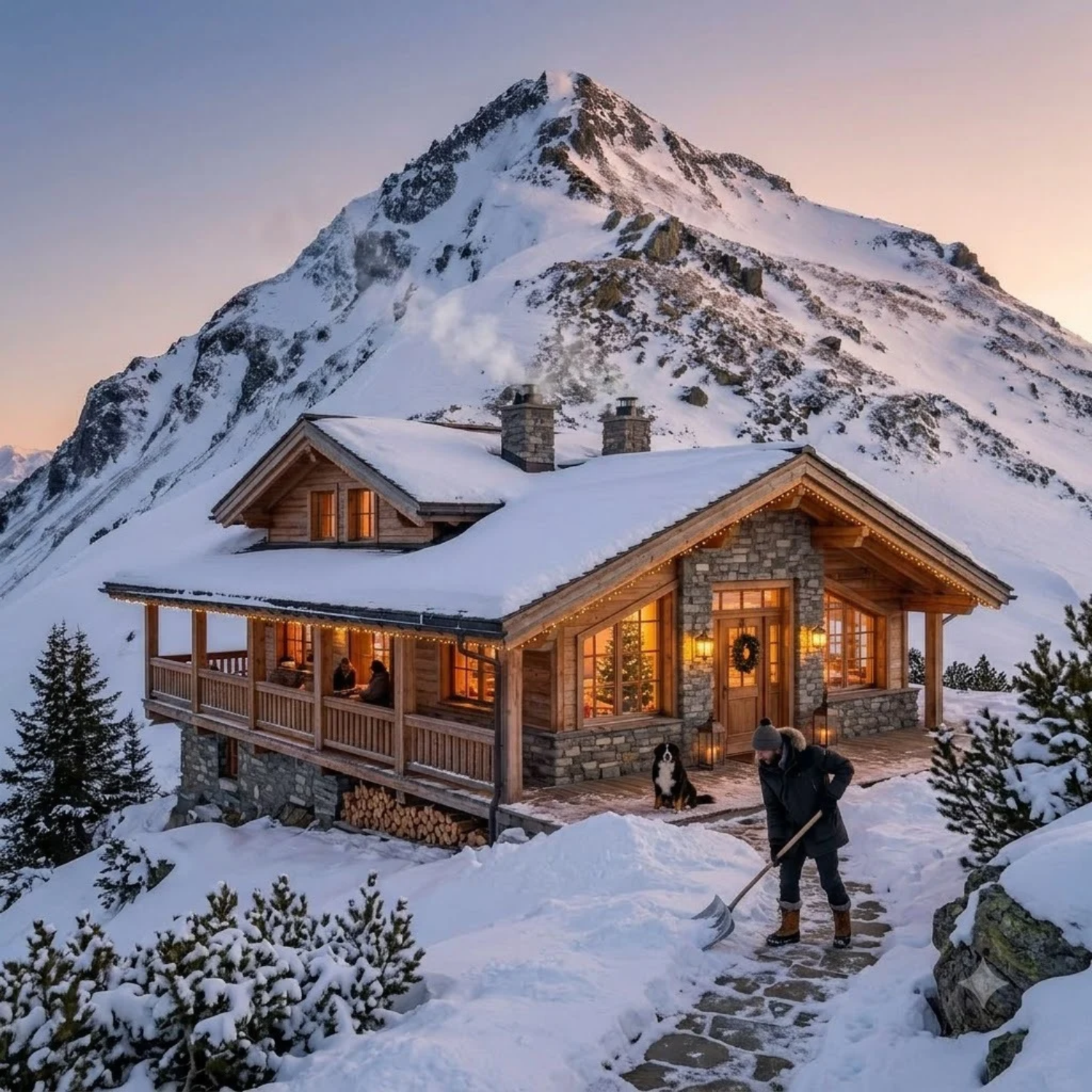
They Mocked the Buried Shelter She Dug Beneath the Ridge Until It Outlasted a 19 Day Storm
The Malicious Siege
The winters in that northern territory were not merely cold; they were a form of active, malicious siege.
They arrived in November not as a seasonal transition, but as an invading arctic force. The wind was a blade honed on a thousand miles of frozen rock, ice, and unyielding snowfields. It found every single seam, every imperfectly chinked joint in the neat log cabins that dotted the valley floor.
These were good cabins, built by proud, experienced hands like Silas Croft’s. They were constructed from the finest timber the river bottoms could offer, featuring tight dovetailed corners and stone fireplaces that stood as monuments of frontier masonry. They were the very picture of resilience.
And they were failing.
The failure was slow, insidious, and measured out in cords of ash and oak. A family might spend their entire autumn felling, limbing, splitting, and stacking a massive mountain of timber, only to watch it vanish into the hungry mouth of the hearth within a matter of weeks. The fire roared, a blazing orange heart in the center of the home, but its comfort was a cruel illusion.
Step six feet away from the hearth, and the temperature would plummet by twenty degrees. The outer walls, constantly assaulted by the howling gale and sub-zero air, became surfaces of radiant cold, actively pulling the thermal energy right out of the bodies of anyone foolish enough to sit near them.
A cup of water left on a bedside table near the north wall would develop a hard skin of ice overnight. Ink froze solid in its glass wells. Families lived their lives trapped in a pathetic, tiny orbit around the fire, cooking there, eating there, and huddling there under towering piles of heavy wool blankets while the structural timbers of their sturdy homes groaned under the strain of the frost. They slept with a rime of frost forming on their blankets from their own condensed, frozen breath.
It was survival, certainly, but it was a brittle, exhausting, and perpetually precarious existence. One bad flu, or one week of blinding blizzard that kept a man from his woodpile, and survival could flip into tragedy in the blink of an eye.
Inara Vance had witnessed this firsthand during her first winter in the territory, when she had rented a small, well-built cabin from a family that had broken under the strain and fled back east. She had felt the insidious, bone-deep chill; she had watched her own modest woodpile shrink with terrifying speed; she had seen the hollow, haunted look of exhaustion in the faces of her neighbors—the constant, low-grade terror that lived behind their eyes from November through March.
But she had looked at the problem through an entirely different lens.
Inara was not a farmer’s daughter, nor a rancher’s bride. She was the daughter of a Welsh coal-mining foreman from the Rhondda Valley. She had grown up surrounded by men who spent their entire lives beneath the crust of the earth. To her, the earth was not merely a decorative surface upon which to set a house; it was a substance, a medium, a known and reliable quantity. She understood its properties deep in her bones.
She knew that twelve feet below the frost line, the earth held a steady, constant temperature. It was never warm down there, but it was also never forty below zero. It was a vast thermal battery, unimaginably slow to cool and slow to warm. Up on the surface, the air temperature could swing a hundred degrees in a single season, but down below, the planet remained stubbornly, blessedly consistent.
The cabins in the valley were locked in a perpetual war against the cold. They were fragile islands of artificial warmth floating in an ocean of lethal, freezing frigidity, constantly leaking their heat into the void and constantly demanding more fuel to maintain their failing equilibrium.
Inara had no intention of fighting the winter. She intended to surrender to it—to use its own parent, the earth itself, as her indestructible shield.