They Mocked the Widow Until Her Children Played Barefoot While Their Own Floors Froze Solid
THE GRAVITY OF DEAD THINGS
The physics of survival are entirely devoid of emotion. Warm air rises. Cold air sinks.
That night, lying on the temporary pallets in the canvas tent she had erected over her claim, Techla stared into the dark. Janek was coughing—a wet, rattling sound that terrified her. Marta was huddled against him, trying to share her body heat.
Techla unbuttoned her coat and pulled her children tight against her chest, letting her own body serve as their furnace.
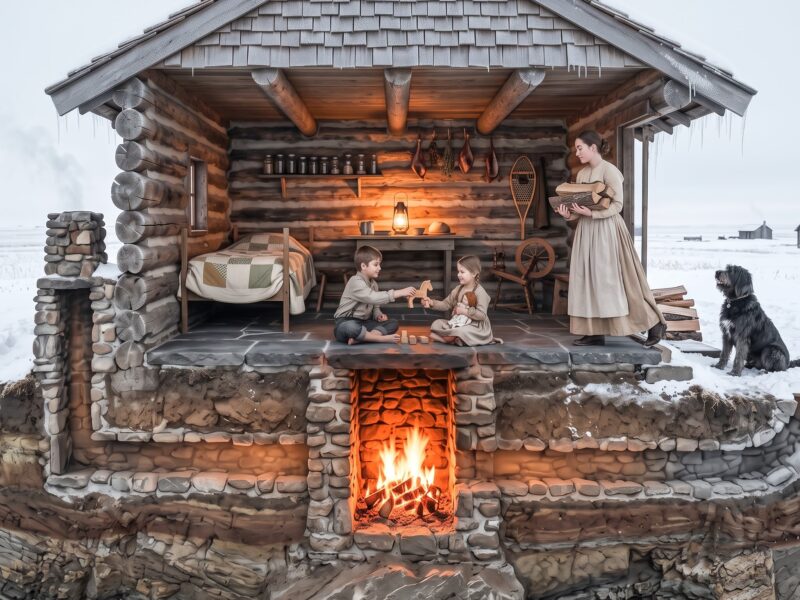
Her mind raced, building the architecture of her revenge. Her father had been a master mason in Poland. While he built magnificent glazed tile stoves for the rich, he taught Techla the secret of the poor. Kachelofen principles applied to the very earth. You don’t fight the cold by burning fuel into the sky. You trap the fire. You force the smoke to travel horizontally through a labyrinth of stone. The masonry absorbs the thermal energy, holding summer’s memory through winter’s worst assault.
She pulled the copper tin from her pocket and ran her thumb over Felix’s wedding ring.
Hask and Oakhums were stealing homesteads. She realized the pattern now. Three other families on this flat expanse of prairie had abandoned their claims after “accidents” last winter. A collapsed roof. A mysterious barn fire. A frozen chimney.
The railroad was coming, and Oakhums was using his authority as a minister and a county commissioner to play God, while Hask bankrolled the violence.
If she went to the territorial sheriff in Fargo, she would be a penniless Polish widow with a piece of paper against two of the most powerful white men in the county. They would institutionalize her children and hang her for perjury.
No. Justice in Dakota Territory wasn’t administered in courtrooms. It was administered by the elements.
The next morning, Techla began the excavation in earnest.
She worked with a violent, focused energy. For six weeks, she dug a serpentine trench system covering the entire 16×20 footprint of the future cabin. Three feet deep. Forty feet of continuous, winding channels.
Neighbors slowed their wagons on the county road to stare. Some pointed and laughed. The crazy widow digging her own grave.
Techla ignored them. She hitched her borrowed mule to a sled and traveled nine miles to the riverbed, loading massive, flat stones by hand. She hauled them back, her muscles tearing, her palms turning to cracked leather.
She mixed fire clay and sand in wooden troughs, testing the ratio by squeezing it between her fingers. Too much sand, and the heat would crack the seals. Too much clay, and the structure would shrink and leak smoke into the room.
She laid the stones vertically to form the channel walls, sealing every joint with meticulous precision. At the center of the room, she built the combustion chamber—a sunken pit large enough to hold half a cord of wood, accessible only by a heavy, flush-mounted stone hatch.
At the bottom of the combustion chamber, she did something her father had never taught her.
She hollowed out a small cavity in the foundation stone. Inside, she placed the copper tin containing Felix’s letter and wedding band. She sealed it over with an inch of fire clay.
The evidence of their crimes was now the literal foundation of her home. If they wanted it, they would have to tear down the house to get it.









