They Mocked the Widow’s Shelter Under Her Woodshed—Then the Worst Winter Drove Everyone Below
Expanding the System
When spring returned in 1885, Sigrid was the only settler within six miles who had lost neither stock nor spirit. Yet Cobb’s pressure intensified. Suspecting her secret, he even sent a hired spy under the guise of a farmhand, whom Sigrid promptly unmasked and dismissed after keeping him busy mending distant fences.
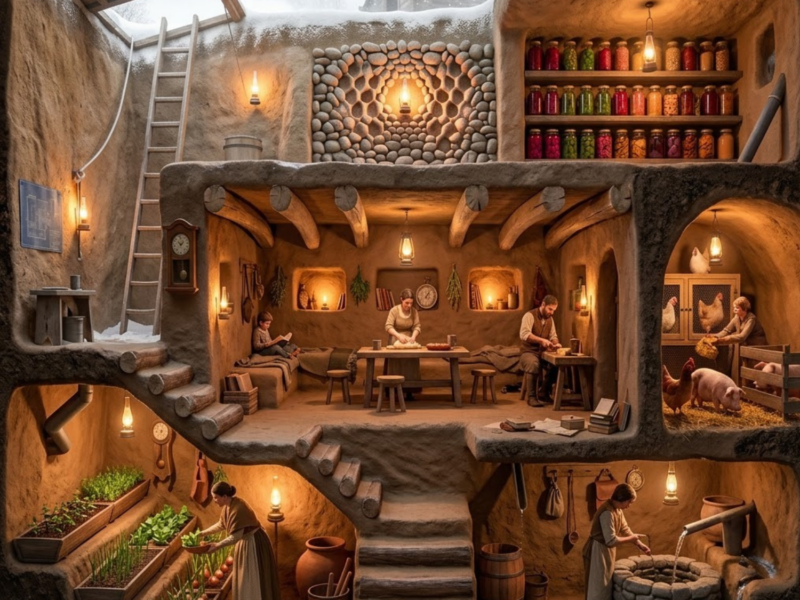
Determined to fortify her defenses for the inevitable escalation, Sigrid expanded the underground system during the summer of 1885. She excavated a secondary alcove off the eastern wall to house her three laying hens, whose body heat would naturally raise the chamber’s ambient temperature.
More ingeniously, she constructed a “heat flywheel”—hauling forty-seven heavy riverstones from the creek and stacking them along the western wall. These dense stones absorbed thermal energy from a lit oil lamp and slowly radiated heat across the following twelve to eighteen hours, drastically cutting down on oil consumption.
By October 1885, the shelter was no longer just a hole in the ground; it was an engineered thermal ecosystem.
The inevitable showdown with Ezra Cobb arrived in October 1886. Cobb drove out, brandishing a freshly acquired freight account that her late husband had supposedly run up. He had bought the note, combining it with her existing store debt, demanding full settlement before the ground froze hard.
“Take the girls to your sister,” Cobb sneered, offering to buy her claim out cheap. “That’s a better bargain than the winter will offer you.”
Sigrid stood straight, her gray-blue eyes flashing with the cold brilliance of a winter storm. “My husband broke this ground, and my father taught me how to hold it. You’ve bought a piece of paper, Mr. Cobb. You haven’t bought me… You’ll have your money, every dollar of it, but you’ll have it on my terms in my time, and you’ll not have this land.”
That night, doing the bitter arithmetic of survival, Sigrid realized she could sell her remaining calves and take on odd labor to chip away at the debt. She refused to break.
The winter of 1886–1887 became legendary across the northern plains—a season of unmitigated catastrophe. On January 9th, a monstrous blizzard struck without warning, plunging temperatures to 38 below zero with winds exceeding 45 miles per hour.
Josiah Hollis’s wood-storage shed collapsed under the snowdrifts, leaving his family facing freezing death within hours. Desperate, Josiah wrapped rags around his frostbitten feet and trudged two miles through the whiteout to Vangan farm, begging for help.
Sigrid didn’t hesitate. She gave him hot coffee, wrapped him in warm gear, and delivered a command that inverted their entire social dynamic: “Go home. Get Anna and the children into their warmest things. Tie them together, and bring all of them here.”
Within two hours, the entire Hollis family—seven souls in total—stumbled out of the white wasteland into Sigrid’s yard. Sigrid guided them down the hidden trapdoor into the amber glow of the underground sanctuary.
Word of the refuge spread through the desperate whispers of the frozen frontier. Over the next week, as the storm raged on, more neighbors arrived: Anar Grondall (who had kept his horse alive inside his kitchen), the Petersons, the Soulbergs (bringing their shivering pig into the alcove), and the elderly Brundads.
At the peak of the storm, sixteen people, along with a dog, three hens, and a pig, crowded into the ten-foot subterranean chamber.
Midway through the siege, as the shelter hummed with communal warmth and shared rations, a freezing and broken Ezra Cobb arrived at the yard in his stalled buggy. His store in Ellismore had collapsed under the snow load, and every door in town was shut to him.
Shivering and humbled, Cobb stood before the widow he had tried to ruin. “I find myself without a place to wait out the cold,” he muttered, unable to meet her eyes.
Sigrid looked at the man who had weaponized her husband’s debts. She weighed her resentment against her father’s teaching. “There’s room,” she said quietly. “Put your horse in the barn… You’ll come down as anyone comes down, Mr. Cobb. Not as the man who holds my note. Down there, nobody holds anybody’s paper. If you can come as that, you’re welcome.”
Swallowing his pride, Cobb descended into the dark. Seated against the earthen wall, watching Sigrid mediate disputes, ration oil, and tend to freezing children, the merchant underwent a silent, profound transformation. He watched the woman he had deemed worthless sustain an entire community.









