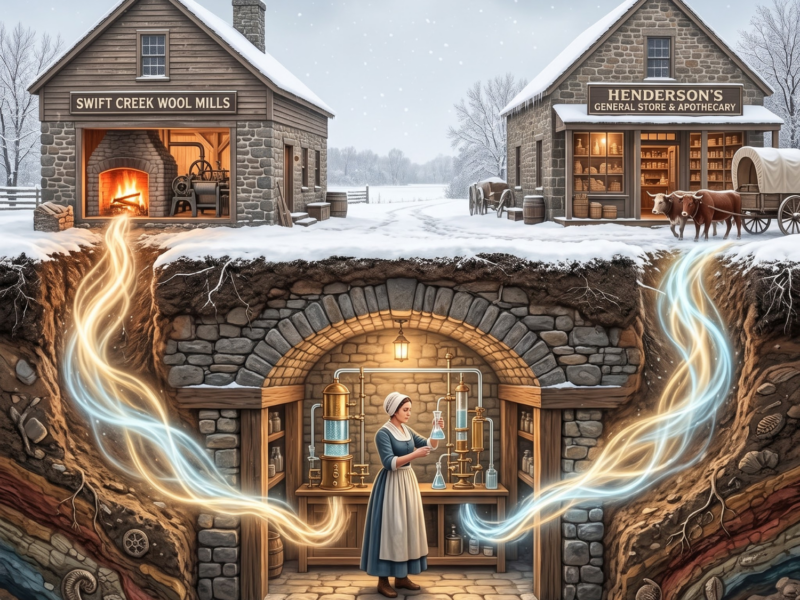
They Mocked the Woman Digging a Tunnel—Then Her Horses Survived the Worst Blizzard in 40 Years
THE MIDWIFE AND THE MUD
Levvenia Holm lived four miles south in a sod-roofed house that looked like it had grown directly out of the earth. She was sixty-one, a widowed midwife who could read frost depth by pressing a knitting needle into the ground. She had buried a husband and two children on the prairie, and she stayed because the prairie was the only thing that hadn’t left her.
Joran didn’t ride to Levvenia with a plan. She rode with a charcoal drawing on a flour sack.
Levvenia sat at her heavy oak table, staring at the charcoal lines. A sloped passage descending five feet below grade. A covered trench running forty yards from the cabin to the barn, shored with timber, roofed with sod.
“You want to dig a tunnel,” Levvenia said. Her voice was like dry leaves.
“My father called it a root cellar with two doors,” Joran said. “The earth doesn’t make heat, but it keeps what foolish people let escape. The horses generate eight hundred degrees of accumulated warmth a night. It will travel up the slope to the cabin floor.”
Levvenia pushed a knitting needle into a pan of damp soil she kept near the stove. She poured water over it. It pooled on the surface.
“Wyoming clay,” Levvenia said, watching the puddle. “Dig it wrong, and you build a grave with doors. If the ground tilts even one inch across forty yards, the water will find it. It will freeze, expand, and push your walls apart.”
“Then show me how to dig it right.”
Levvenia looked up. Her eyes were sharp, missing nothing. She saw the bruising under Joran’s eyes, the cracked skin of her knuckles, and the terrifying, immovable resolve setting her jaw.
“Why are you doing this, Joran?” Levvenia asked softly. “You could sell to Doll. You could survive.”
Joran reached into her pocket and placed the sawed piece of hickory on the table next to the flour sack.
Levvenia stared at the smooth, cut edge of the wood. The breath slowly hissed out of her teeth. “Torbin’s wagon.”
“The axle was cut,” Joran said. “And the debt Doll claims I owe is a lie. I found Torbin’s ledger. He paid Doll two days before he died. Doll killed my husband for this land.”
Levvenia closed her eyes. Her hands trembled, just once, before she pressed them flat against the table. “Ingram Doll is a rot in this valley. Twenty years ago, he forged a land deed and took my husband’s farm. My husband went to confront him… and never came back. The sheriff said he got lost in a storm.”
Joran stared at the older woman, realizing the depth of the shared ghost between them.
“He takes,” Levvenia whispered, opening her eyes. “He takes until there is nothing left.”
“Not this time,” Joran said. “I am going to hold these horses. I am going to hold this claim. And when spring comes, I am going to take this wood to the federal marshal in Cheyenne and see Ingram Doll hang.”
Levvenia picked up the flour sack drawing. “Six hundred cubic feet of earth,” she calculated. “You have ten weeks before the clay becomes stone. You will have to choose: dig the passage, or cut the hay you need. You cannot do both.”
“If I dig the passage, I can feed them twice a day in a whiteout with the hay I have,” Joran countered. “If I have hay but no passage, they die in the barn while I freeze in the cabin.”
Levvenia stood up, reaching behind her stove for a pair of heavy leather gloves with the fingertips worn through.
“I will map the soil,” Levvenia said. “But I cannot dig. My back will not allow it.”
“I have two shovels,” Joran said.









