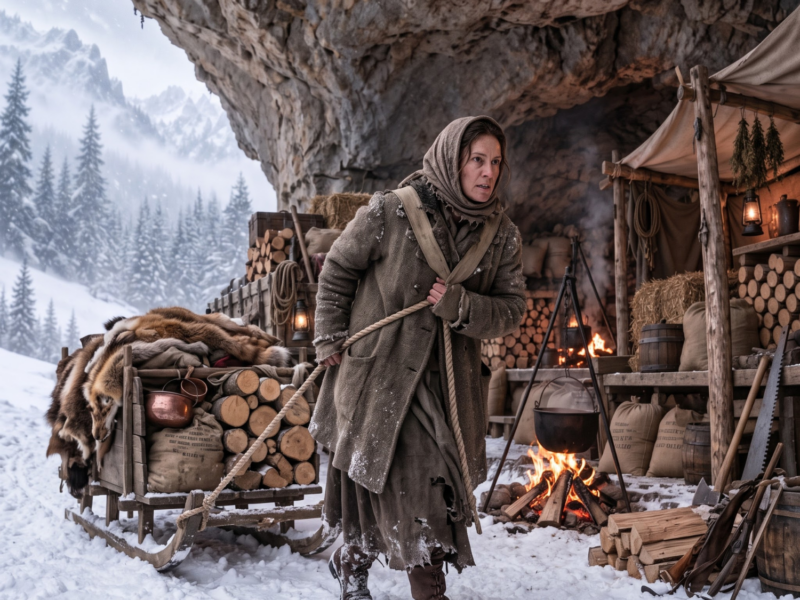
Thrown Out at 18, She Dragged a Wagon Into a Cave and Made It Home — Then the Great Freeze Struck
The Muddy Thaw
Winter changed its grip slowly after the terrifying roof repair. At first, the signs of surrender were almost too small to trust.
Water no longer froze solid in the metal kettle overnight. The long, lethal icicles near the entrance began dripping a slow, steady rhythm at midday when the sun hit them. The hard, icy walls of the snow tunnel softened along its southern edge, turning slushy.
Evelyn did not relax. She kept strictly rationing the food, collecting deadwood on the rope, clearing the smoke vent daily, and obsessively checking every wooden support. She knew from her father that mountain weather was a liar; it could offer the warmth of spring at noon and return to a killing winter blizzard by dark.
Then, one bright afternoon, she heard it.
The unmistakable sound of running water beneath the snow.
She followed the sound downhill, slipping in the wet snow, and found a narrow, dark opening where the ice had melted above the river. The water was rushing fast and clear.
For the first time in four agonizing months, she knelt and filled her heavy kettle directly from moving water instead of painstakingly melting snow over the fire.
Jasper, tied to a tree nearby, pulled excitedly at the lead rope and nosed at a patch of exposed, pale green grass near the bank.
Evelyn watched the horse eat the fresh grass, and a sound escaped her throat. She laughed. A real, full laugh, before she could stop herself. The sound startled her. It echoed off the limestone cliffs, bright and unfamiliar.
As the thaw strengthened over the next two weeks, turning the world into a landscape of mud and slush, she began preparing to leave.
She dug out the wagon wheels entirely, cleared the mud from the axle, inspected the repaired leather bindings, and packed only what still mattered into the wagon bed.
But as she prepared to hitch Jasper, she looked back at the shallow, dirty limestone recess.
She refused to abandon the shelter as a ruin, the way she had found it.
She spent two days rebuilding the outer wall with heavy stones. She replaced the broken roof timber entirely with a massive, solid pine log. She cleared the smoke channel of soot, stacked a large, neat pile of dry wood deep beneath the limestone shelf, and used the shovel to deepen the drainage trench so water would flow away from the interior.
In the driest corner, beneath a stone ledge, she left a small bundle of dry kindling, a tin cup, and a glass jar containing a handful of iron nails.
When a solid, muddy line finally appeared through the melting snow where the trail to town had been, she loaded the wagon, climbed onto the seat, and clicked her tongue. Jasper leaned into the harness, pulling the wagon downhill.
The repaired wheel turned perfectly, without breaking.
At the first sharp bend in the trail, Evelyn pulled the reins and looked back. The shelter was nearly invisible, blending perfectly between the gray stone and the dark green spruce trees.
Months earlier, she had arrived there terrified, nearly broken, because every other door in the world had violently closed on her. Now, she was leaving under her own immense power.
With Jasper beside her and the muddy road open ahead, she turned forward, set her jaw, and did not look back a second time.
Epilogue: The Architect of Survival
Silverton appeared through the trees in the late spring, looking somehow smaller and dirtier than Evelyn remembered.
Gray smoke rose lazily from brick chimneys. Deep wagon tracks cut through the thick, black mud where the melting snow finally released its grip on the main road.
People stopped on the wooden sidewalks when they recognized her. Some stared in shock; they had believed she had gone south to warmer climates. Others whispered that they thought she had died freezing above the river.
Nobody expected the eighteen-year-old girl Silas Hart had cruelly pushed from his house to return with the exact same horse, the same repaired wagon, and most of the heavy tools she had carried away. She looked thinner, her face weathered by the wind, her hands scarred and calloused, but her eyes held a terrifying, unbreakable clarity.
Evelyn drove the wagon past the road leading to Silas’s property without so much as turning her head.
She rented a small, cheap room at the edge of town, paying with the last of her coins, and immediately accepted whatever hard labor she could find. She sharpened tools for the miners. She patched heavy leather harnesses for the teamsters. She repaired broken wagon boards, split cordwood for the mercantile, and reset loose axe handles.
Her father’s tools stopped being sentimental relics from a lost home. In her scarred hands, they became the beginning of another one.
When the heat of summer arrived, Evelyn packed the wagon and returned to the limestone recess above the river.
She spent a week there. She strengthened the timber extension further. She dug the drainage deeper. She enlarged the wood stack to a massive pile, and left sealed, waterproof tins of food hidden beneath the stone shelf. She replaced the simple branch marker above the entrance with a tall, brightly painted iron pole that could still be seen easily after ten feet of heavy snow.
Years later, the townspeople of Silverton would remember that specific winter for its frozen roads, the staggering number of dead livestock, and the brutal storms that buried fences until spring.
Evelyn remembered the smaller, deadlier things.
She remembered the terrifying hiss of wet flour near the fire. She remembered the sight of precious grain scattered across dirty snow. She remembered the sound of a timber groaning above Jasper’s head in the dark, and the sound of his desperate call when she had lost the trail.
She had spent months meticulously measuring what remained—wood, food, hay, daylight, energy—and she had returned to civilization with far less than she carried into the mountains.
Yet, she had returned with something Silas Hart could not have handed her, and could never, ever take back.
When another hard winter inevitably came to the San Juan Mountains, Evelyn Hart knew exactly what to watch. She knew what to save. She knew when to turn around. And she knew how to begin again.
She had not conquered the mountain. The mountain could not be conquered.
She had simply learned how to survive it, without ever surrendering herself.









