The Boy and the Two Lions
Chapter 1: The Bread on the Silver Tray
The bread was still warm.
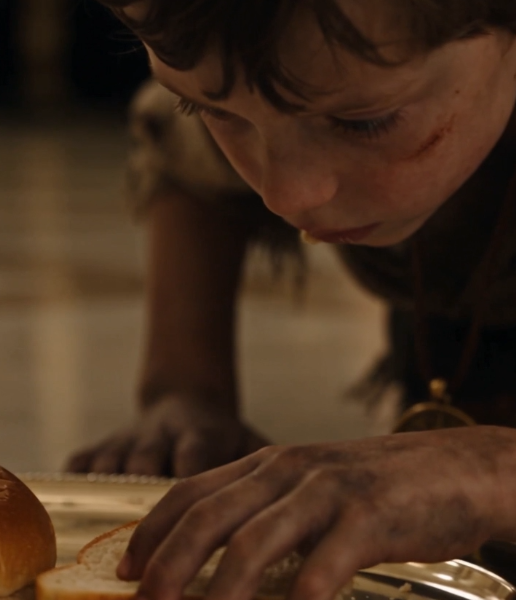
That was the first thing Theo understood, and it nearly broke him. In three days he had eaten half a stale pretzel from a bin outside a train station and the frozen crust of a sandwich some stranger had dropped in the snow. Now, on his hands and knees on a floor so polished he could see his own smudged face in it, his fingers closed around a roll that had come out of somebody’s oven an hour ago. Warm. Soft. Smelling of butter and yeast and every kitchen he had ever been allowed to stand in.
He did not look up. If he looked up, he would see the room, and if he saw the room, he would understand how impossible it was that he was in it, and he would run. So he kept his eyes on the silver tray at the end of the buffet table, where the bread lay in careless piles as though it were nothing, as though it were free, as though there were not children in the world who dreamed about it.
He bit down.
Salt. Butter. A crust that crackled against his split lip and made it sting. He did not care. He chewed with his eyes squeezed shut, and the tears came anyway, hot and shameful, cutting clean lines through the dirt on his cheeks. He was eight years old. He had walked eleven miles to get here. He had a bruise on his ribs the size of a saucer and a scrape under his left eye from a fence he had climbed in the dark, and he was crying over a dinner roll.
Behind him, the Grand Meridian ballroom glittered like the inside of a jewel box.
Three enormous chandeliers hung from a ceiling painted with clouds, each one dripping a thousand crystals that threw tiny rainbows across the walls. A string quartet played something slow and expensive on a raised platform. Waiters in white gloves drifted between the guests carrying trays of champagne flutes, and the guests themselves moved in slow, glittering currents, men in black tuxedos, women in silk and sequins and diamonds that caught the light every time they turned. A banner stretched across the far wall in gold thread: HALLWORTH FOUNDATION WINTER GALA. EVERY CHILD DESERVES A HOME.
Theo had read that banner from the service corridor, sounding out the long word, Foundation, with his lips. It was the reason he had come. Old Pete had told him, in the last weeks, in the cold back room of the bakery with the blanket pulled up to his chin and his breath rattling: If ever you’re lost, boy, you find the lions. You find the people with the lions.
He had not known what Pete meant. He only knew that when he saw the lions on the banner’s corner, small and gold and stitched beside the foundation’s name, his hand had flown to his chest and closed around the medallion that hung there on its braided cord, warm from his skin, the one thing he owned that nobody had ever taken.
The lions on the banner were the lions on his medallion.
So he had come. Through the kitchen door someone had propped open with a crate of lemons. Past the dishwashers who were too busy to notice a small shape slipping by. Along the wall behind the heavy curtains, and then out across open floor, low and fast on his hands and knees, because walking upright felt like asking to be seen. He had meant only to find someone kind. Someone with the lions. Instead he had found the smell of bread, and his body had made the decision for him.
He swallowed the last of the roll and reached for another.
“Charles.”
The voice was thin and sharp, and it came from above and to the left. Theo froze with his fingers on the tray’s cold rim.
“Charles, look. There’s a child. Under the table.”
He made himself turn his head. Two pairs of shoes stood a yard from him, black patent leather and gold sandals with straps that sparkled. Above them rose a woman in a one-shouldered champagne gown, her blond hair swept up in a style that must have taken hours, a glass of something pale gold in one hand and a ring on every finger of the other. Beside her stood a heavyset man in a tuxedo with a face the color of boiled ham.
“Good Lord,” the man said. “Where did that come from?”
“Delphine Aubrey, you do not stare,” the woman said to herself, and stared. “Look at his clothes, Charles. Look at his hands. Somebody has let the street in.”
“This is a charity event,” said a third voice, a woman in lilac whose lipstick had bled into the creases around her mouth. “I suppose it’s not a bad thing to see the cause up close.”
“Not when the cause is eating the canapés,” said Charles Aubrey, and a few people laughed, a low, nervous laugh, the sound of people who wanted to be cruel and wanted to be seen to be above it.
Theo’s face burned. He wanted to say something. I’m sorry. I’m hungry. I only took the bread. The words were in his mouth, but they were too small, and the room was too big, and the more faces turned toward him the more he felt himself shrinking, shrinking, until he was the size of a crumb on the silver tray.
“Where is security?” Delphine Aubrey said, not quietly. “Someone must find security.”
They found him before anyone had to look.
The man who came across the floor was enormous, shaven-headed, in a black suit with a wire curling from his collar into his ear. Behind him walked two more, identical in their blankness. They did not hurry. They did not need to. Guests parted before them like water before the prow of a ship, and Theo watched their polished shoes come closer, closer, each footfall echoing off the marble.
“Sir,” said the big man, and Theo realized he was speaking to him, in the flat voice of someone reading from a card. “I’m going to need you to come with me.”
“I didn’t take much.” It came out cracked and tiny. “Only two. I only took two.”
“Come with me, please.”
“I can pay. I can…” He did not have a penny. He had a medallion. He closed his fist over it without thinking, and the guard saw the motion, and something shifted in the man’s face, the way a dog’s does when it smells a thing it has been trained to hunt.
“What’s that in your hand?”
“Nothing. It’s mine.”
“Let me see it.”
“It’s mine.”
A hand the size of a shovel closed on the back of his shirt and hauled him upright. The world swung. His feet left the floor and found it again, and he was standing, swaying, in the middle of the ballroom with every eye in the room on him. A hundred, two hundred, a sea of painted faces. Somewhere a woman gasped. Somewhere a glass clinked against another. The quartet, sensing the shift, faltered and went quiet, one violin trailing off alone.
And then, at the far end of the ballroom, the great double doors opened.
It was not loud. No herald announced it. But something in the air changed, a cooling, a tightening, as when a cloud crosses the sun. Conversations died in the middle of sentences. People who had been staring at the boy turned, one after another, toward the doors, and their expressions rearranged themselves into something careful and respectful.
A woman stood in the doorway.
She was tall, and she was old, though she carried her age like a blade she had decided not to draw. Her gown was the deep, pure blue of a sapphire held up to a lamp, long-sleeved, severe, falling to the floor in a single line of silk. Her silver-gold hair was drawn back from a face that had once been beautiful and had become something harder and better: composed, watchful, carved by grief into a kind of stillness. Diamonds blazed at her throat. She wore long dark gloves. She wore no smile.
“Margaret Hallworth,” someone whispered near the buffet, with the reverence people use for churches. “She doesn’t come to these anymore. Not since the boy.”
“What boy?”
“Her grandson. Four years ago. You remember. The hospital.”
“Oh. Oh, that’s right.”
Theo did not hear any of this. He was looking at the woman in blue, and he could not have said why his heart had begun to knock against his ribs like a fist on a door. She was far away. She was a stranger. He had never seen her in his life. And yet something in the way she stood, the set of her shoulders, the tilt of her chin, was as familiar as the creak of a stair in a house he had forgotten he lived in.
She began to walk.
Two more guards fell in behind her, at a respectful distance. She crossed the great floor with a stride that never hurried and never slowed, the blue silk whispering around her ankles, and the guests drew back to let her through, forming a corridor of tuxedos and sequins. Her eyes moved over the room, over the chandeliers, the quartet, the tables of untouched food, with the weary courtesy of a woman who had attended a thousand such evenings and felt nothing at any of them.
Then her gaze reached the middle of the floor. A guard. A boy. A scene she was already composing a sentence to end.
“What is this?” she said, not loudly. She did not need to be loud.
“A trespasser, Mrs. Hallworth,” said the big guard, and gave Theo a small shake, the way you shake a coat to knock the dust from it. “Came in through the kitchens. We’ll have him out in a moment.”
“I’m not a thief,” Theo said. His voice shook. “I’m not. I came because of the lions.”
Nobody understood him. The guard muttered something about calming down. Delphine Aubrey sighed at the indignity of it all. Theo twisted in the man’s grip, desperate now, and the guard’s hand tightened and yanked, and the braided cord around Theo’s neck, worn thin by four years of rain and sleep and running, finally gave way.
It snapped with a tiny sound.
The medallion dropped.
It did not fall straight. It struck the marble edge-on, rang once like a struck bell, and went rolling, spinning, flashing gold under the chandeliers, across the polished floor in a long, wobbling curve that every person in the ballroom followed with their eyes. It rolled past the guard’s black shoes. It rolled past the hem of Delphine Aubrey’s gown. It slowed, and wavered, and fell flat with a last soft chime.
It came to rest against the toe of a blue satin shoe.
The woman in the sapphire gown looked down.
Chapter 2: The Lion at Her Throat
Margaret Hallworth had learned, over seventy-one years, that the most dangerous moments of a life do not announce themselves. They arrive disguised as small things: a telephone ringing at the wrong hour, a doctor’s careful silence, a coin rolling across a floor.
She looked at the medallion at her feet and did not breathe.
It lay face up. Bronze-gold, the size of a large coin, heavy-rimmed, worn smooth at the edges by years of handling. On its face, in relief so fine that she could see it from where she stood, were two lions rearing on either side of a shield, a crown balanced above them, a ribbon curling beneath. Every line of it was known to her. She had stood in a jeweler’s workshop in Hatton Garden on a wet November morning and approved the drawing herself.
Her ears filled with a high, thin sound like wind through a keyhole.
No. The word rose in her mind with perfect calm. No. They are common. Anyone might have made a copy. Someone found it, someone stole it, someone sold it. This is a coincidence. This is a cruelty. This is the kind of thing that happens when a woman lets herself hope for four years.
She bent. She did it slowly, because her knees were old and her hands were not steady, and because some animal part of her knew that if she moved too quickly the thing would vanish. She picked up the medallion with two gloved fingers. It was warm. It was warm, with the warmth of skin, of a body, of something worn against a heartbeat.
She turned it over.
There was a scratch across the back, a deep, ragged line running from the rim to the centre, as though somebody had dragged a small sharp object across it in a moment of childish determination. Beneath the scratch, in lettering so small that she had to tilt the gold toward the light, were four words engraved by a craftsman four years before the scratch existed:
LIONS FIND THEIR OWN.
The ballroom had gone entirely silent. Nobody coughed. Nobody shifted. Somewhere above, a chandelier crystal tinkled against its neighbor in the warm air from the vents, and the sound was as loud as a gunshot.
Margaret reached up with her other hand and drew a slender gold chain from beneath the neckline of her gown, hidden until now under the weight of her diamonds. At the end of the chain hung a medallion. The same bronze-gold. The same two lions, the same shield, the same crown. She had worn it every single day for four years under every dress and coat she owned, against her skin, where nobody could see. She wore it to meetings and funerals and the dentist. She had slept in it. It had become a second heartbeat, a tiny weight she carried so that she would not float away.
She held the two medallions side by side in her palm.
They were identical down to the last hair of the lions’ manes. The only difference was the scratch.
It had been her grandson who made it, in the summer he turned four. She remembered precisely. He had been sitting on the kitchen floor of the old house with a dessert fork he was absolutely not supposed to have, grinding the tines into the back of his own medallion with his tongue between his teeth, and she had said, Theodore Hallworth, what are you doing? And he had looked up at her with enormous solemn eyes and said, Making it mine, Grandmama. So nobody can make another one.
Her vision blurred. She did not let it fall.
“Mrs. Hallworth?” The big guard was speaking, and his voice reached her from the bottom of a well. “Ma’am, I apologize. We’ll remove him at once. He must have taken that from a guest. If you’ll just…”
He was still holding the boy.
Margaret lifted her eyes. For the first time, she truly looked at the child in the guard’s grip. She saw the grime on his cheeks, the scrape under his eye, the split lip, the ragged shirt hanging off his thin shoulders, the brown hair standing up in spikes where nobody had combed it in weeks. She saw the way his bare knees shook. She saw his hands, small and filthy, curled into fists against his chest as if he were trying to hold something in.
And she saw his eyes.
They were gray-green, wide-set, very serious. Daniel’s eyes. Her son’s eyes, which she had last seen closing in a hospital bed on a rainy Tuesday five years ago, before the long grief, before the baby was gone too.
“Take your hands off him,” she said.
She had meant to say it loudly. It came out as barely a breath. The guard did not hear it. He was already turning, already adjusting his grip, already saying something to his colleague about the service entrance.
Margaret Hallworth took one step forward, and her voice, when it finally came, rang through that enormous room like a bell struck in a cathedral.
“I said, take your hands off that child.”
The guard let go so fast he nearly fell backwards.
Theo stumbled and caught himself. He stood there swaying, a small ragged figure in a sea of silk, and the woman in the sapphire gown stopped two paces from him and did not move. For a long moment neither of them did. The chandeliers burned above them. A hundred and fifty of the wealthiest people in the city held their breath.
“Mrs. Hallworth,” Delphine Aubrey began, in her thin voice of social alarm. “Surely, if the child has been stealing…”
“Delphine.” Margaret did not look at her. “Be quiet.”
Delphine Aubrey was quiet.
Margaret lowered herself slowly to her knees.
It was the kind of thing that would be talked about for years afterward, in the clubs and the salons and the quiet corners of other people’s parties: the way Margaret Hallworth, who had never in living memory bent to anyone, gathered the blue silk of her gown in one hand and knelt on the cold marble in front of a filthy child, so that her face was level with his. The gown pooled around her like spilled ink. Her diamonds trembled at her throat. Her gloved hand, the one holding the medallion, shook so badly that the gold chimed against itself.
“Child,” she said. Her voice was very soft now. “Look at me.”
Theo looked.
“Where did you get this?”
“It’s mine.” His chin wobbled, but he held her gaze, and there was something fierce under the fear, a stubbornness she knew in her bones. “I didn’t steal it. I swear. Please don’t take it. It’s the only thing I’ve got.”
“I’m not going to take it.” She held it out on her open palm, and her hand shook. “I would never take it. Who gave it to you, sweetheart?”
He stared at the medallion in her palm. Then, slowly, at the other one hanging at her throat. His lips parted. His eyes moved from one to the other, back and forth, back and forth, with the slow dawning bewilderment of someone looking at his own reflection in a river where there should be no river.
“My mama,” he whispered. “My mama gave it to me. Before the hospital.” He swallowed. “She said it was a promise. She said there was another one, and as long as I kept mine, the other one would find me.”
Something in Margaret’s chest, something that had been held shut for four years by the sheer force of will, began, very quietly, to give way.
“Did she,” she said. “Did she say what the other one looked like?”
Theo looked at the gold lion hanging at her throat. Then he looked up, past it, into her face. And when he spoke it was in a small, wondering voice, a voice with no hope left in it, the voice of a child who had stopped expecting miracles and was merely observing one.
“She said it would be worn by a lady in blue,” he said. “A tall lady. With sad eyes.”
Around them, a hundred and fifty people stood frozen in their diamonds, and not one of them breathed.
Chapter 3: What the Boy Remembered
For a long moment nobody in the Grand Meridian ballroom moved, and the silence grew so large that it seemed to press against the painted ceiling.
Margaret Hallworth knelt on the marble with her sapphire gown spread around her and looked at the boy as though he were a door she had spent four years knocking on, and which had just, without warning, begun to open. She did not trust her voice. She did not trust her hands. She had stood beside two graves in the span of a single year and had not wept in public at either, and now a child with a split lip and dirt in his hair was undoing her with six whispered words.
A lady in blue. A tall lady. With sad eyes.
“What is your name?” she asked.
The boy hesitated. She saw him weigh the question, saw something old and wary cross his face, the look of a creature that has learned that names are things people take away.
“Tommy,” he said. Then, quickly, as if confessing: “But that’s not my real one. That’s the one she gave me.”
“Who gave you that name?”
“Miss Crane.”
The name dropped into the silence like a stone into a well. Margaret felt it go all the way down. She had never heard it before, and yet her whole body reacted to it, a cold line drawn down her spine, the instinct of a woman who has learned to recognize the shape of an enemy before she can see the face.
“Tell me your real name,” she said gently. “Whenever you’re ready.”
He looked at her. His lower lip trembled. And then, very softly, he said it, the way you set down something fragile and precious that you have carried a long way.
“Theodore,” he whispered. “Theodore Daniel Hallworth. But Mama called me Teddy. And Daddy called me Little Lion.”
A sound went through the ballroom, not a gasp exactly, but the exhalation of a hundred and fifty people who had all been holding the same breath. Somewhere near the buffet a woman began to cry quietly into a napkin. Charles Aubrey, whose face had been the color of boiled ham, had gone the color of paper. And Margaret Hallworth, who had spent four years training herself not to react to hope, closed her eyes.
Little Lion.
Only one person had ever called him that. Only one person alive or dead could have told this boy. Daniel had said it on the night of Theo’s birth, bending over the cot in the hospital with tears on his face and his tie still crooked from the drive, and she had been standing in the doorway and heard it. She had never repeated it. She had not even written it down.
She opened her eyes. “Teddy,” she said. “May I touch your hand?”
He nodded. She peeled off one long dark glove, finger by finger, because she wanted nothing between them, and took his small cold hand in her bare one. It was rough. There were calluses on the palm, hard little ridges, and a scatter of old burns across the knuckles. She turned it over and looked at them, and her throat closed.
“Oven burns,” Theo said, a little defensively. “Old Pete said everyone gets them. He said they mean you’re learning.”
“Who is Old Pete?”
And so the boy began to tell her.
He told it in pieces, out of order, the way children tell things that have been locked up too long, with long silences in the middle and sudden surges of detail that came from nowhere. Margaret did not interrupt. She knelt in the center of the ballroom, holding his hand, while the quartet sat motionless on their platform and the waiters stood like statues with their trays, and a hundred and fifty of the city’s richest people listened to a barefoot street child tell the story of his life.
He remembered the hospital. He remembered it in colors: green walls, white sheets, the yellow light of a lamp that his mother had asked the nurse to leave on. His mother had been very sick. She had been sick for a long time, since after Daddy, and she had grown so thin that her wedding ring slid around her finger. On the last night she had called him to her bed and pressed something warm and heavy into his hand and closed his fingers over it. This is a promise, Teddy. There’s another one, and it belongs to Grandmama. As long as you keep yours, hers will find you. Lions find their own.
“I didn’t know what it meant,” Theo said. “I was only four. I just held on.”
Margaret’s hand tightened around his. She had been in a conference room in another city that night, signing papers she could no longer remember, because the foundation was the only thing that had kept her upright, and the call had come at three in the morning, and when she had arrived the bed was empty and the lamp was still on and the little boy who should have been asleep in the chair beside it was gone.
She had never learned how. The hospital had searched. The police had searched. She had paid, she estimated afterward, enough money to buy a small country to anyone who might know anything. Nothing. A child had walked out of a ward, in the middle of the night, with a stranger, and the world had closed over the spot like water.
“A lady came,” Theo said. “After Mama closed her eyes. She said she was from the family. She had a gray coat and she smelled like peppermints.” His nose wrinkled with the memory. “She said Grandmama was waiting in the car downstairs and I had to be very quiet so I wouldn’t wake the other patients. She said it was a surprise.”
“Miss Crane,” Margaret said.
“Yes.” He glanced down. “I was so sad about Mama, and she gave me a mint, and I wanted to see you. I thought you’d be there. But it was just a car, and a long, long drive, and I fell asleep, and when I woke up it was a different place and nobody was waiting.”
There was a rustle among the guests. Margaret did not look around. She did not need to. She could feel the shift in the room, the slow cold change in the temperature, as a hundred and fifty people who had come to drink champagne beneath a banner about children began to understand what they were hearing.
“Where was the different place?”
“A house by a canal. Far away. It had a lock on the outside of my door.” He said it flatly, without self-pity, and that was worse than any weeping could have been. “Miss Crane said you didn’t want me anymore. She said you’d sent me away because I was too much trouble, and that nobody was going to come, and that if I told anybody my real name, bad things would happen. So I was Tommy.”
“I never…” Margaret’s voice cracked. She stopped. She breathed. “Teddy. Listen to me carefully. I never sent you anywhere. I looked for you every single day. Every day for four years I…”
“I know,” he said.
She stared at him.
“I think I knew,” the boy said, very quietly. “The medallion was warm. Every night I held it and it was warm. I thought, if she’d really stopped wanting me, it’d be cold.”
Margaret Hallworth, who had not wept in public in five years, put her free hand over her mouth and let the tears come.
It took the boy a while to reach the end of his story, and when he did it came in a rush. He had been six when he found a gap in the fence behind the canal house and ran. He had slept in doorways and train stations and the back seats of unlocked cars. He had been cold and hungry and chased and once, for three terrible days, lost entirely in a city that had no name. And then, one evening in the sleet, he had curled up against the warm brick wall behind a bakery in a small town called Marlow Bridge, and the back door had opened, and a heavy old man with flour on his forearms had looked down at him for a long moment and said: Well. I suppose you’d better come in.
“That was Old Pete,” Theo whispered. “He had a bakery. He let me sleep next to the ovens. He taught me to knead the dough, and to read the clock by the colour of the crust, and he never asked where I came from. Not once. He said that was my business.” His eyes shone. “He never took the medallion either. Even when he was sick and we had no money. He said it wasn’t his to take.”
“Where is he now?”
“He died. In the autumn. It was his heart.” Theo’s voice thinned to a thread. “Before he went he told me about the lions. He’d seen them on a poster at the post office. The Hallworth Foundation Gala. He said they were the same as mine. He said, If ever you’re lost, boy, you find the lions. So when the bakery got sold and they said I had to go to a home, I didn’t. I walked. It took me three days.”
He finished speaking and looked at her, the whole weight of four years sitting in his small, steady, hollow-cheeked face.
“Did I find you?” he asked. “Am I allowed to be here?”
Margaret took her other glove off. She cupped his face in both hands, her thumbs brushing the grime from his cheekbones, and looked into the gray-green eyes that were so exactly her son’s that her heart seemed to turn over inside her.
“You are allowed,” she said, “to be anywhere you like, for the rest of your life.”
Then, at last, she pulled him in.
He came stiffly at first, a small, braced body, unused to being held. Then something let go in him all at once, and he collapsed against her, burying his face in the blue silk, his thin shoulders heaving, and the sound he made was not a child’s crying but something older, a sound that had been waiting four years for permission. She wrapped both arms around him. She rocked him. She whispered into his filthy hair a litany of nothing, I’ve got you, I’ve got you, I’ve got you, while the diamonds at her throat slid sideways and the chain of her own lion medallion swung and touched his.
Two small gold discs, knocking together with a sound like a tiny bell.
A hundred and fifty people watched. Not one of them could have said how long it lasted. Delphine Aubrey had her hand pressed flat against her sequined chest. The big guard who had hauled the boy upright now stood a little apart with his head bowed, studying his own shoes. Waiters had set down their trays. Even the string quartet, those professionals of the discreet and the invisible, had lowered their instruments and turned their faces away to give the moment room.
It was Dr. Samuel Okafor, silver-haired, seventy, the Hallworth family physician for thirty-one years, who finally broke the silence. He stepped out from among the guests with his hand trembling on his cane.
“Margaret,” he said hoarsely. “The chin. Look at his chin.”
She looked. Beneath the dirt, along the underside of the jaw, there was a small pale crescent scar, no longer than a fingernail.
“He fell from the dining chair at Christmas when he was three,” Okafor said. “I stitched it myself on your kitchen table. I told him he was the bravest patient I had ever had.” He blinked rapidly. “Margaret, I would know that scar anywhere.”
Theo lifted his head from her shoulder. He looked at the old doctor, and a slow wondering recognition came into his face. “You gave me a lollipop,” he said thickly. “A green one.”
Dr. Okafor made a sound halfway between a laugh and a sob.
And it was precisely then, in the warm, wet, trembling hush of the moment, with the boy in his grandmother’s arms and the whole room dissolving around them, that a man’s voice spoke from the back of the ballroom. Smooth. Amused. Perfectly calm.
“What a lovely story,” it said.
Chapter 4: The Man at the Back of the Room
Victor Hallworth had a gift for entering rooms.
It was not a gift he had been born with. He had cultivated it across fifty-three years, the way other men cultivate orchids: patiently, with attention to light and temperature and the exact moment at which a thing must be shown. He could cross a boardroom so that its occupants stopped speaking before he reached the table. He could stand in the back of a funeral and make the widow feel that he had loved her husband best. Tonight, he stepped through the parted crowd with a champagne flute in one hand and a pained, tender, faintly rueful smile on his handsome silver-framed face, and for several seconds it was as though the whole ballroom turned to look at the one reasonable man in it.
“Aunt Margaret,” he said, and his voice was warm and low and grieved. “My dear. I think we should all take a breath.”
Margaret did not release the boy. She looked up from the floor at the man who had been her husband’s nephew since before he could walk, who had sat at her table every Sunday for thirty years, who had held her hand at Daniel’s funeral and again, three years later, in the empty nursery. His charcoal tuxedo was impeccable. A small gold lion pinned to his lapel caught the light. He was Vice-Chair of the Hallworth Foundation, and he was smiling at her with such gentle sorrow that for one dizzy moment she felt that she was the one behaving unreasonably.
“Victor,” she said. “Look at him.”
“I am looking, Aunt.” He came closer, set his champagne glass on a passing waiter’s tray without looking at the waiter, and crouched with a small pained grimace to bring his eyes level with the child’s. “I’m looking at a very frightened little boy. And I am so sorry for him. Truly. But I’d be a poor nephew if I didn’t ask you to think very, very carefully.”
“Think about what?”
“About the timing.” He said it softly, as if loath to say it at all. “Aunt Margaret. The gala. The press outside. The whole city watching. It’s the first time you’ve appeared at one of these in four years, and a child, a perfect, heartbreaking child, walks in off the street and produces the one object in the world that will touch you most deeply.” He spread his hands. “My darling, I don’t want to believe it either. But if I wanted to hurt you, if I were someone who preyed on grief, I could not have designed a better trap.”
A murmur rippled through the room. Margaret felt it like a change in the weather. A moment ago the guests had been united in a single trembling feeling; now, as Victor’s reasonable voice settled over them, she saw the faces begin to split, to turn inward, to calculate. Doubt, once spoken aloud in a warm and plausible voice, is a very contagious thing.
“It’s the medallion,” Delphine Aubrey said, with the air of a woman who has found the nearest rope. “Victor’s right, Margaret. Forgive me. Those pieces could have been copied. It was in the newspapers, the design, when the boy disappeared.”
“It’s not a copy,” said Margaret.
“How would you know?”
“It has the scratch.”
“A scratch can be made,” Victor said gently.
She turned her head and looked at him for a long moment, and something in her expression made his smile falter, just fractionally, the way a candle flame shivers when a door opens somewhere in the house.
“The scratch,” she said, with terrible clarity, “was never in the newspapers. It was never photographed. It was never described, because I did not know it was important until tonight. I have told one person about that scratch in four years, and he is standing behind you, and he is a doctor and a gentleman and has never lied to me in his life.”
Dr. Okafor, behind Victor, said stoutly: “I have never heard of it either, Margaret.”
“Hm,” said Victor. He recovered quickly. He was always quick. “Then there are other explanations. The boy was in the hospital. Someone in the ward saw it. A nurse, a cleaner, a family member of another patient. Aunt Margaret, I’m not accusing the child. Children are used. They are used by terrible people every day. All I’m asking, all I’m asking, is that we do this properly.”
He turned to the room, to the guests, and spread his arms in a gesture so rehearsed in its apparent spontaneity that it would have taken a trained eye to see the seams.
“A test,” he said. “Tomorrow morning, at a reputable laboratory, with an independent witness. If this child is Theodore, if he is truly my cousin’s son, I will be the first to kneel at his feet. I will weep like a baby. But until then,” and here his voice dropped to a pained, sympathetic murmur, “I beg you, Aunt, not to give your heart to a stranger before the facts are in. It would kill you if you were wrong.”
It was beautifully done. A decent man pleading for caution. The kind of thing, Margaret thought with a distant and growing cold, that would be remembered as admirable, whichever way it fell out.
She might have agreed. That was the astonishing, humiliating thing she would turn over in her mind for months afterward. She was an old woman who had been hurt for four years, and Victor’s voice was kind and clear and sensible, and for the space of three heartbeats she felt the whole wide weight of her hope pivot toward doubt, because doubt is safer than hope, because doubt does not break you when it fails.
Then the boy in her arms went rigid.
It was not the sort of stiffening that comes from fear. It was something sharper and more specific, as if a wire had been pulled through his whole body. Theo had lifted his head from her shoulder. He was staring over her arm, past the curve of her sleeve, at the man crouched three feet away. His face had gone absolutely white beneath its dirt. His pupils had widened until the gray-green was a thin ring. His fingers, which had been curled in her gown, clenched until the knuckles stood out like pale buttons.
“Teddy?” she murmured. “What is it?”
He did not answer. His lips moved soundlessly. Then, in a voice so small and strange that she had to bend her head to catch it, he said:
“Say it again.”
Victor blinked. “I beg your pardon, young man?”
“What you said before. At the start.” The boy’s voice was shaking, but it did not break. “Say, I think we should all take a breath.”
The smile on Victor’s face stayed exactly where it was. Margaret, who was watching his mouth, thought that something behind it had stopped working, like a clock in a quiet room.
“I don’t think that’s…”
“Say it.”
“Theodore,” said Margaret, very softly. “What do you remember?”
The boy was shaking now, all of him, but he was holding her sleeve with one hand and the medallion with the other, and his small, cracked voice rose and steadied as though he were reading from a page he had been trying not to see for four years.
“The night of the hospital,” he said. “After Mama closed her eyes. Before Miss Crane came. There was a man in the corridor. I was in the chair and I was pretending to sleep, because I was scared, and I heard him talking to her. Low. Like this.” He swallowed. “He said, We’ll take him somewhere quiet. Somewhere the old woman will never think to look.”
The ballroom could not have been quieter if it had been emptied.
“And then he came into the room,” Theo said. “He crouched down by my chair, just like that. And he looked at me. And he smiled, just like that. And he said, so kindly, so kindly…” The boy’s whole face crumpled and held. “Be a good boy, Theodore. Be very good, and very quiet. The lions will never find you.”
Victor Hallworth stood up.
He did it slowly. His knees cracked. The smile was still on his face, though it had begun to look like a thing nailed there, and a muscle in his jaw had begun to tick beneath the skin, once, twice, in a rhythm Margaret recognized, because she had seen it a thousand times across her own dinner table, whenever he lost an argument and was determined not to show it.
“Aunt Margaret,” he said, and for the first time his voice was not smooth. It had a thin dry edge, like paper tearing. “Surely you can’t take the word of a hysterical child. A child who has been coached. A child who…”
“Say it again,” said Theo, and now he was not afraid. Something had ignited in him, some long-banked ember of a four-year-old boy who had lain in a hospital chair pretending to sleep and listened to a stranger decide his life. “You said it nicely. You said it just like that. I never forgot your voice. Not ever. I used to hear it in my dreams.”
Victor looked at the boy. The boy looked back. The room held its breath, two hundred eyes fixed on a man in a charcoal tuxedo with a gold lion pinned over his heart.
The champagne flute he had set down on the waiter’s tray, a moment before, tipped over. It shattered on the marble, and in the silence it sounded like a gun going off.
“I have never,” said Victor Hallworth, in a voice gone suddenly, dreadfully flat, “seen this child in my life.”
But he said it a little too fast.
And everyone in the ballroom heard it.
Chapter 5: The Weight of Gold
There is a particular sound a room makes when it changes its mind about someone. It is not loud. It is the sound of a hundred small movements: a glass lowered, a shoulder turned, a half step backward on a polished floor. It is the sound of people who have been standing near a man, admiring the light that falls on him, discovering that they would rather stand somewhere else.
Victor Hallworth heard it. Margaret watched him hear it. She saw his eyes flick left and right, a quick unconscious sweep, the glance of an animal that has felt the ground shift beneath a familiar trail.
“This is absurd,” he said. “This is an absurdity, and I won’t stand for it. I am the Vice-Chair of this foundation. I have given thirty years to this family, and I will not be put on trial in a ballroom on the word of a street urchin.”
“Nobody has put you on trial, Victor,” said Margaret.
She rose. It took her a moment, and Dr. Okafor hurried to give her his arm, which she accepted without looking at him. Theo came up with her, his hand locked in hers, and stood pressed against her side in the blue silk with his chin lifted and his shoulders squared. Even filthy and barefoot, even shaking, he looked, she thought with a pang of fierce astonishment, like a Hallworth. Like a boy who had decided to stand his ground and was going to do it if it killed him.
“I have only one question for you,” Margaret said, “and you can answer it in a single sentence. Why have you spent the last year asking me to sign the petition?”
The room stirred. Few of the guests knew what she meant. But Victor did. She saw the knowledge hit him, the muscle ticking in his jaw, the faint tightening around his eyes.
“What petition?” someone whispered.
“In the eyes of the law,” Margaret said, in the clear unhurried voice she used at board meetings, “a missing person may be presumed dead after five years. For the past twelve months, my nephew has been very gently, very lovingly, urging me to begin that proceeding. To let go. To grieve properly. To free myself, in his words, from the burden of hope.” She did not look away from him. “The hearing is on Friday.”
“Because you were destroying yourself,” Victor said, too quickly. “Everyone could see it. Aunt Margaret, I did it out of love.”
“Under the terms of the Hallworth Trust,” said Margaret, “if Theodore is legally dead, the controlling share passes to the nearest surviving male heir of the family line. Which is you.”
A stir ran through the guests like wind through wheat. Charles Aubrey’s mouth fell open. Delphine put a hand to her throat. It was not that anyone had not known the terms of the Trust, because in that circle everyone knew everyone’s terms, but nobody had put the two facts side by side until now, and put side by side, they were an ugly pair.
“That is a monstrous implication,” said Victor.
“It is an arithmetic,” said Margaret. “I have not yet made it an implication.”
Theo tugged on her hand.
“Grandmama.”
It was the first time he had called her that. She felt it go through her like a warm wire. She bent her head. “Yes, my darling?”
“I can tell you something else,” he said, in a small, determined voice, and in the silence of that great room it carried to every corner. “About Miss Crane. At the canal house, I couldn’t go outside. There were no books, and I was so bored, and I wanted to learn how to read. So I read the envelopes.”
“Envelopes?”
“The ones that came for her. They were pushed through the slot in the door. I used to sit on the floor by the mat and copy the letters with my finger.” His forehead creased with the effort of remembering. “I couldn’t read the big words. But the little ones, in the corner, they were always the same. Every month. Four letters, and then a word. V. H. Holdings.”
The name fell into the room.
Margaret did not need to look at her nephew. She heard it in the sudden stillness, the absolute stillness of a man trying very hard to appear as though he had heard nothing at all.
“V. H. Holdings,” she repeated, slowly. “Charles. Tell me. Is that not the private company that Victor incorporated in the Cayman Islands six years ago?”
Charles Aubrey, who sat on three of Victor’s boards and had golfed with him for two decades, said in a thin and dreadful voice: “I believe it is.”
“That’s a coincidence,” said Victor.
“Of course it is.” Margaret’s tone was gentle. “And the corridor camera at St. Anselm’s, the one that was wiped at fourteen minutes past two the night Teddy vanished, with an administrator code that only four people in the city possessed. That was a coincidence too, I suppose. The foundation funded the entire pediatric wing, after all. Its vice-chair had full access.”
Victor’s face did something terrible then. It did not collapse. It was far more controlled than that. It simply stopped being a face and became a mask of one, smooth and pale and set, and behind it something small and cold and furious moved for the first time into the light.
“You don’t understand,” he said, and his voice had gone quiet. It was a voice nobody in that ballroom had ever heard from him, a flat, dry, curdled voice, with all the honey boiled out. “You never understood. Thirty years I sat at your Sunday table. Thirty years I carried your husband’s coffin and your son’s, and held your hand at every funeral, and smiled, and waited. And you never once, never once, looked at me and saw anything but the nephew. The helpful one. The spare.”
“Victor,” said Dr. Okafor, in horror.
“Everything I built, I built for the foundation. And Daniel, golden Daniel, who never did a day’s work in his life, got it all by being born. And then he died, and the one clean chance I’d ever had was sitting in a hospital chair with his mother’s ring around his neck, and the old woman,” he spat the word, “was going to leave him the lot, because he had the right eyes.”
The words hung in the air. Nobody moved. Nobody breathed. He seemed to hear himself a moment late, like a man who has stepped off a curb into traffic and only then looks down.
Theo whispered, “He did say it.”
“He did,” said Margaret.
Victor looked around the room. He saw them then, truly saw them: the guests in their jewels, the women with their hands pressed to their mouths, the men with faces gone stone-still, the waiters, the quartet, the guards. Not one of them was looking at him with fear. They were looking at him with the polite, cold, final revulsion of people who had been dining beside a thing and had only just learned what it was.
He took a step back. Then another. His polished shoes slid on the marble, in the broken glass.
“I’m leaving,” he said, and made for the nearest side door.
He got four paces.
The big shaven-headed guard, the one who had hauled Theo upright by the shirt not twenty minutes earlier, was standing in the doorway. He had not been there a moment before. He filled the frame as a door fills a wall. His hands hung loose at his sides, and his face, which had been blank all evening, was not blank now.
“Mr. Hallworth,” he said, in a flat, low, careful voice. “I’d stay where you are.”
“Get out of my way, Brandt. You are my employee.”
“No, sir,” said the guard. He did not glance at Margaret. He did not need her permission and did not ask for it. He looked at the small barefoot boy pressed against her side, and his jaw tightened, and something in his eyes was ashamed and fierce and steady all at once. “I work for the foundation. And the foundation,” he said, “is that lady.”
From the far side of the ballroom came the soft, deliberate sound of heels on marble. A tall woman in a navy suit was crossing the floor, flanked by two men in dark jackets who had, until that moment, been indistinguishable from the other guests. She carried herself with the unhurried assurance of a person for whom doors have always opened. She held up a leather wallet with a gold badge.
“Deputy Commissioner Alicia Brooks,” she said, to the room in general and to Victor in particular. “Mr. Hallworth, I have been standing at the back of this room for the last ten minutes, and I would very much appreciate a conversation. At the station, I think. With a lawyer, if you want one.”
“This is outrageous. This is a set-up.”
“It might be,” said Deputy Commissioner Brooks pleasantly. “We’ll find out together.”
He looked at the guard in the door. He looked at the badge. He looked, last, at Margaret, as though some final appeal might still reach her across the glittering floor. She looked back at him steadily, and she did not hate him, or not yet; what she felt, at that moment, was something older and more tired and more exact. She thought of a small boy in a lamp-lit hospital chair, pretending to sleep.
“You taught him to be quiet,” she said. “And you taught me to hope quietly, too. I’m done with both.”
Victor Hallworth did not answer. Two plainclothes officers fell in at his shoulders, and he went with them, between the parted ranks of the guests, past the buffet, past the string quartet, past the long banner that read EVERY CHILD DESERVES A HOME. He did not look up at it. The great doors closed behind him with a soft, ordinary click, and the whole ballroom let out a breath it had been holding for twenty minutes.
Chapter 6: Where the Lions Sleep
It was Delphine Aubrey who moved first, which surprised everyone, including Delphine.
She crossed the floor with her champagne gown trailing and her blond hair coming loose at one side, and stopped a respectful distance from the old woman and the boy. She seemed, for the first time since Theo had known her, to have run out of things to say. Her ringed hands fluttered. Her eyes were wet. “Margaret,” she said finally. “I said something unforgivable. I am so very sorry.”
“You did,” said Margaret. “But you said it before you knew.” She paused. “Now you know. What you do with that is your own business.”
Delphine nodded, hard, as if taking a blow. Then she bent, with difficulty, in her tight gown, so that her face was level with Theo’s, and said in a small cracked voice that bore no resemblance to the one she had used all evening: “Young man. I am sorry I called you the street. I will never say it again as long as I live.”
Theo studied her. He had learned, in four years, a great deal about the people who looked at you and the people who looked through you, and he was a fair judge. After a long moment, he said gravely: “It’s all right. I did take the bread.”
A short, startled, tear-streaked laugh went through the room, a release like a breaking fever, and all at once the ballroom was moving again. Waiters hurried forward. Someone brought a coat, a heavy black cashmere overcoat that had belonged to one of the gentlemen, and settled it around Theo’s shoulders; it swallowed him to the ankles. Someone else, a tall woman Theo did not know, pressed a handkerchief into Margaret’s hand. The string quartet, after a moment’s hesitation, began very softly to play, not the slow, expensive thing they had played before, but something simpler, something plain and warm.
And then a young waiter, hardly more than a boy himself, with a white napkin over his arm and an expression of terrified purpose, came forward across the marble with a clean silver tray. On it, on a folded white cloth, sat a single roll, golden and warm, with a small curl of butter beside it.
“Ma’am,” the waiter said, scarlet to the ears. “Sir. I thought… I mean. If it’s all right.”
Margaret Hallworth looked at the tray, and at the boy, and at the roll. She understood in that instant something that she would carry for the rest of her life: that the simplest things, a warm piece of bread on a clean plate, set before a hungry child by someone who does not look away, are the whole of what the world is for.
She took the roll herself. She broke it open, and the steam rose, and she spread the butter with the little silver knife, slowly, as though performing a rite. Then she put it in his hands.
“Eat,” she said. “Sitting down, with a plate, at a table. And never again from a floor, Teddy. Never again as long as I’m alive.”
He took the bread in both hands. He looked at it. And he began to cry, not the wrecked heaving cry of before but something quieter and more like relief, tears sliding down his cheeks into the corners of a mouth that had started, in spite of everything, to smile. He ate. He ate slowly this time. Between bites he laughed, a hiccupping, astonished laugh, and she laughed with him, and under the great chandeliers, with a hundred and fifty witnesses and a string quartet and a banner about children and homes, the Hallworth family sat down on a ballroom floor and began, again, to be one.
The DNA results came at nine the next morning, delivered by a courier to the old house on Linden Square. Margaret read the single line at the bottom of the page, one number, ninety-nine point nine nine nine, and folded the page in half, and put it in the drawer of her husband’s desk. She did not need it. She had known at the first sight of the lion on the marble. But she was glad, afterward, that the world had its proof, because the world was going to want one, and she intended Theo to face it with every possible shield.
That first night, though, there were no results, and no proof, and no world.
There was a car. It was a long dark car, and Theo sat in the back of it with his head on his grandmother’s shoulder and the black overcoat wrapped around him, watching the city lights slide across the glass. He had never been in a car this smooth. It hardly seemed to move at all. He thought, drowsily, that this must be what it was like to be carried.
There was a house: tall, narrow, lit in every window, with a front door the color of oxblood and a brass lion’s-head knocker that Margaret touched, in passing, with two fingers, as she had every night for forty years. Inside it smelled of beeswax and woodsmoke and old paper. A housekeeper in a gray cardigan stood in the hall with her hands pressed to her mouth. There was a staircase wide enough for three people to walk abreast, and at the top of it, a long corridor, and at the end of the corridor a door.
“I never changed it,” Margaret said, quietly. “I couldn’t. I came in every morning and dusted. I told myself it was for the maid.”
She opened the door.
It was a small bright room with a slanted ceiling. There was a bed with a blue quilt and a shelf of picture books. A wooden train lay on its side on the rug, where somebody had left it, four years ago, in the middle of a journey. A lamp glowed on the nightstand. Margaret had left it on every night since, and the bulb had been changed so many times that she had stopped counting.
Theo stood in the doorway and did not speak. He went in, slowly. He picked up the wooden train, and turned it over in his hands, and set it on its wheels. He ran his fingers along the quilt. Then he walked to the window, and pressed his palm flat against the cold glass, and looked out at the square, the black trees, the lamplight on the wet pavement.
“It’s the same,” he whispered. “It’s all the same.”
“Not all,” said Margaret behind him. “You’ve grown.”
He laughed, a small cracked laugh, and turned around.
She bathed him herself, though the housekeeper offered. She sat on the edge of the tub in her ruined blue gown with her sleeves pushed to the elbow and washed four years from his hair, and neither of them said much. She found the bruise on his ribs and said nothing but touched it very gently with one finger; she found the old scar on his knee and the new one on his palm. She dressed him in the oldest pajamas she could find, the blue ones with the faded stars that had been his on the night he left, and which, absurdly, still almost fit. She put him in the bed. She pulled the quilt up under his chin.
“Grandmama?”
“Yes, darling.”
“Will it still be here in the morning?”
She looked at him a long moment, at the hollow of his cheek and the shadow of his lashes, and she thought of every lamp she had left burning.
“Teddy,” she said, “I am going to be here when you wake up, and the morning after that, and every morning for as long as God lets me. And if the house disappears, I’ll build you another one. Do you understand?”
“Yes,” he said, and his eyes were already closing. He was so tired. He had been tired for so long. He reached out, blindly, and found her hand, and held it. “Grandmama? Mama said something else. About the promise.”
“What did she say?”
“She said…” He yawned. His fingers moved on the medallion, which she had threaded onto a new gold chain and fastened round his neck. “She said to look inside.”
Margaret frowned. “Inside what, darling?”
“The lions,” he mumbled, and was asleep.
She sat there for a long time with the lamp throwing its soft light across the child’s face, the child who was breathing, who was warm, who was here. Outside the window the first snow of the winter had begun to fall, drifting down through the lamplight over Linden Square. She did not move. She was afraid that if she moved, she would wake from something.
At last, because she could not help herself, she reached out and lifted the little gold disc where it lay on his chest. She turned it over in her fingers. The lions stared up at her, rearing, crowned, patient. She turned it again, and ran her thumbnail slowly around the rim, and felt it: a hairline seam, almost invisible, that she had never noticed in thirty years of looking at its twin.
She pressed the edge of the shield.
There was a click, so small that it might have been her own heart.
The medallion opened like a locket.
Inside, folded to the size of a postage stamp, was a photograph. It showed a newborn baby in a hospital blanket, tiny and furious and bald, with a wrist band that read HALLWORTH, GIRL. The picture was soft with handling. On the back, in her daughter-in-law’s looping blue ink, in the unmistakable hand of a woman writing in a hurry and in pain, were seven words.
Lily is alive. Don’t let Victor find her.
Margaret read them once. She read them twice. Then she sat in the lamplit room with the snow falling on the square and her grandson sleeping at her side, and understood, with a feeling like the floor dropping out from under her, that the night of the lions was not the end of the story.









