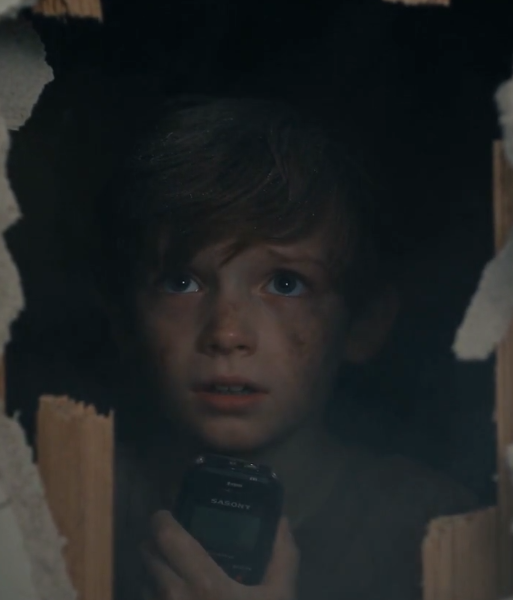
The Boy Behind the Wall
Chapter 1: The First Blow
The first blow of the hammer shook dust from the chandelier.
Elena Marsh felt the impact travel up her arms and into her shoulders, a hard, bright jolt that rattled her teeth. A crack ran across the cream-colored plaster, thin as a hair, then widening, then splitting into a spider’s web of fissures that crawled up toward the crown molding. A spray of white powder drifted down over her black uniform, over her white collar, over the marble floor she had mopped every morning for six years.
She did not stop. She drew the hammer back over her shoulder and swung again.
The second blow tore a fist-sized hole in the wall. Fragments of plaster skittered across the floor like broken teeth. Behind the wall there was darkness, and a smell, old dust, old wood, and something else, something faint and sour and human that made the hair rise along her arms.
“Elena.”
The voice came from the far end of the Great Hall, crisp and cold as a knife laid on a table. Elena did not turn. She was breathing hard. Her dark hair, which she wore pinned in a tight bun for the work, had come loose in a damp curl across her cheek, and her palms were slick on the handle of the hammer, which she had taken from the groundskeeper’s shed an hour earlier and hidden under a stack of linens.
“Elena Marsh. Put that down. Right now.”
Now she turned.
Vivian Wren stood at the foot of the grand staircase with one hand on the banister, in a long black dress that hung from her shoulders like a mourning veil. Her blond hair was smooth as poured honey. Her face, usually so calm, so perfectly arranged, had gone tight around the eyes. She came across the marble with short precise steps, her heels clicking, and stopped a dozen feet away, well outside the reach of the hammer, as if she were approaching an animal that might bite.
“What on earth do you think you are doing?”
“There’s someone in the wall, Mrs. Wren.”
“There is what?”
“Someone’s in there.” Elena’s voice shook, but she held the hammer steady. “I heard him. I’ve heard him for three days.”
A beat of silence. The great house hummed around them, the faint tick of a grandfather clock, the hush of the ventilation. On the far wall hung a portrait of the late Anna Wren, the first Mrs. Wren, in a gown of pale green, smiling down at the room with a calm, amused, faintly puzzled expression, as if she were watching something she could not quite believe. Beside the portrait, bolted to a bracket, hung the American flag, because the house belonged to a United States Senator, and the Senator liked it displayed.
“Elena,” said Vivian, very gently, with the patience of a woman addressing a child, “you are exhausted. I’ve noticed it. The staff has noticed it. You haven’t been sleeping. You’ve been seeing things.”
“I haven’t been seeing anything.”
“You’ve been hearing things, then.”
“I’ve been feeding him.”
It came out before she could stop it. Vivian went entirely still.
“I put bread through the vent in the back stair,” Elena said. “And water through a straw. Three nights. He tapped on the pipe. Three taps, then three, then three. Like his mother taught him.” She swallowed. “It’s Eli, Mrs. Wren. It’s your stepson. He’s in the wall.”
For a heartbeat, no one moved.
Then Vivian laughed.
It was a pretty laugh, low and genuinely amused, the kind of laugh that had charmed donors and committee chairs for years. “Oh, Elena,” she said. “Oh, my dear. Eli is in Switzerland.”
“He isn’t.”
“He is at Brightmoor Academy. He left on Thursday. His father arranged it. Everyone knows that. We discussed it at dinner.”
“His father was in Washington on Thursday,” said Elena. “And his shoes are still by the back door. And his inhaler is on his nightstand, and his bear is on the window seat, and no driver took him to any airport, because I asked Marcus, and Marcus said nobody did.” Her voice was climbing. “He isn’t in Switzerland, Mrs. Wren. He’s here.”
Behind Vivian, in the arched doorway to the kitchen corridor, the staff had begun to gather. Mrs. Hadley the housekeeper, with her hand pressed against her chest. Two of the young maids, wide-eyed. The cook, in her apron, with a wooden spoon still dripping in her fist. They stood very still. Not one of them said a word. Elena saw their eyes go from the broken wall to the hammer to the woman in the black dress, and she saw the fear in them, and she understood with a flat cold clarity that they were afraid of the wrong person.
“I think,” said Vivian, quietly, “you had better give me that hammer.”
“No.”
“Elena.”
“Listen.” She lowered her voice. “If I’m wrong, call the police. Call them now. Let them come and break the whole wall down, and arrest me, and I’ll go quietly. But if I’m right…” Her throat locked. “If I’m right, then there’s a nine-year-old boy in there who has been in the dark for six days, and you’re standing here talking to me about a hammer.”
Vivian’s smile did not move. But something behind it did, a flicker, a tightening, the faint twitch of a muscle at the corner of her mouth. And in that instant, Elena knew, with a certainty so deep that her knees almost buckled, that she was right.
She turned back to the wall. She lifted the hammer.
“Stop her!”
Vivian moved faster than Elena would have believed. She was across the floor in three strides, her black skirt snapping around her ankles, and her hand closed on the hammer’s handle just below Elena’s own. The two women stood nose to nose, chest to chest, both gripping the same wooden shaft. Elena smelled the expensive jasmine of Vivian’s perfume. She saw the tiny pores of her skin, the cold blue of her eyes, and in them, for the first time, not calm but something wild.
“Let go,” Vivian hissed.
“No.”
“You stupid, stupid woman. Do you have any idea what I can do to you?”
“I know exactly what you can do.”
“I will have you fired before sunset. I will have you blacklisted in every house in this state. I’ll see to it that your daughter’s tuition…”
Elena jerked the hammer sideways with all the force of her shoulders, and Vivian’s grip slipped. The older woman stumbled back two steps and caught herself on the arm of a velvet chair. Her hair had come loose on one side. Her lips were pressed white. For a moment the perfect mask had cracked wide open, and behind it Elena glimpsed something that made her want to run.
It was not anger. It was fear.
“Rosie,” Elena said quietly. Her daughter’s name came to her like a prayer. Rosie, twenty years old, in her second year of nursing school, who had a photograph of her mother taped inside her locker and who called every Sunday at six. “You’ll take my job? Take it. I’ve been a maid for twenty years. I can be a maid somewhere else. But I won’t go back to that vent tonight and tap on the pipe and hear nothing back. I won’t.”
She raised the hammer a third time.
And from inside the wall, faint and muffled and unmistakable, came a sound.
Tap.
Elena’s arms froze in mid-swing.
Tap. Tap.
A pause. The whole hall seemed to hold its breath. The two maids in the doorway had both clapped their hands over their mouths. Mrs. Hadley had begun to cry silently. And Vivian Wren stood with her back to the velvet chair and her face the color of candle wax, staring at the broken place in the plaster as if it were an open mouth.
Tap. Tap. Tap.
Three taps. Three taps. Three taps.
“Eli,” Elena whispered, and the hammer slid out of her fingers and clattered to the floor. “Oh, sweetheart. I’m here. I’m here.”
She dropped to her knees on the marble, among the shards of plaster, and pressed her mouth to the ragged hole in the wall.
“Hold on, baby,” she said, her voice breaking. “Hold on. I’m coming.”
And then, from the front of the house, through the tall windows of the Great Hall, came the crunch of tires on the long gravel drive, and the low familiar growl of a car engine that did not belong there, not at eleven in the morning on a Tuesday, not when the Senator was supposed to be in Washington until Friday.
Vivian turned her head toward the sound.
And Elena saw her face change from fear to something far worse.
Chapter 2: Three Taps
It had begun on a Saturday, with a sound so small that Elena had almost convinced herself she imagined it.
She had been polishing the brass fittings in the back stair, the narrow servants’ staircase that ran up through the center of Wren House like a hidden spine, behind the rooms the family used and the rooms the guests admired. It was a quiet job. She liked it. She liked the old wood and the creaking treads and the way the light came down through a small high window in long dusty bars. Nobody came here but the staff. The house, in this one place, was honest.
That was why she heard it.
Tap.
She stopped, rag in hand. The sound had come from somewhere behind the wall, from the plaster beside the second landing, where an old iron vent, a square grille the size of a hymnal, had been set into the paneling a century ago to carry warm air from the kitchen up through the house. She frowned. Pipes, she told herself. Old houses ticked and settled. They always had.
Tap. Tap.
A pause.
Tap.
The cold that went down her back was not the cold of the stairwell. She set down the rag. She crouched in front of the vent and pressed her ear to the grille, which smelled of rust and dust and some other smell underneath, damp, close, animal, and she held her breath and listened.
Silence. Then, from deep inside the wall, so faintly she thought it might be only the beating of her own pulse, three small deliberate raps against old metal.
Tap. Tap. Tap.
A short rest. Then three more. Then three more.
Elena had been a maid for twenty years. She had raised a daughter alone in a rented two-room flat. She was not a fanciful woman. But she knew what that rhythm meant, because every child in that house had been taught it, in the days when Anna Wren was alive and sat on the edge of her son’s bed at night and tapped the code on the headboard: three short for the S, three long for the O, three short again. If you ever need me, Eli, and I can’t hear you call, tap it. Tap it and I’ll come.
She had heard Anna say it one evening, passing the open door with a laundry basket. She had smiled. She had not thought of it again for two years.
“Eli?” she whispered into the grille. “Is that you?”
There was a long silence. Then a single weak tap. Then another.
Elena sat back on her heels with her hand over her mouth.
She did not scream. She did not run. She had learned over a lifetime of service that the instinct to act at once is very seldom the wise one, and she made herself sit there on the cold floor and think. She remembered the Thursday. She remembered Mrs. Wren coming into the kitchen at seven o’clock in the morning, immaculate, brisk, announcing in her pleasant voice that Eli had been unhappy at his day school for a long time and that she and the Senator had decided, after much anguish, to send him to Brightmoor Academy in the Alps, where he would get the discipline he so clearly needed. She remembered the way Mrs. Hadley had blinked. She remembered the cook saying, But he hasn’t packed, and Mrs. Wren answering, smoothly, His things will follow.
She remembered that no car had come. No luggage had gone. No driver had been called.
And she remembered, last of all, with a clarity that made her stomach turn, that the Senator had been in Washington since Monday. That the Senator’s phone, when Mrs. Hadley had cautiously asked his secretary to relay a question about the boy, had apparently been switched off in a series of committee hearings. That Mrs. Wren had personally, graciously, taken charge of the whole matter.
“Eli,” she said into the grille, very softly. “Are you hurt?”
A pause. Tap. Then, after a long moment: Tap, tap.
One for yes, two for no, perhaps. She guessed. “Are you hungry?”
Tap.
“Thirsty?”
Tap.
“All right,” Elena said, and her voice was not quite steady. “All right, my love. I’m going to bring you something. I’m going to be very quick. Don’t make a sound until I come back.”
She was back in six minutes. She had walked, not run, to the pantry, and filled a clean napkin with the heel of a loaf and a wedge of cheese and two apples, and taken a plastic drinking straw and a small bottle of water from the cook’s stores, and none of them had looked at her twice, because maids carry things. She climbed the back stair with her heart hammering. She knelt at the vent. The grille, she found, could be pried a finger’s width from the wall if she worked a table knife under the corner, and into the narrow gap she fed the bread, and the cheese, and the straw, and she heard from the darkness inside a faint scrabbling, a rustle of cloth, and then, so small and cracked she could hardly make it out, a voice.
“Thank you.”
Elena closed her eyes. Tears ran down her face.
“Don’t thank me,” she whispered. “Eat. Slowly. You’ll be sick if you go too fast.”
They talked through the vent for the next three nights, in murmurs, in fragments, in the small hours when the house slept. The boy’s voice was dry and thin, as though he had used it too little. He did not tell her much at first. He was nine years old and very frightened and he had learned, in a very short time, that grown-ups were not always what they seemed. But bit by bit, between bites of bread, it came.
He had been playing in the back stair on the Wednesday evening. It was his favorite place, the old servants’ way, with its hidden turns and its secret door behind the pantry that opened onto a narrow passage between the walls, a passage that had been used by a long-dead butler and forgotten by everybody but a small boy with a flashlight and a good imagination. He had been hiding there, in fact, because he had overheard something. A telephone call. Mrs. Wren in the library, with the door not quite shut, speaking in a voice he had never heard her use: low, hard, businesslike, with none of the sugar in it.
He did not say what she had said. He said only that she had been talking to a man, and that it was about his father, and about the money his mother had left him, and about after.
After what? Elena had whispered.
I don’t know, said the small voice. I think she meant after I wasn’t a problem anymore.
Elena had put her forehead against the cold plaster and shut her eyes.
He had tried to creep away. He had not been quick enough. She had found him in the passage, he said, with his flashlight and his mother’s little silver recording machine in his hand. The one Anna had used to dictate her letters. The one he carried everywhere, because it still held her voice. He had pressed the button without thinking, he said. When Mrs. Wren came, it was still running.
He did not tell Elena what happened after that. He said only: She told me to be quiet. She told me to stay put. She said she would come back. And then: She didn’t come back.
And then, in the dark of that third night, he said the thing that made Elena’s hands go numb.
They closed the door, Miss Elena. I think they put something over it. I heard a man’s voice and a trowel. It smelled like wet chalk.
She went to find the door the next morning.
The entrance to the old passage had been behind the pantry shelves, behind a false panel, a flat rectangle of wood that her fingers could trace if she knew where to look. It was gone. Where the panel had been, there was a smooth, pale, freshly painted expanse of wall, still faintly damp beneath its coat of cream, the exact color of the rest of the room. A professional job. Quick. Tidy. A man had come in the night, and a trowel, and a bucket, and by morning the world had closed over the boy like water.
She did not tell anyone. Who could she have told? The staff were frightened of Mrs. Wren, and the Senator was unreachable, and the police, if she called them, would find a respectable lady of the house and a hysterical maid with no proof beyond a voice in a wall. She had thought of it for a day and a night. She had thought of Rosie. She had thought, bitterly, of how very easily a woman in her position could be made to disappear from a story.
She decided to wait for the Senator.
He was due home on Wednesday.
On Monday, Mrs. Hadley mentioned in passing that the committee had run over, and that the Senator would now be kept in Washington until Friday.
And on Monday night, at a quarter past midnight, Elena knelt at the vent with a fresh napkin of bread, and put her mouth to the grille, and said, “Eli?”
No answer.
“Eli. It’s Elena. I’ve brought you some soup in a flask.”
Nothing. Not a tap. Not a breath. The silence in that wall was the loudest thing she had ever heard.
She waited ten minutes. Twenty. She tapped on the grille with her knuckle, three short, three long, three short, and she pressed her ear to the iron and heard nothing, nothing at all, and the thought rose in her mind like a flood: too late. I was too late. I waited and now it’s too…
“What on earth are you doing, Elena?”
The voice was pleasant and quiet and perfectly calm.
Elena did not turn at once. She stayed on her knees for one long second, the napkin of bread in her hands, her face lit by the thin light of the stairwell’s single bulb, and in that second she felt the whole shape of her life tilt on a hinge. When she did turn, she did it slowly.
Vivian Wren stood on the stair above her in a silk robe the color of cream, one hand resting on the banister, her blond hair tied back for the night. She was smiling. It was a perfectly ordinary smile. It was the smile she gave the florist, the smile she gave the Senator’s donors.
“I was only, ma’am, I was cleaning the vent,” said Elena.
“At midnight?”
“There was a smell. I thought it might be a mouse.”
“With a napkin of bread.”
Elena looked down. The napkin lay in her lap, the loaf’s heel sticking out of it, as incriminating as a confession.
“It’s for the mouse,” she said weakly.
Vivian came down the stairs, one step at a time, unhurried. She stopped two steps above Elena and looked down at her for a long moment, her head tilted a little, with an expression of faint, thoughtful pity. She reached out and touched Elena’s cheek, very lightly, with one cool finger.
“You’ve always been so soft,” she said. “It’s what I like about you. It’s what I’ve always liked. You’d feed a mouse. You’d feed a stray cat. You’d feed anyone who asked.”
Her finger slid under Elena’s chin and tilted her face up.
“But you do understand,” she said, in the same gentle voice, “that soft people are the first to be broken.”
Chapter 3: The Man in the Navy Suit
The Senator’s car was a long black sedan with tinted windows and a small flag on the fender, and it rolled up the gravel drive of Wren House at eleven minutes past eleven with the unhurried dignity of a hearse.
Inside the Great Hall nobody moved.
Elena knelt in the plaster dust with her mouth still pressed to the broken wall. She heard the car door open and close. She heard footsteps on the front steps, brisk, heavy, a man’s. She heard the key turn in the lock, and she heard Vivian Wren draw in a single sharp breath and begin, with astonishing speed, to rearrange her own face.
It was the most terrible thing Elena had ever witnessed. In the space of three heartbeats the wildness drained out of Vivian’s expression. The pallor softened into a delicate pink. The tight lines around her mouth smoothed away. The hair she had pulled loose in the struggle she tucked behind one ear with a hand that did not tremble. By the time the great front doors swung open, she was a different woman altogether: a worried wife, a gracious hostess, a lady whose household has just been disturbed by something shocking and sad.
“Thomas!” she cried, and ran across the marble with her arms outstretched. “Oh, thank God. Thank God you’re early.”
Senator Thomas Wren stopped in the doorway.
He was a tall man in a navy suit, fifty-one years old, broad-shouldered and graying at the temples, with the weary, courteous, handsome face of someone who had spent twenty years being photographed at funerals. He carried a leather briefcase in one hand. His tie was loosened. There were shadows beneath his eyes that no amount of public life had ever quite managed to hide. He had come back early, he would say later, because of a feeling he could not name, a restlessness that had begun in a Senate hearing room at nine that morning and grown until he left in the middle of a sentence and told his driver to take him home.
He took in the scene all at once.
The broken wall. The scattered plaster. The hammer on the floor. The staff clustered in the doorway with their faces drawn tight. His wife running toward him with her hands out. And, at the far end of the hall, on her knees in the rubble with her black dress white with dust, the maid, Elena, whom he knew by name and had always greeted, because his late wife had taught him that you greeted the people who kept your house.
“Vivian,” he said slowly. “What in God’s name has happened here?”
“It’s Elena.” She caught his sleeve. Her voice shook, and the shake was perfect, a woman at the edge of tears. “Oh, darling, it’s dreadful. She’s had some kind of breakdown. I found her with that hammer, tearing at the wall, and she’s been saying the most dreadful things. She says that Eli is inside. She says she’s been hearing him. She’s been feeding him through the vents. She’s quite out of her mind, the poor thing, I think she’s been overworked for months and I never noticed…”
“Eli.” The Senator stopped. The briefcase slipped from his fingers and hit the floor with a thump. “Eli is at school.”
“Of course he is.”
“In Switzerland. You told me on the phone.”
“Yes, darling. Of course. It’s what I told her. But she won’t listen, she keeps…”
“Senator,” said Elena.
It came out hoarse and cracked, but it carried. Vivian’s grip tightened on her husband’s sleeve. The Senator turned his head.
Elena rose to her feet. It took her two attempts. Her knees were bruised, her palms were scraped raw, and her hair hung in disordered strands around her face. She took a single step toward him across the plaster and stopped, and then, with a slow, deliberate dignity that nobody in that hall would ever forget, she knelt again, all the way down, until her forehead touched the cold marble between her outstretched hands.
It was not servility. It was the posture of a woman who had run out of every other way to be heard.
“Sir,” she said to the floor. “I am begging you. I have never asked you for anything in six years. I’ll ask for nothing again. Break the wall. Please. He’s alive. He’s in there. He’s been in there for six days, and he’s been tapping, and I swear to you on my daughter’s life, I’m not mad.”
“Thomas, don’t,” said Vivian softly. “She’s ill. It’s cruel to indulge her. Let me call Dr. Hargrove. Let me call someone, and we’ll get her some help…”
“Be quiet, Vivian.”
It was not a loud voice. But something in it made his wife fall silent mid-word.
Thomas Wren looked down at the woman on the floor, and then up at the broken wall, and for a long moment he did not speak. He stood with his hands at his sides in the cold light from the great windows, a big tired man in a blue suit with his late wife’s portrait hanging at his back, and in his face a struggle was taking place that the whole room could read. Reason argued one way. Instinct pulled the other. And between them, thin and fragile as a thread, hung the single word he had just heard.
Alive.
“Elena,” he said at last, very quietly. “Stand up.”
She stood. She kept her eyes lowered.
“Look at me.”
She lifted her face. Her cheeks were streaked with plaster and tears. Her eyes were red and wide and fixed on his with an intensity that was almost unbearable.
“You say he’s tapping,” said the Senator.
“Yes, sir.”
“What does he tap?”
Elena drew a shaking breath. “Three short. Three long. Three short, sir. The way Mrs. Anna taught him. The way she used to tap on his headboard at night, when he was small and afraid.”
The color left the Senator’s face.
It happened all at once, as if someone had pulled a plug. His lips parted. His hand, which had been resting on his tie, went slowly to his chest. In the stillness of that high hall every person could hear him breathe.
“She told you that,” he said hoarsely. “Somebody told you that.”
“No one told me, sir. I heard her say it once. I was passing with the laundry.”
“No one outside this family knew that code.” His voice cracked. “Anna made it up. It was theirs. She never told anyone, not even me, until the last year, when she was ill. She sat on his bed and she showed him. I only know because I was standing in the doorway.” He swallowed. “We never talked about it after.”
“Thomas.” Vivian had gone very white again, and this time she did not fix it. Her voice rose, thin and quick. “Thomas, darling, you must see that this is exactly the kind of thing, it’s manipulation, she’s playing on your grief, she’s using Anna’s memory to…”
From inside the wall, faint, muffled, and unmistakable, there came a sound.
Tap.
The Senator turned his head.
Tap. Tap.
Nobody in the Great Hall breathed. The old grandfather clock in the corner ticked, and ticked, and ticked. Vivian’s mouth had fallen slightly open. The cook let her wooden spoon slide from her hand and it hit the marble and rolled.
Tap. Tap. Tap.
Three short. A pause. Three long, slower, wobbling, as though they cost the tapper everything he had. A pause. Three short again.
Thomas Wren did not make a sound. He took three steps toward the broken wall, and then he was running, running across the marble in his good leather shoes with his tie flying over his shoulder, and he went down on both knees in the rubble beside Elena as though the floor had been cut from beneath him and pressed his open palm flat against the cracked plaster.
“Eli,” he said. His voice broke in the middle. “Eli. Eli, it’s Dad. Can you hear me?”
A pause. A long, long pause.
Then, so faintly that Elena thought she had dreamed it, the wall answered. Not a tap. A voice. A thin, cracked, disbelieving whisper, ragged with thirst and tears.
“Daddy?”
The Senator made a sound that none of the people who had heard him speak on the floor of the Senate would have recognized. He turned his head, and his eyes found the hammer where it lay in the dust, and he seized it. He rose. He did not look at his wife. He did not look at anyone.
“Stand back,” said Thomas Wren to the maid, to the staff, to the world. “Everyone, stand back.”
And he swung.
Chapter 4: Six Days in the Dark
Eli Wren had learned to count in the dark.
He counted his breaths, which came short and shallow because the air in the passage was thick with dust. He counted the beats of his heart, which he could feel in his ears. He counted the slats of old wood he could reach with his fingertips if he stretched out his left arm, nine, and the ones he could reach with his right, seven, and the number of steps from one end of the narrow space to the other, which was four, if he took very small ones. He counted the days by the sounds of the house, the faint clump of the cook’s boots at six in the morning, the high hum of the vacuum at nine, the dinner bell, the slow settling creaks of midnight. Six. He had been inside for six days.
He was nine years old, and he was very, very tired.
The dark in the passage was not like the dark of his bedroom, which had a nightlight and a strip of gold under the door. It was a solid dark, a thick dark, a dark with weight. For the first two days he had had his flashlight, a little yellow one with a rubber grip that his mother had bought him on a camping trip, and he had kept it switched on and pointed at the floor to save the batteries. Then the batteries had begun to fade. The beam had gone amber, then brown, then a tiny dying thread, and on the third night it had gone out altogether, with a small, dismal click, and he had sat there with the useless plastic in his hand and cried without making a sound.
He had not cried since. He was nine. He was a Wren. His mother used to say that Wrens were small and brave and made themselves heard.
His mother.
He slid his hand into the pocket of his brown sweater, and his fingers closed around the thing that had kept him alive.
It was a small silver recording machine, the size of a deck of cards, with a worn black button on top and a tiny window where a red light glowed when it was working. His mother had used it for years. She had dictated her letters into it, and her grocery lists, and her silly stories, and in the last year, when she was too tired to read aloud, she had recorded whole chapters of his favorite books so that he could play them at bedtime. After she died he had asked his father if he could keep it. His father had looked at it for a long time, and then, without a word, he had put it in Eli’s hands.
He had carried it everywhere since. In his pocket at school. Under his pillow at night. It still held her voice. Not all of it, there was a long and terrible stretch of silence on the tape where the last recordings should have been, but enough. Hello, my darling Eli. Once upon a time, in a kingdom beside the sea…
On the third night of the dark, he had held the machine to his ear and played the oldest recording on it, the one from his sixth birthday, the one where his mother laughed and sang and could not get the tune right, and he had listened to it six times in a row. The sound had been so small and so warm that for a little while the walls around him had seemed to fall away.
Then the batteries had begun to fail in that, too.
He had not played it since. He held it tightly instead, with his thumb resting on the button, and he did not press it.
He remembered the day it had begun. He remembered it perfectly. He was good at remembering things, his teachers said; he had a mind like flypaper. He had been in the passage because it was his place, the secret door behind the pantry that only he and the long-dead butler knew about, the narrow space between the walls where he could sit with a book and be quiet. Wren House was large, and cold, and since his father had married Vivian, it had grown colder. In the secret passage nobody told him to sit up straight or talk softly or not touch the piano. Nobody told him that his mother’s portrait made the visitors uncomfortable and ought to be moved to the attic.
He had been reading, with the flashlight, when he heard her voice.
It came through a crack in the wall from the library on the other side, where the door must have been left ajar. Vivian’s voice, but not the one she used with him or his father, not the soft voice, the sugared one. This was a voice like a drawer sliding shut. Cold. Flat. Businesslike.
Gerald. No. Listen to me. Once Thomas signs the transfer, the trust is mine to manage, but it’s the boy who is named. Do you understand? The boy. If anything were to happen to Thomas, if anything, the whole thing reverts to Eli. He’s the only heir. The only one.
A pause. A murmur from the other end of the line.
No. I don’t want an accident. Don’t be a fool. Accidents get investigated. I want him somewhere that nobody can visit. Somewhere quiet. A school in the mountains, perhaps. Somewhere with very strict rules about letters and phone calls. I’ve drawn up the papers. In a year, perhaps two, a child who’s been away that long will have a different sort of file entirely. A delicate child. A troubled one. And a father who hasn’t seen him…
Eli had stopped breathing.
He did not understand all of it. He was nine. But he understood enough. He understood that she was talking about him, and that the voice she used when she talked about him was the voice you used about a stain on a carpet.
He had pressed the button on the recorder. He did not know why. It had been instinct, the way a rabbit freezes in the grass. His thumb had found it in the dark. The tiny red light had flared, and the tape had begun to turn, and he had sat motionless in the passage with his heart slamming against his ribs while his stepmother finished her call.
Then the library door had closed. Footsteps. Another door, nearer. And the false panel behind the pantry shelf had slid open, and the light from the kitchen had fallen across his face, and Vivian had been standing there, looking at him.
She had not shouted. That was the part he could not forget. She had not shouted or reached for him or even looked especially surprised. She had looked at him for a long, quiet moment, and then at the recorder in his hand, with its little red light, and then at him again. Something in her face had gone very smooth and very far away.
Eli, she had said gently. You really shouldn’t be in here.
I wasn’t listening, he had said. I swear.
Of course you weren’t. She had smiled. Stay just where you are, darling. I’m going to fetch something. Don’t move.
She had closed the panel. He had heard her go. And he had sat in the dark, thinking she was fetching a blanket, perhaps, or a cookie, or his father, until he heard the other sound: a man’s voice, low and polite, saying, Mrs. Wren, it’s really no trouble, and the scrape of a metal bucket on stone, and the soft wet whisper of a trowel on plaster.
He had hammered on the panel. He had screamed. Nobody had come. The house was big, and the walls were thick, and the people who might have heard him were at the other end of it, doing what they were told, believing what they were told.
The plaster had dried by morning. It smelled like wet chalk.
Now, six days later, curled in the black with the machine in his hand, he thought about all of this very carefully, because it was something to do. He thought about how he had found the vent. He thought about how, on the second day, he had discovered the old iron grille at the end of the passage, the one that opened onto the back stair, and how he had pressed his face against it and breathed in the smell of beeswax and floor polish and thought, That’s the outside. He thought about how he had tapped on it, three, three, three, for two days, and nobody had come.
And then Miss Elena.
He thought about Miss Elena more than anything. He thought about her voice, soft and low and a little cracked, saying, Eli? Is that you? He thought about the bread and the cheese and the straw that tasted of plastic and the best water he had ever drunk. He thought about the way she had said my love, as no one had said it to him since his mother. He thought about her saying, last night, in a whisper, I’ll get you out, I promise, I promise, and about the fact that he had been too weak, then, to answer her.
He had not tapped on Monday night. He had tried. His arm had not obeyed him. He had lain with his cheek on the dusty boards, listening to her knock on the grille, and he had thought, with a distant, calm sort of sorrow: I’m going to sleep now. Just for a little.
He did not know how long he had slept.
He woke to a sound.
It was a dull heavy thud, and the wall beside him shook. A little shower of grit pattered across his face. He blinked. In the darkness he could see nothing, and his mind, thick with sleep, supplied a thousand explanations: thunder, a truck, the house falling down. Thud. The wall shuddered again. A thin line of white light appeared in the blackness, hair-thin, trembling.
Light.
He had not seen light in six days. He stared at it. It seemed impossible. It seemed like something painted on the inside of his eyelids.
Then the light widened. The wall cracked. A hole opened in the plaster, a ragged, jagged hole, and through it came dust and noise and the unbearable brilliance of the outside world, and his eyes streamed and he flung up his arm to shield them. And through the noise, through the roaring, he heard a voice that he knew.
Eli. Eli, it’s Dad. Can you hear me?
He could not speak. His throat had closed. His mouth was so dry that his tongue clung to it. He tried to say yes, and what came out was a creak, a whisper, a ruined thread of breath. “Daddy?”
Then the hammer fell again, and again, and the plaster fell away in great slabs, and the light poured in over him like water, and there were hands. A woman’s hands, small and rough and wonderfully warm, reaching in for him. A man’s hands, big and shaking, tearing at the wood. A face in the hole, white with dust and wet with tears, bearing so little resemblance to the sleek, calm face he knew from the television that for a moment he did not recognize it at all.
“Eli,” said his father, and his voice cracked in the middle like a child’s. “Oh, my boy. Oh, my brave boy.”
He was lifted. He did not remember being lifted. There was the sensation of his own weight leaving him, of arms like iron bands around his back and knees, of the smell of wool and aftershave and sweat. The dust fell away. Above him, impossibly high, a chandelier blazed like a cluster of stars.
He lay in his father’s arms on the marble floor of the Great Hall, among the broken plaster, with Elena kneeling beside him with her hand on his hair, and he looked up into his father’s face, and he said the only thing he could think of to say. It came out as a croak. It was the thing his mother had taught him, long ago: when you have something important, say it plain.
“Daddy,” he whispered. “I pressed the button. I pressed it the whole time.”
And he opened his small, dusty, trembling fist, and showed his father what he was holding.
Chapter 5: What the Machine Remembered
The silver recorder lay in the boy’s palm like a coin.
Thomas Wren stared at it. It was the one he had put into his son’s hands on the day after Anna’s funeral, a battered, dented, familiar thing, scratched along the casing where she had dropped it once in the garden. The tiny red light in its window was still glowing. Dimly, now, weakly, but glowing.
“What is this, Eli?” he said.
“It’s got her. Vivian. Talking.” The boy’s voice was a husk. “I didn’t mean to. But it did. It got all of it. And it got the man, too, the one with the trowel.” His eyelids fluttered. “I’m sorry I was in the passage, Daddy. I know I’m not supposed to be.”
“No,” said his father, and his voice failed him entirely. He pulled the boy against his chest and held him with one hand cupped around the back of his head, rocking him slowly as though he were a baby, while the maid knelt beside them and wept openly, and the rest of the staff, who had edged out of the kitchen corridor one by one, stood in a silent ring around the wreckage with their faces wet.
Mrs. Hadley had already gone for the telephone. They could hear her voice from the hall, shaking, urgent: an ambulance, please, to Wren House, a child, he’s been, he’s alive, please come quickly. The cook had run for water. One of the young maids had fetched a blanket from the linen cupboard and laid it over the boy’s thin shoulders.
And Vivian Wren, standing three paces away with her hair slipping from its pins and her hands pressed to her mouth, said in a high, shocked, quivering voice: “Oh, thank God. Oh, thank God. Thomas, my darling, I had no idea. I swear I had no idea. How could this possibly have happened, who could have done such a…”
She broke off.
The Senator had raised his head. He was looking at her.
There was no anger in his face. That was what frightened her, Elena saw. She had expected rage, the kind of rage a man of his size and standing might unleash on a person who had harmed his child. But the Senator’s expression was something far more terrible: a kind of blank, bottomless quiet, the face of a man standing at the edge of a drop and looking down.
“Vivian,” he said, very softly. “You told me he was in Switzerland.”
“Because I thought he was! Darling, Mr. Pryce arranged it all, I never imagined…”
“Mr. Pryce.” He turned the name over slowly. “Gerald Pryce. Anna’s old physician. The man who handles the family’s trust.”
Vivian’s hands fell to her sides.
“I haven’t mentioned Gerald Pryce this morning,” said the Senator. “I haven’t mentioned him all week.”
Something flickered in her eyes. It was only for an instant, but Elena saw it, and so did the Senator, and so did every pair of eyes in that hall: the quick, startled, calculating look of a woman who has stepped on a stair that is not there.
“You said it yourself,” Vivian said quickly. “A moment ago. You said…”
“I said nothing.”
“Thomas…”
The Senator laid his son carefully on the blanket in Elena’s arms, and the maid took the child to her breast as though she had been born to it. He stood. He was a big man, and standing in the rubble of his own hall with plaster in his hair and his tie torn askew, he seemed bigger. In his right hand he held the silver recorder. He turned it over. He ran his thumb across the worn black button.
“Eli says it’s recorded everything,” he said. “Shall we find out?”
Vivian moved.
She had been quick all her life, and she was quicker than any of them could have guessed. In one fluid motion she crossed the space between them, her black skirt whipping, and her hand shot out for the recorder with her nails extended like talons. The Senator was ready. He yanked his arm back. Her fingers raked across his knuckles and drew three thin red lines, and she lunged again, wild now, not calm, not smooth, her blond hair flying, her face stripped of every mask, and he caught her by the wrist with a grip like a vise.
“Give it to me!” She was screaming. Elena had never heard that sound from her before, high and ragged and utterly out of control. “Give it to me, you fool, you don’t know what you’re doing, that child is a liar, he’s always been a liar, he’s his mother’s son…”
She wrenched sideways. The Senator pivoted to keep his balance. For a moment the two of them were locked together in the middle of the Great Hall in an ugly, graceless, desperate dance, her free hand clawing at his sleeve, his shoulder braced against her weight, the silver recorder held high above both their heads. Someone shrieked. The cook dropped her pitcher. Marcus the driver, who had come in behind his employer and been standing frozen in the doorway, finally unfroze and ran forward.
Vivian’s heel caught on a slab of fallen plaster.
She went down hard. Her wrist twisted free of the Senator’s hand and she crashed onto the marble among the debris, her black dress billowing around her, and a cloud of white dust rose from the wreckage and hung in the air like smoke. She lay there for a moment, stunned, one arm flung out, her hair spread across the broken stone. Behind her, forgotten, the American flag hung from its bracket on the wall, bright against the white.
Then she raised her head, and she looked at the man standing over her. And for the first time Elena saw what was underneath the beautiful face: not a monster, not exactly, but something smaller and sadder and more ordinary, a woman who wanted what she wanted so badly that she had stopped being able to see anything else.
“Marcus,” said the Senator, without taking his eyes off his wife. “Stand at the door. Nobody leaves.”
“Yes, sir.”
Thomas Wren looked down at the silver machine in his bleeding hand. He turned it. His thumb, which was shaking only slightly, found the old worn button. He pressed it.
The tape whirred.
There was a crackle of static, a long faint hiss. And then, filling the Great Hall from end to end, thin and tinny but perfectly clear, there came a woman’s voice. Cool. Brisk. Utterly unmistakable.
“Gerald. No. Listen to me. Once Thomas signs the transfer, the trust is mine to manage, but it’s the boy who is named. Do you understand? The boy. If anything were to happen to Thomas, if anything, the whole thing reverts to Eli…”
Vivian made a sound on the floor, a small, dreadful, animal sound.
“No. I don’t want an accident. Don’t be a fool. Accidents get investigated. I want him somewhere that nobody can visit. Somewhere quiet…”
“Turn it off,” Vivian whispered. “Please. Thomas. Turn it off.”
He did not turn it off.
“…A delicate child. A troubled one. And a father who hasn’t seen him…”
A click. A pause. Footsteps on the tape, a door sliding. And then her voice again, close now, low and gentle, the voice of a woman speaking to a frightened child: “Eli. You really shouldn’t be in here. Stay just where you are, darling. I’m going to fetch something. Don’t move.”
The recording ran on. The scrape of a bucket. A man’s voice, quiet and reasonable, saying: “Mrs. Wren, it’s really no trouble.” The wet whisper of a trowel. And over all of it, small and muffled and heartbreaking, a child’s fists beating on wood, and a child’s voice, rising, calling out a single word, again and again.
“Daddy. Daddy. Daddy.”
The Senator pressed the button. The tape stopped.
In the silence that followed, a siren sounded far off, thin and rising, coming up the long road from the village.
Nobody in the Great Hall moved. The cook was crying into her apron. Mrs. Hadley had sunk into a chair with both hands over her mouth. The two young maids clung to each other. Marcus stood at the door with his arms folded and his face like stone. And at the feet of the United States Senator, among the shards of her own beautiful plaster, his wife lay with her cheek against the marble and her eyes wide and unseeing, and said nothing at all.
“That is your voice,” said Thomas Wren.
It was not a question.
“It’s a trick,” she whispered. “It’s edited. A child could, a child could fake that, with a, with a machine…”
“It is your voice,” he said again, “and that is my son’s, and I would know it in a thousand years.”
He turned his back on her. It was the most brutal thing he could have done, and he did it without cruelty, as a man shuts a door on a room he will never enter again. He walked across the broken floor, stepping over plaster and splinters, and knelt beside the maid and the boy. He looked at the woman who had held his son against her heart in the dark of his own house for three nights, who had risked her livelihood and her daughter’s future and her own safety on the strength of a tapping in a wall, and he could not at first find any words at all.
“Elena,” he said at last.
“Sir.”
“How do I…” His voice broke. He tried again. “There is nothing I can say.”
“Then don’t, sir,” said Elena Marsh, with the fierce, tender, unsentimental practicality that he would remember all his life. “He needs water. And a doctor. And his father. Say it to him.”
The sirens grew loud. Blue light flickered across the great windows and swept the walls, and the front doors burst open, and the men in uniform came in.
Chapter 6: The Last Recording
The hospital room was white and very quiet, and the morning sun came through the blinds in long pale stripes across the blanket.
Eli slept. He had slept, with short interruptions for water and broth and the soft murmured examinations of nurses, for almost twenty hours. The doctors had been calm and thorough. Dehydration, they said, severe but treatable. Bruising on the hands and forearms, where he had beaten against the wood. A chest full of old dust that would take weeks to clear. A great deal of fear that would take longer. But he was nine years old and he was strong, and he was going to be well.
A child who was fed, the attending physician had said quietly to the Senator in the corridor, even a little, even through a vent, is a child who has a margin. If nobody had brought him bread and water for three days, I would be having a very different conversation with you right now.
The Senator had nodded. He had not trusted his voice.
Now he sat in the vinyl chair beside the bed with his jacket off and his sleeves rolled to the elbow, and he had not left that chair, except to wash his face, for twenty hours. He held his son’s hand in both of his own. He watched the small chest rise and fall. Every few minutes, as if to prove it, he touched the boy’s forehead with the back of his fingers.
The door opened softly.
Elena Marsh stood on the threshold in a borrowed cardigan, with her hair freshly braided and her face scrubbed clean of plaster. She looked ten years older than she had the day before and, somehow, ten years straighter. Behind her, a tall young woman in nursing scrubs hovered anxiously with her hand pressed to her mother’s shoulder. She had her mother’s dark eyes and her mother’s stubborn chin, and she had driven four hours through the night to get here.
“Sir,” said Elena. “I didn’t want to disturb him.”
“You’re not disturbing anyone.” The Senator rose. The chair scraped. He seemed, for a moment, not to know what to do with his hands. “Please. Come in. Both of you.”
“This is my daughter, Rosie.”
“I know.” He crossed the room and took the young woman’s hand. “Your mother talked about you at dinner, once, and I wasn’t listening. I’d give a great deal now to have listened.” He looked from one to the other. “I owe you more than I can ever repay.”
“You owe us nothing, sir,” said Elena.
“Elena.”
He did not raise his voice. But something in it made her stop.
“The police have been to the house,” he said. “They’ve taken the statements. They’ve taken the broken plaster as evidence. They have a warrant for the library files, and for Gerald Pryce’s offices, and they picked him up two hours ago at the private airfield with a suitcase and a ticket to a country that does not extradite. My wife is in custody. She has asked for her lawyer, and for me, and I have declined the second.” His jaw tightened. “I have a great deal to be ashamed of. I did not see. A man who prides himself on seeing everything, and I sat at that table and I did not see a single thing.”
“She was clever, sir,” said Elena, quietly.
“She was. But you were braver.” He paused. “You said that you were a maid. That you’d be a maid somewhere else. I want you to know that no one in my house will ever again speak to you that way. And that whatever you ask of me, anything, anything at all, a position, a pension, tuition for your daughter’s whole degree, I would count it as nothing.”
Elena was silent for a long moment. Then she looked at the bed.
“There is one thing,” she said.
“Name it.”
“The portrait, sir. Mrs. Anna’s. In the Great Hall. I heard Mrs. Wren say it should go up to the attic.” She swallowed. “I’d like it to stay where it is. I’d like it to hang there for good. And I think when the boy comes home, he’d like to see her face before he sees anyone else’s.”
The Senator turned away abruptly and stood at the window with his back to the room. His shoulders moved once, twice. When he turned around again his eyes were wet, and he did not trouble to hide it.
“That is done,” he said.
A small sound came from the bed.
They all turned. Eli’s eyes had opened. He was looking at the ceiling, blinking slowly, with the dazed expression of someone returning from a long way off. Then his gaze drifted sideways and found his father, and the corner of his mouth lifted.
“Dad.”
“I’m here.”
“Is it a dream?”
“No.” The Senator was at the bedside in two strides, down on one knee. “It isn’t, Eli. It’s real. You’re safe. You’re never going back in there. Never again.”
The boy’s eyes moved to the woman in the cardigan standing at the foot of the bed. They widened a little. His lips parted.
“Miss Elena,” he whispered. “You came.”
“I told you I would, sweetheart.”
“You said you’d get me out.”
“I did.” Her voice trembled. “With a little help.”
Eli turned his head on the pillow and studied her. He was nine years old, and he had been in the dark for six days, and he looked at her for a long moment with an expression that was very grave and very old. Then he held out his small bruised hand, and she took it, and he said, with the matter-of-fact generosity of a child:
“I tapped on the pipe on Monday. But I think you didn’t hear. I was too tired.”
“I heard you, my love.” She bent and laid her forehead against his hand. “I always hear you.”
They stayed like that for a while. Rosie, at the foot of the bed, wiped her eyes with the back of her wrist. The Senator knelt with his hand on his son’s hair. And outside the window the morning grew brighter, and the stripes of sun crept up the blanket, and the machines beside the bed beeped their steady, patient, ordinary little song.
It was Eli who spoke next.
“Dad. Do you still have Mom’s recorder?”
The Senator reached into his trouser pocket and drew out the small silver machine. He had not let go of it since the Great Hall. He held it out. Eli took it in both hands and turned it over, his thumb running along the worn black button, and for a moment his face crumpled, and then smoothed again.
“I never played the last part,” he said. “The part at the end. After the birthday. There’s a really long gap, and then a little bit more. I was always scared to hear it.” He looked up. “Do you think we could?”
“What do you mean, the last part?”
“The recording. It’s the very last one. It’s from the night she…” He did not finish. “There’s a hidden one. I found it once by accident. I think she made it, Dad. I think it’s her.”
Thomas Wren felt something cold settle in the center of his chest.
“Anna made a recording the night she died?”
“I don’t know. I’m not sure. I never pressed it.” Eli’s fingers tightened on the machine. “I think she was trying to tell us something.”
There was a long silence in the room. The Senator looked at the maid, who had gone very still. He looked at the machine. Outside the door a nurse’s cart rattled past and faded away down the corridor.
“Eli,” he said carefully. “We don’t have to listen to it now. You’ve had a terrible week. We can wait until you’re stronger, until you’re home…”
“No, Dad.” The boy’s voice was thin, but it was steady. “I’m done waiting. I waited six days in the dark. I don’t want to wait anymore.”
He looked down at the tiny silver device in his hands, and then up at his father, and in his gray-green eyes, which were his mother’s eyes, the Senator saw a courage so complete that it frightened him.
“Wrens make themselves heard,” said Eli. “Mom said.”
Thomas Wren closed his eyes.
“Press it,” he said.
The boy pressed the button.
There was a long crackle, a hiss of static, a stretch of nothing so deep that the air in the room seemed to still. Then, faintly, a rustle, bedclothes, the creak of a mattress. A cough. A faint, ragged, labored breath. And then, small and thin and exhausted and unmistakably, achingly alive, a voice that Thomas Wren had not heard in two years.
“Eli. Thomas. If you’re hearing this, it means I couldn’t tell you in person.”
The Senator’s hand flew to his mouth.
“I’m so tired. I’m not going to be able to say this well. Gerald has been so kind. He sits with me every night, and he brings me the tea. But something is wrong with the tea. It’s, I don’t know. It tastes of, it tastes the way my mother’s medicine used to taste. And Gerald, Gerald says it’s only to help me sleep, but I’ve been sleeping all day and I’m not getting better, I’m getting…”
A cough. A long pause. A footstep, close, and a soft click, as of a door.
“Gerald,” said Anna Wren’s voice, suddenly, quite differently, with a thin, trembling, dreadful brightness. “Oh. Oh, you’re early. I was just, I was only dictating a letter. To the boy. For his birthday.”
A man’s voice, low and warm and perfectly kind: “Of course, Anna. Of course. But you really should be resting. Here, I’ve brought your tea.”
The tape hissed.
Then, softly, in a whisper so faint that the whole room leaned toward the machine to catch it, a woman’s final words, spoken while a man stood by her bed holding a cup.
“Eli. My darling. Whatever they tell you, I didn’t leave you. Look for the…”
The recording cut off.
Nobody in the hospital room moved. The Senator’s face was gray. Rosie had both hands pressed to her mouth. Elena had drawn the boy’s hand against her cheek. And in the bed, the nine-year-old child who had survived the wall, who had survived six days, who had pressed the button and held on, lay with his small fingers locked around his mother’s last unfinished sentence and stared at his father with eyes the size of saucers.
“Dad,” he whispered. “Look for the what?”
Thomas Wren did not answer. He was looking at the machine. He was thinking of a man in a gray suit, with a gentle voice and a medical bag, who had sat at his wife’s bedside every night for six months and been thanked for it at her funeral. A man who had been sitting, at that very moment, in a police interview room with a lawyer at his elbow and a ticket in his pocket to a country that did not extradite.
He thought of the trust. He thought of the signature on the transfer. He thought of the line on the tape, whatever they tell you, I didn’t leave you.
And for the first time in two years, Thomas Wren understood that the wall in the Great Hall had not been the end of anything.
It had only been the first door.









