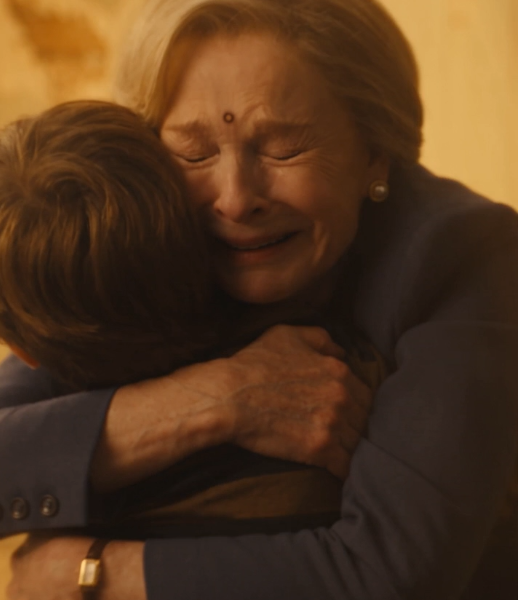
The Mark at St. Brigid’s
CHAPTER ONE — The Senator’s Face
Every morning for eight years, Senator Margaret Callahan had spent exactly four minutes erasing a part of herself.
She did it in the bathroom of her house in Georgetown, at ten minutes to six, in the cold blue light of the tube above the mirror, with the door locked and the tap running to cover the sound. She did it before coffee. She did it before the newspaper. She did it before she let herself think a single thought about the day ahead. She took a small flat tin out of the left-hand drawer, and a sponge the size of a thumbnail, and she bent to the glass, and with the fierce, practised, absolutely unemotional precision of a surgeon closing a wound, she covered the mark.
It was not much to look at.
It was a dot. A small round mole, the colour of strong tea, about the size of a lentil, set in the exact centre of her forehead, a half-inch above the bridge of her nose. It had been there since the day she was born. It was, her mother used to say, God’s thumbprint, and her grandmother had called it the Callahan seal, and the family priest, a fat red-faced Irishman with a taste for poteen, had once told her at her confirmation that it was a sign of a destiny. She had not believed him. She had been nine, and her mother had wept when she was born, because the mark was exactly as it had been on her own mother’s face, and her grandmother’s before her, passed down through the first-born daughters of the line like an heirloom.
The Callahan mark. It skipped a generation, sometimes. It missed a few cousins. But it always, always appeared on the eldest.
She had worn it proudly for fifty years.
She had worn it through law school and the district attorney’s office, through three terms in the state legislature and four in the House, through the long hard scraping campaign for the Senate that made her, at fifty-six, the first woman from the western half of Pennsylvania to win a statewide seat. She had worn it in photographs. She had worn it on the cover of Time. Her opponents had used it against her in a dozen ugly ways, and she had turned it round, with a wry smile, into a trademark, until half the state wore a small brown dot on their lapels on election day, in solidarity, in the form of a campaign sticker.
The Dot Stops Here, the stickers said.
And then, one wet October night eight years ago, a river had come up over a bridge in a place called Harlow Falls, and she had never been able to look at it again.
She finished the left side and began on the right, tilting her head, working the sponge in small neat circles from the centre outwards, blending, feathering the edge of the foundation into the skin. It took practice. It took a good light. And the thing was that it never quite worked: a faint dark ghost of the mark always showed through, if you knew where to look, a subtle shadow beneath the beige. She had learned to live with it. She had learned to angle her face away from certain cameras.
She did not look at her own eyes while she did it.
She looked at the dot, only, as one looks at an enemy through a rifle sight, and she held the tin in her left hand, and she thought what she thought every morning, with the same quiet dull ache, like a toothache in a tooth that has already been pulled.
Daniel had it.
He had been a small round-faced dark-eyed boy with a gap in his teeth, and the mark had sat on his forehead like a drop of chocolate, and she had kissed it a thousand times. He had not minded it. He had been proud of it. At fifteen he had drawn it on the back of his hand in biro, to impress a girl. At twenty-two, at his graduation, he had stood on a stage in a mortarboard and looked down into the audience, and she had seen it, bright and brown and defiant, between the tassel and the eyebrows, and she had thought her heart would stop.
And the baby had it.
She set the tin down on the edge of the sink.
It was a very small baby. It had been eleven months old, a round placid solemn creature with a great deal of dark fluff and enormous brown eyes, and a mark so small and perfect that the hospital nurse had cooed over it in the delivery room. Oh, look. It’s a beauty spot. Daniel had laughed. He had held the child up in the golden light of the maternity ward, with his wife Claire laughing beside him, and said, in a voice that she could hear still, thick and wondering and happy: Mom, look. He’s got the seal.
Theodore Daniel Callahan.
Theo.
She had held him exactly eleven times.
She had counted. She had counted afterwards, in the long white sleepless hours, lying in the dark in a bedroom that suddenly smelled of nothing, going through them one by one: the christening. The first birthday party that never happened. The long Sunday in August at the lake, when he had grabbed her pearls and put them in his mouth. The last, on the doorstep, on the evening of the fourteenth of October, as Daniel strapped him into his car seat and Claire turned back to wave.
Drive carefully, she had said. It’s going to rain.
She did not remember the rest.
She remembered a telephone, ringing. She remembered a man’s voice, the state police captain, a decent, kindly, hopeless voice, saying her name over and over, Senator, Senator. She remembered a long wet black road with the lights of ambulances pulsing in the rain. A bridge, with a gap in the middle where a bridge should have been. A swollen brown river. A mangled silver car with its roof peeled back like a tin of sardines, and a young policeman in a yellow slicker, who would not look her in the eye.
They had found Daniel and Claire in the morning.
They had not found the car seat.
They had searched for eleven days. They had dragged the river, and dredged the reeds, and walked the banks for six miles downstream with dogs and divers and a helicopter with a heat camera, and a hundred volunteers from the church, in rubber boots, calling a name that nobody answered. They had found a small shoe. They had found a soft blue blanket, torn and sodden, in a tangle of branches below the dam. And on the twelfth day, a young man in a clean uniform had come to the house, and sat on the edge of her sofa with his cap in his hands, and told her gently that there was no more hope.
The current was very strong, ma’am. He would not have suffered.
She had thanked him. She had shown him to the door. She had gone upstairs, and shut herself in the bathroom, and looked in the mirror at a woman with a small brown dot on her forehead, and she had taken a bar of soap, and tried to scrub it off.
She had scrubbed until the skin bled.
It would not come off. It never did.
So she had learned to hide it.
“Senator?”
The knock came at the door at five past six, light and respectful.
“Senator, I’m sorry. The car’s here. Mr. Brandt says we need to leave at six-fifteen if you want to be in Harlow Falls by noon.”
“Thank you, Priya.”
She straightened. She closed the tin, and slid it back into the drawer. She studied the mirror with a cool, flat, appraising gaze, as one studies a painting for flaws. The face that looked back at her was handsome, and tired, and sixty-eight years old: a clear pale oval under a cap of silver-blonde hair, with level blue eyes and a long straight mouth and a pair of small gold earrings. It had been described in the press as formidable. It had been described, once, by a hostile columnist, as a face like an unopened letter.
There was no dot.
She put on her navy suit. She buttoned the jacket. She fastened a single strand of pearls at her throat, as she had done every day since her husband gave them to her on their twentieth anniversary, and pinned a small enamel flag to her lapel, a little crooked, as it always was.
It was a gesture that had become, over the years, almost a prayer.
She did not want to go.
That was the truth. She had told no one. She had sat in the Senate cloakroom on Tuesday morning with a letter in her hand, a single thin sheet of cream paper, covered in the small, upright, slightly shaky copperplate of a woman who had learned her letters from the nuns in 1948, and she had read it four times. And at the end of the fourth reading she had put it in her pocket, and told her chief of staff to clear her Friday, and said nothing at all.
Dear Senator Callahan,
You will not remember me. I am Sister Agnes Brennan, of the Order of the Sisters of Mercy, and I have been, for fifty-one years, a servant of St. Brigid’s Home for Children in Harlow Falls. I write because I understand that the building is to be demolished on the first of November, and that the decision rests with a committee of which you are the chair.
I do not ask you to spare it. It is a ruin. The roof is rotten and the floors are unsafe, and I would not wish any child within its walls. But before you sign, I beg you to come and see it. Alone, if you can. On any day before the first.
There are things in this building that belong to you.
Yours faithfully in Christ,
A. Brennan, S.M.
It had been postmarked Harlow Falls.
That was what had held her, in the end. Not the strange, quiet, certain tone of the letter, nor the mild, steady audacity of its last line. It was the name of the town. She had not been to Harlow Falls in eight years. She had flown over it, once, in a helicopter, on the way to a rally in Erie, and had asked the pilot to change course.
But it was the nearest town to the bridge.
She took her coat from the hook on the back of the door. She checked her face in the glass for the last time, and saw only a woman in a navy suit, perfectly composed, perfectly flat, with a stranger’s smooth forehead.
What things? she thought.
But she knew that she was going. She had known it since Tuesday. And as she opened the bathroom door and walked down the cold bright stairs of the house in Georgetown, with her heels clicking on the marble and her chin held high, there rose in her, quite unaccountably, quite without warning, a small cold prickle at the back of her neck, like the first breath of a draught from a door long shut.
CHAPTER TWO — The House That Groaned
St. Brigid’s Home for Children stood at the top of Mill Street, in the rain, like a dead thing that had not yet been told.
It was a tall, gaunt, grey-brick building of three storeys, built in 1911 by an order of Irish nuns who believed that charity should be solid, and who had put into its walls enough good Pennsylvania brick to survive a war. It had a steep slate roof and a row of narrow pointed windows and a front door of black oak with a brass knocker in the shape of a lamb. Above the door, carved in stone, were four words, worn nearly smooth by a hundred years of weather: SUFFER THE LITTLE CHILDREN.
The windows were boarded. The garden was a jungle. A chain-link fence ran round the whole property, with a yellow sign wired to the gate: DANGER. CONDEMNED. STRUCTURALLY UNSOUND. NO UNAUTHORISED ENTRY. And in the lower corner, in neat black lettering, stamped by the county in September: DEMOLITION SCHEDULED, 1 NOVEMBER.
“Senator, I really must object,” said Dennis Brandt.
He was her chief of staff. He was a thin harassed man of forty with prematurely grey hair and an anxious, hunted look, and he stood beside her in the rain with an enormous black umbrella held over her head and his other hand gripping a clipboard, as though it were a lifeline. “I’ve spoken to the county engineer. He says it’s a fire trap. He says the whole third floor could go at any moment. And with your, ah, profile— I mean the press— If a sitting senator were to be injured in a, a condemned—”
“Dennis.”
“Ma’am?”
“I am going to walk into that building.”
“With respect—”
“I am going to walk in, and look at what there is to see, and walk out. I should like you to remain here with Priya and the car. If I am not out in forty minutes, you may call the fire department, and you may tell them where to find the body.”
“That’s not funny, ma’am.”
“It wasn’t meant to be.”
She took the umbrella from his hand. She closed it, with a snap, and gave it back. The rain fell on her bare head in thin cold needles, running down through her hair and over the small crooked flag at her collar, and she did not feel it. She was looking at the front door.
It was open.
Not wide. A hand’s breadth. But the great black oak door, which should have been chained and padlocked by order of the county, stood slightly ajar, with a fine wedge of darkness between it and the frame, and from somewhere deep inside the house came the faintest possible sound, so low and small and far away that she thought at first it was the wind. It was a kind of humming. A thin, tuneless, murmuring thread of sound, rising and falling.
She stood quite still.
A lullaby, she thought.
It was ridiculous. It was a trick of the wind in the chimneys. She turned her head sharply to Dennis, who was staring at his feet, and Priya, who was fussing with her phone, and neither of them had heard. She looked again at the dark gap in the door. The sound had gone.
She pushed it open.
It swung inward without a creak. A breath of air came out to meet her: cold, dry, dusty, thick with the smell of old plaster and rotted wood and, underneath, very faintly, something sweet and clean and ordinary, like soap. She stepped over the threshold. The door swung to behind her, softly, and the sound of the rain dropped away to a murmur, and she was standing in darkness.
It took a minute for her eyes to adjust.
She was in a long, high, narrow hall, with a stone floor and a staircase rising on the right into shadow. There was a smell of damp. A pale grey light fell in long shafts from gaps in the boarded windows, and in it, slowly, a million motes of dust turned over and over like tiny planets. Water dripped somewhere. The walls had once been painted green: she could see it still in flakes, in great peeling scabs, hanging in long curls from the plaster. Along the left-hand side, at about the height of a child’s shoulder, ran a row of small brass hooks. Beneath each, in a faded hand, was a name. Michael. Josephine. Peter. Mary Kate. Thomas.
She walked along them slowly.
She did not know why her heart was beating so hard. It was an empty building. It had been empty for three years. It was a perfectly ordinary Catholic orphanage, of the sort that had stood in every industrial town in America before the war, and she had visited a hundred. She had cut ribbons at dozens of them. She had made speeches. She was a seasoned public servant, with forty years of experience in lonely buildings, and there was nothing in this hall to be afraid of.
She was afraid anyway.
She stopped before a hook near the end of the row.
It was a small one, lower than the rest, hammered into the wall at the height of a toddler’s reach. It had no name beneath it. Only a space, where a name had once been painted, and then scrubbed away, so thoroughly that the plaster had worn thin. And hanging from it, quite incongruous in the dust and the wreckage, was a small red knitted hat.
It was clean.
“That’s mine,” said a voice.
She did not scream. She had learned, in a long career, not to scream. But every muscle in her body jerked, and her hand flew to her throat, and she wheeled round so fast that her heel skidded on the stone.
A small boy was standing in the doorway at the far end of the hall.
He was perhaps eight years old. He was thin, and brown-haired, and rather dirty, in a striped wool sweater two sizes too large and a pair of faded blue jeans and sneakers with one lace undone. He stood with his hands in his pockets and his head a little on one side, looking at her with the large, grave, steady, unastonished regard of a creature that has lived all its life in a quiet place, and does not frighten easily.
“You shouldn’t touch it,” he said. “It’s the only hat I’ve got. Sister Agnes knitted it.”
“I’m sorry,” said Maggie, rather faintly. “I didn’t mean— I wasn’t going to—”
“It’s okay.” He considered her. “You’re the lady from TV.”
“I suppose I am.”
“I’ve seen you. Sister Agnes has a little television in the kitchen at the convent. She lets me watch the news if I’m quiet.” He frowned. “You look different in real life. You look more—” He hesitated, searching for the word. “More tired.”
Maggie found, to her great surprise, that she was smiling.
“I believe that’s the nicest thing anyone has said to me in a week,” she said. “What’s your name?”
“Eli.”
“Eli what?”
He shrugged. “Just Eli.”
“And do you live here, Eli?”
He glanced away. There was a short, wary pause, and she saw him weigh the question in his mind, with the grave and delicate caution of a small boy who has been told many times not to tell grown-ups things.
“Sometimes,” he said.
“Sometimes.”
“When I don’t like where I’m supposed to be.” He kicked at the floor with the toe of his sneaker. “I used to live here all the time. When I was little. Then they closed it down, and I had to go and live with a family, in a house with a car. But they weren’t—” He did not finish. “So I came back. Sister Agnes gives me dinner. She doesn’t tell. She says it’s a secret between me and God and her.”
“That seems a very reasonable arrangement.”
“I know.” He looked up at her, with a sudden quick shy glint of a smile. “Do you want to see the room with the cradles?”
“The—”
“Upstairs. It’s the best room. It’s got all the old beds in it. I’ll show you. You’re allowed, as long as you come with me.” He turned already, with a quick eager bob of his head, and started towards the foot of the stairs. “This way. You have to keep to the left. The right side’s rotten.”
Maggie hesitated.
It was not a thing that she would ever be able to explain. She had been a prosecutor, a legislator, a senator, a woman of reason and law and the cool, hard, patient evaluation of fact. She knew the rules about children and strangers. She knew the rules about condemned buildings. She knew that Dennis Brandt was standing in the rain, outside the door, with a clipboard and a rising sense of doom, and that if she followed a stray child up a rotten staircase in a ruin scheduled for demolition, she would deserve every sneering paragraph that would be printed about her afterwards.
But the boy had turned his head, in the grey light from the window, and looked back at her over his shoulder, and something in the quick sidelong tilt of it went through her like a needle.
It was only a profile. A small thin face, and a damp lock of brown hair that fell across the forehead, and a pair of wide dark eyes.
She could not have said what it was.
“Eli,” she said slowly.
“Yes?”
“How old are you?”
He considered. “I think I’m eight,” he said. “Sister Agnes says my birthday’s the fourteenth of October. But she says that’s just the day they wrote down, so I’m probably a bit older.”
The cold prickle at the back of her neck turned, suddenly, into a slow, creeping, icy flood.
The fourteenth of October.
It was a coincidence. It had to be a coincidence. There were three hundred and sixty-five days in the year, and a great many children had birthdays in October. She breathed in, very carefully. She put out one hand and laid it on the cold newel post at the foot of the stairs, and she found that it was shaking.
“Show me,” she said. “Show me the room.”
They went up together, in the grey light, keeping to the left. The stairs creaked beneath them. The banister was slick with damp. At the first landing, the boy stopped, and cocked his head, and listened; and far overhead, deep in the body of the old house, there came a low, slow, shuddering groan, like the sound of a very large animal turning over in its sleep.
“It does that,” said Eli, comfortably. “It’s just the house.”
CHAPTER THREE — The Ceiling
Eli loved the house the way you love a very old dog: with a patient, fond, slightly worried tenderness, knowing that it could not last.
He had been born in it. That was what Sister Agnes said, anyway, though she said it with a funny, careful little pause, as if she were choosing her words one at a time from a tray. You came to us in the autumn, Eli. In the rain. The Lord sent you. He had never quite understood what she meant by that, but he liked the sound of it. He liked the idea of being sent. It made him feel like a parcel that someone had been expecting.
He knew every board in the building. He knew which stairs squeaked and which ones were silent. He knew where the draught came in under the scullery door, and where the old iron radiators still gave out a faint, dying warmth if you put your back against them on a cold night. He knew the long second-floor corridor, with its rows of green doors and its brass numbers, and the one door at the end, with a little painted lamb on it, which led to the room he liked best.
He had never taken anyone there.
Not the other kids, when there had been other kids. Not the foster family, with their big car and their small, tight, shut-up faces. Not even Sister Agnes, who came every evening at six with a basket on her arm and a thermos of soup, and sat with him on the kitchen step while he ate, and told him stories about the old days, when there were ninety children in the house, and the long dining hall rang with singing.
But he had decided about the lady in about four seconds.
He could not have said why. It was just a feeling. He had been standing in the dusty window of the first-floor landing, with his nose against the cold glass, watching the big black car pull up in the rain, and he had seen her get out. A tall, straight, silver-haired woman in a navy blue coat, with her hands in her pockets and her chin up. She had stood for a long time in front of the gate, looking up at the building, quite still, and the man with the umbrella had fussed at her elbow, and she had not so much as turned her head. And the way that she stood, with her feet apart and her shoulders squared, like somebody bracing against a wind, had made something in his chest go small and tight and strange.
She looks like somebody who’s lost something, he had thought.
He knew that look. He saw it in the mirror.
He had followed her in. He had not meant to speak. But she had stopped in front of his hat, and touched it, and he had felt a quick hot flare of possessive alarm, and the words had come out before he could stop them. And now he was leading her up the stairs of St. Brigid’s Home for Children, in the cold grey half-dark, and she was walking behind him, very quietly, with her hand on the banister, and he could hear her breathing.
She was nervous. He could tell. She breathed in short careful sips, like someone walking on ice.
“This way,” he said. “Keep left.”
The second-floor corridor was long and narrow and dim.
It ran the whole length of the building, perhaps a hundred feet, with a row of tall green doors on either side and a bare plank floor that sagged here and there like a hammock. The walls were stained and flaking. Great strips of old wallpaper hung down, in the shape of ghosts. At the far end, a single high window let in a thin grey light, which fell across the boards in a long pale rectangle. A row of small framed photographs ran down the right-hand wall, faded to the colour of tea. Eli did not look at them. He knew them by heart. They were all children. Hundreds and hundreds of children, in lines, in rows, in white communion dresses and itchy woollen jackets, squinting at the sun.
The lady stopped.
She had been looking at the photographs. She stood before the nearest, which was a picture of a small girl with a round face and two black plaits, sitting on the steps of the house, and she did not say anything at all. But he saw her shoulders move. And then, with a small shake of the head, as though she were pushing something away, she followed him on.
“What’s it like?” she said. “Living here?”
It was a funny question. Nobody had ever asked it. He thought about it with great care.
“It’s quiet,” he said. “And it’s big. When it rains, it sounds like drums. When the wind blows, it sounds like singing.” He frowned. “Sister Agnes says the house is full of ghosts, but they’re nice ones. She says they’re all the kids who used to live here, and they come back at night to check on us.”
“And do you believe her?”
“Sometimes.” He glanced over his shoulder. “I hear them. Mostly in the nursery. It’s like— humming.”
He saw the lady’s face change.
It was a small movement. A flicker. But he saw it, in the grey light, and he saw her hand tighten on the banister, and for some reason he went on, quickly, to fill the silence.
“It’s probably the pipes. Sister Agnes says so. But I think it’s a lullaby.”
“A lullaby,” said the lady, in an odd flat voice.
“A real one. With words. I can almost hear them. It goes—” He hummed three notes, tuneless, shy, without meaning to, and then stopped, embarrassed.
The lady stood perfectly still.
She had gone very white. In the dim light her face was like carved marble, with the eyes enormous and dark. She did not move. She did not blink. She was staring at him with an expression that he did not understand, a kind of terrible, stricken, hungry attention, as though he had said something in a language she had spoken as a child and thought she had forgotten.
“Where did you learn that?” she whispered.
“I didn’t. It’s just in my head.”
“Who sang it to you?”
“Nobody.” He shrugged. He felt suddenly shy, and rather hot, and not at all sure what he had done. “I don’t know. I think maybe I made it up.”
The lady said nothing.
She took a step towards him, and stopped, and put one hand up to her own mouth.
And it was then, in the silence, in the cold grey light of the corridor, with the dust turning slowly in the shafts from the window, that the house spoke.
It began as a creak.
It was a long low drawn-out sound, a protest of old wood under strain, deep in the roof above their heads. It rose and fell. It shivered through the floor and up through the soles of his sneakers into his shins. It was the sort of noise the house made every day, and he had never once been afraid of it. But the lady’s head had jerked up. She was staring at the ceiling, with her lips parted and her eyes wide, and he saw a small, fine trickle of white powder come sifting down between the joists and settle on her shoulder like snow.
“Eli,” she said sharply.
“It does that,” he said. “It’s just the house.”
“Eli, stay close to me.”
Her voice had changed. It was not the voice of the lady from TV, level and smooth and calm. It was a new one, quick and low and absolutely certain, a voice that went through him like a bell, and without thinking he took two steps towards her. She caught his hand.
Her fingers were cold. They closed round his so tightly that it hurt.
“Listen to me,” said the lady. “I want you to walk back the way we came. Slowly. Don’t run. Keep to the left. I’m going to be right behind you. Do you understand?”
“But the room with the cradles—”
“Eli.”
He looked up.
She was staring at the ceiling, and the ceiling was moving.
He saw it quite clearly. It was a thing he would remember for the rest of his life, in every slow separate detail, like the frames of a film. The old plaster, cracked and blotched with damp, was sagging. It was belling downward in the middle like a sail filling with wind, in a long, slow, pregnant curve, and a line of fine black cracks was running across it, branching, racing, with a faint dry whispering sound. Dust poured down. A shower of grit rattled across the floor. Somewhere above, in the third floor, in the dark, something very heavy shifted, and groaned, and let go.
“Run,” said the lady, very quietly.
He ran.
He did not decide to. His legs did it. He tore down the long grey corridor with the boards bucking beneath his feet and his heart slamming against his ribs and the roar rising behind him like an express train in a tunnel, a vast, rumbling, tearing, thunderous roar that seemed to come from every side at once. He heard a crack like a gunshot. He heard a sound like a thousand tiles breaking. He heard the lady’s voice, high and ragged and clear, over all of it, “Eli, RUN!”
And then he was in the air.
It was not the roof that threw him. It was her. He felt it afterwards, in the long time of the dream, and could never quite believe it: two hands, hard as iron, flat between his shoulder blades. A massive shove. A body behind him, launching itself like an arrow from a bow. He flew. He sailed forward through the roaring dusty dark with his arms flung out and his sneakers off the floor, and the whole world turned to white powder, and there was a blow on his back like the kick of a horse, and a weight, heavy and warm and soft, driving him down onto the boards.
The roof came down.
It came down with a sound like the end of the world. It was not a crash. It was a detonation. A great grinding, splintering, pulverising avalanche of timber and slate and brick and plaster, thundering into the corridor behind them, filling it floor to ceiling, throwing up a vast boiling cloud of pale grey dust that rolled over them like a wave. He felt the floor leap. He felt the whole house shudder, down to its foundations, like a struck bell. Beams struck beams. Something big and heavy bounced off the wall and skittered past his head. A rain of fragments pattered down onto his back, onto his legs, onto the blue jacket that covered him.
He lay with his face against the boards, and his eyes squeezed shut, and he could not breathe.
There was a body on top of him.
It was curled over him like a shell. He could feel the heat of it, and the quick hard thud of a heart, and a pair of arms wrapped round his head and shoulders, bracing, shielding, rock-steady. He felt a small sharp thing digging into his cheek. It was a string of pearls. And somewhere above him, close to his ear, so faint that it was almost lost in the roar, he heard a voice, whispering the same words over and over, hoarse and broken and fierce.
“I’ve got you. I’ve got you. I’ve got you.”
CHAPTER FOUR — Dust
It took Maggie Callahan some time to realise that she was alive.
The world had gone grey. It was soft and thick and silent, like being buried in flour, and the only sound was a high thin ringing in her ears, like the note of a glass. She was lying face down on a floor. Her cheek was pressed against rough boards. Her mouth was full of grit, and her eyes burned, and there was a hot wet trickle running down the side of her face from somewhere above her left temple.
She lay perfectly still, and took stock.
It was a habit from her days as a prosecutor. One. I am conscious. Two. I can feel my hands. Three. I can feel my feet. She wriggled her toes. They moved. She clenched her fingers. There was a sharp stab of pain in her right shoulder, and a dull heavy ache in her back, where something large had struck her as she fell, but nothing, she thought, was broken. She tried to lift her head, and the whole grey world swam and tilted.
Eli.
The name rose in her mind like a bubble through water, and burst.
Eli.
She moved.
She did it all at once, with a violence that shocked her, shoving herself up onto her hands and knees through a litter of broken plaster, coughing and choking, with the dust boiling up in clouds round her face. She could not see. The air was thick and white and opaque, glowing faintly where a shaft of daylight had broken through the gap where the roof had been. Beams lay everywhere at crazy angles. A pile of slate and brick, ten feet high, blocked the end of the corridor like a landslide. The floor was littered with debris.
“Eli!”
Her voice came out a rasp.
“Eli!”
Nothing.
Her heart was beating in her throat. She crawled, in her ruined navy suit, in her torn stockings, in a rain of falling grit, along the length of the floor. She felt along the boards with her hands. She groped through dust and splinters. Her palm came down on something small and soft, and recoiled, and came down again. It was a sneaker. It was a small blue sneaker with one lace undone.
“Oh, God,” said Maggie. “Oh, God. Oh, God.”
She followed it.
He was lying on his side beside the wall, curled up in a heap of white plaster, with his knees drawn up and one thin arm flung over his head. He was so covered in dust that he looked like a statue. His striped sweater was grey. His brown hair was grey. His face, turned away from her, was a smooth pale mask.
He was not moving.
She made a sound that she had not made since the night of the flood.
She fell on her knees beside him, and her hands went out, shaking, hovering, not knowing where to touch. Don’t move him. Check the airway. Check the pulse. She had done a first-aid course in 1984. She could remember nothing. She laid two fingers against the small hollow of his throat, and felt, after a terrible age, a thin, rapid, thread-like flutter, like a bird’s heartbeat in a cupped hand.
He’s alive.
“Eli,” she said. Her voice cracked. “Eli. Eli, sweetheart. Talk to me. Can you hear me? Are you hurt?”
He coughed.
It was a tiny dry convulsive sound. His whole body shook with it. His eyelids fluttered, and a thin white cloud puffed out of his mouth, and he drew in a long shuddering breath, and let it out, and lay still. Then slowly, as if from a great depth, he turned his head.
He opened his eyes.
They were enormous. They were dark brown, flecked with gold, and very bright against the white powder on his face, and for a moment they were wild and glazed and unseeing. Then they focused. They found her. And Maggie, kneeling over him, with her hands pressed to her mouth and the tears cutting clean tracks through the dust on her cheeks, felt something inside her go still and clear and quiet, like a lake after the wind drops.
“Hi,” said Eli, in a small rusty voice. “You’re bleeding.”
“I’m fine. I’m perfectly fine. Are you hurt? Does anything hurt? Your head? Your neck? Can you move your legs?”
“I think so.” He wriggled experimentally. “My back’s sore.” He grimaced. “You landed on me.”
“I know. I’m so sorry.”
“It’s okay.” He considered. “You saved my life.”
“I did nothing of the kind.”
“You did. I saw. You pushed me.” He was looking at her with a strange, solemn, wondering expression, as if she had done a conjuring trick. “Nobody ever did that before.”
She could not answer. Her throat had closed up completely. She sat back on her heels on the cold filthy floor, in the grey drifting dust, and wiped her face with the back of her wrist, and smeared a long pale streak of plaster across her cheek.
“Can you sit up?”
He could. She helped him. He swayed, and put a hand to his head, and she held him steady by the shoulders, and for a moment they sat there together in the wreckage like a pair of survivors on a raft. Beyond them, the corridor was gone. The great mound of rubble steamed and settled. From far off, outside, muffled by brick and slate, she heard a faint distant shouting, and the clang of a fire-engine bell.
“They’ll be coming,” said Maggie. “Dennis will have called. We only have to wait. They’ll be here in five minutes, and they’ll—”
She stopped.
He was staring at her.
He had not said anything. He had not moved. He was sitting very still, with his small grey hands in his lap, and his head tipped back, looking straight up into her face with an expression of the most intense and absorbed attention. It was not fear. It was not pain. It was something else: a wide-eyed, dawning, intent curiosity, like a child who has seen a rare bird and is afraid to breathe in case it flies.
“What?” she said. “What is it? Is it my face? Is there blood—”
“You’ve got a dot,” said Eli.
She went completely cold.
“I beg your pardon?”
“A dot.” He put up one hand. He pointed, very carefully, at the middle of his own forehead, between his eyebrows. “Right here. A little brown one. You didn’t have it before.” He tilted his head. “It’s like mine.”
The ringing in her ears had stopped.
The world seemed to stand quite still. She heard her own breath, in and out, in and out, slow and harsh. She heard a small piece of plaster fall somewhere in the dark, and tinkle. She heard the thud of her own heart, as far off as a drum on a distant hill. She lifted one hand. It did not feel like her own. She laid her trembling fingers against her forehead, in the place where she had spent eight years painting out a small brown mark, and when she took them away, they were smeared with a thick beige paste, mingled with sweat, and plaster, and the thin red smear of her own blood.
The concealer was gone.
She had not thought of it. In the whole mad rush of the last ten minutes, in the dust and the thunder and the panic, she had not given it a single thought. But the dust had done what the scrubbing had never done: it had wiped her clean. The sweat and blood and white grit had washed away the careful layers of foundation, and left her bare, and in the cold grey light, for the first time in eight years, Maggie Callahan’s face was naked to the world.
It was a very small thing.
A tiny round mole, the colour of strong tea.
“Eli,” she said. Her voice did not sound like hers. It was a long way off, thin and high, like a voice on a bad line. “Eli, I want you to do something for me. I want you to push back your hair.”
He frowned. “Why?”
“Please.”
“Sister Agnes says not to. She says never to show it to strangers.” He ducked his head, suddenly shy. “She says it’s a special thing, and I have to keep it covered till the right person asks.”
“Until the right person asks.”
“Yeah.” He hesitated. He looked at her, a long, searching, steady look, and something in his small grave face seemed to shift and settle, as a boat settles when the tide comes in. “I think maybe you’re her.”
He put up both hands.
He pushed back the thick, dusty, tangled mass of brown hair from his forehead, slowly, with grubby fingers. It fell away in two dark wings, on either side of a wide, pale, smooth, childish brow. And there in the very centre, just above the bridge of a small snub nose, between a pair of straight dark eyebrows that she had last seen on a ruined bridge, in the rain, in a picture in a newspaper, there was a mark.
It was small. It was perfectly round.
It was brown.
She did not scream.
She had thought, in the dreadful years after the flood, that if this ever happened, if she ever met a miracle, she would scream, or faint, or fall to her knees. In her dreams she had done all of these. She had run down the length of a long white road in the dark with her arms stretched out. She had burst through doors. She had wept and laughed and been dragged back, hands over her mouth, from the edge of a bridge.
But now, in the dust and the silence, with the child’s wide eyes on hers, she found that she could do nothing at all.
She sat frozen on the floor with her hands in her lap.
She was looking at the mark. And behind it, as in a slow double exposure, she could see another face. A baby’s. A round rosy placid sleeping face, in a pool of golden light, held up in two strong young hands.
Mom, look. He’s got the seal.
The light was so warm. It poured through the window of a hospital maternity ward, thick and gold as honey, and in it Daniel was laughing. He was twenty-seven, and radiant, with his shirt untucked and his hair on end and a pair of tired, shining, adoring eyes. He was holding the baby high in front of him, and Claire sat propped on a heap of pillows beside him, fair and flushed and exhausted, with a smear of something on her cheek, and a look on her face of such simple, uncomplicated, overflowing happiness that Maggie, standing in the doorway with a bunch of white roses in her arms, had felt her heart turn right over.
Look at him, Mom. Look at that. He’s perfect.
The baby had opened his eyes.
They had been dark, and bright, and enormous. They had looked straight at her, across the width of a hospital room, with the grave unfocused solemnity of the very new. And between them, as small and neat and perfect as a drop of ink on a page, there had been a little round brown dot.
She had walked across the room. She had held out her arms.
She had never, in all her life, been so happy.
“No,” whispered Maggie.
The word came out of her in a breath.
“No. It isn’t. It can’t—”
Her hands flew up to her face. She pressed them over her mouth, over her nose, over her eyes, pressing so hard that her fingers left white marks, as if she could push the thing back, as if she could stop what was rising up through the middle of her. It was a pressure like water behind a dam. It came up from her stomach, her chest, her throat, enormous and unstoppable, and it broke through all at once, with a long, shuddering, tearing sob that seemed to rip her in half.
“It can’t be,” said Maggie Callahan, through her fingers, in a high cracked voice. “They said— They searched for eleven days— They said—”
She doubled over.
She wept as she had not wept since the day the policeman sat on her sofa with his cap in his hands: in great, harsh, helpless, uncontrollable gasps, with her whole body shaking and the tears pouring down her face, carving long clean streaks through the grey dust. She rocked. She made small broken noises, between a moan and a prayer. She was a United States Senator. She had faced down presidents and filibusters and the cameras of five hundred television crews. She had never once, in forty years of public life, been seen to cry.
She did not care.
She knelt on the ruined floor of a condemned orphanage in the rain, with her pearls in the dust and her face streaked with blood and her hair full of plaster, and she cried for her son, and for his wife, and for eight years of sleepless nights, and for a small brown dot that she had painted over every morning of her life, as one paints over a window.
And a small cold hand crept into hers.
CHAPTER FIVE — T and C
“Please don’t cry,” said Eli.
He said it in a very small voice. He was sitting cross-legged in the dust beside her with his hand in hers, and his thin shoulders hunched, and his big dark eyes fixed on her face with an expression of wretched, helpless, uncomprehending distress. He had never seen a grown-up cry. Not properly. He had seen Sister Agnes tear up once, at Christmas, over a hymn, and the foster mother weep noisily at the television. But this was not like that. This was like the sound a building makes when it falls.
“I’m sorry,” said Maggie. She tried to laugh. It came out as a hiccup. “I’m so sorry, darling. I’m not hurt. I promise. I’m only—”
She could not say what she was only.
She wiped her eyes with the heel of her free hand, and tried to breathe. It was like trying to breathe underwater. There was a roaring in her ears, and her whole body seemed to be coming apart at the seams, and underneath it all, steady and clear and impossibly slow, as in the centre of a hurricane, a single small thought kept turning over and over, like a coin in a fountain.
Ask him. Ask him. You must ask him. You have to know.
She was a prosecutor. She had spent twenty years of her life training herself in the art of the careful question. Never lead the witness. Never put words in his mouth. Let the facts speak. She took a long breath. She laid her hand, very gently, on the child’s small dusty shoulder.
“Eli,” she said. “I’m going to ask you some questions. They may seem strange. I want you to answer them as truthfully as you can, and if you don’t know, you say you don’t know. Is that all right?”
“Okay.”
“How long have you lived at St. Brigid’s?”
“Always.” He frowned. “I think. Sister Agnes says I came when I was a baby.”
“How big a baby?”
“Really little. She says I was about this big.” He held his hands a foot apart. “She says a man brought me in a boat.”
“A boat.”
“A fisherman. He found me in the reeds, down the river, by the old mill. He thought I was a bundle of laundry.” He gave a small, dry, practised, rather proud little laugh, the laugh of a boy who has told a story many times. “He said I was making a noise like a kitten. And I was wrapped up in a blanket. And he didn’t know whose I was, so he took me to the nuns.”
Maggie shut her eyes.
The river. The reeds. The old mill, six miles downstream from the broken bridge, below the weir, where the current ran slack and the banks were lined with willows. She had stood there. She had stood on that very bank on the ninth day, in a borrowed rain jacket, watching a diver in a black wetsuit surface with an empty net.
They had not searched the east side.
They had not searched across the county line. It had been a different jurisdiction. A different sheriff. In the chaos of that week, with the river in spate and the whole valley flooded, nobody had thought of it. She remembered a young state trooper saying, in a voice of gentle regret, The current runs west, ma’am. We’d have found him on this side if he’d come this way.
But the current had turned.
She opened her eyes.
“Do you,” she said carefully, “still have the blanket?”
He hesitated.
Then, with a rather grubby and furtive air, like a boy producing a contraband sweet, he put his hand inside the front of his striped sweater and pulled out something soft. It had been folded very small. It was a square of faded yellow flannel, worn thin and silky with age, frayed at the corners and patched in two places with thread of a different colour. It smelled of dust and woodsmoke and, very faintly, of a clean, sweet, powdery scent that was not quite a smell and not quite a memory.
“I keep it in my pocket,” said Eli. “It’s my best thing.”
He unfolded it on his knee.
It was a baby’s blanket, about two feet square, with a scalloped edge. In one corner, in tiny careful blue stitches, someone had embroidered two letters. The thread was almost gone. But the shapes were still there, and the pale blue shadows of the chain stitch, crisp and neat as the work of a loving hand.
T.C.
Her heart stopped.
It did not slow. It stopped, for one long cold terrible beat, and the whole world went absolutely still. She was kneeling in a ruin. The dust drifted. The light lay across the boards in a dim grey bar. And she was looking at two small blue letters on a faded yellow square, which she had last seen on a Sunday afternoon in August, spread on a picnic rug beside a lake, with a fat baby sitting on it, grabbing at a string of pearls.
Claire had made it.
She had made it in the long weeks of her pregnancy, sitting up in bed with the lamp on and a book propped on her knee, humming under her breath. She had been so proud. Look, Maggie. I did the letters myself. I’m hopeless at it, I’ve pricked my finger about forty times. She had held it up, laughing, for her mother-in-law to admire. Theodore Callahan. T.C. I wanted him to have something that was only his.
“Eli,” whispered Maggie. “Who gave you this?”
“Sister Agnes.” He ran a finger over the faded stitches. “She says I came with it. It was all I had. She says the fisherman wouldn’t take anything for finding me, but he wanted me to keep the blanket.” He looked up. “There’s letters on it. See? T and C. Sister Agnes says it’s probably the name of whoever made it. But she doesn’t know.” His brow puckered. “She said maybe it’s my name. Only I don’t know a name that starts with T.”
There was a long silence.
A faint, far, tinny wail of sirens was growing in the distance, rising and falling, and below it, in the wreckage of the corridor, the only sound was the soft patter of falling grit. Maggie knelt perfectly still. She was looking at the child’s face. She was looking at the brown eyes, the round chin, the shape of the ears. She was looking at the shadow of a dimple that appeared in his left cheek when he frowned. She was looking at the small dark mark in the centre of his forehead.
She was looking at her son.
He had been so much like Daniel at that age. She had not seen it in the first minute, because she had not let herself. It was the sort of thing that a person does not see until they are ready. But it was there. It had been there all along. The tilt of the head. The way that he held his hands, palms up, a little apart, as though about to catch a ball. The slight crookedness of the left eyebrow. It was Daniel, as he had been in the first-grade photograph that still stood on her desk in the Hart Building, in a silver frame, between a flag and a stack of briefing papers.
“T.C.,” she said.
Her voice was a thread.
“T.C. Theodore Callahan.”
She said it slowly. She said it with enormous care, one syllable at a time, as one lays down a heavy thing.
“Oh, God.” She put her hand to her mouth. “Oh my God. My Theo.”
It was Eli who spoke first.
He had been sitting quite motionless. He had followed her whole face with his eyes, with that grave, steady, bright regard, like a person watching a sunrise, and he had seen the name go through her like a current. He did not say what? He did not say who? He sat with the little yellow blanket bunched in his fist, and his lips slightly parted, and something in his dusty, white-streaked face was slowly changing.
“Theo,” he repeated.
It was a funny word in his mouth. He said it rather shyly, rolling it round, tasting it. It was the first time he had ever heard it. And yet, as it came out, a very strange thing happened. He felt it settle, softly, deep down, in a place where there had always been a small cold empty space, like a key sliding into a lock.
Theo.
It did not feel like a new name.
It felt like something he had been called a long time ago, in a warm bright room, by a voice that sang.
“Is that me?” he said.
Maggie opened her mouth. She closed it. Her chin was shaking so hard that she could not speak. She nodded, and nodded, and nodded, with the tears running down in two silver streams.
And then, without any warning at all, in a thin, hoarse, wavering, broken voice, she began to sing.
It was not a good voice. It had never been a good voice. She had been told so, often, by her husband and her son. It was flat, and husky, and slightly out of tune, and it cracked in the middle of the first line. But the words came out of her, one by one, as they had come out of a young mother in a nursery in the fall of 2018, rocking in a white wicker chair by the window with a fat baby in her arms and a lamp turned low.
Down by the water, where the herons stand,
Hush, little one, I’ve got your hand.
The river runs and the river’s wide,
But I’ll be waiting on the other side.
The silence was absolute.
It lasted a heartbeat. Two. Then the boy beside her drew in a long, slow, trembling breath, and his lips began to move, and out of his small dusty mouth, quite softly, in a clear true piping treble, came the next two lines. He did not seem to know that he was doing it. His eyes were fixed on nothing. His face had gone quite smooth and quiet and far away.
Close your eyes and don’t you fear,
Mama’s here. Mama’s here.
He stopped.
He looked at her.
He was crying. She had not seen it begin. The tears simply stood in his big brown eyes and ran over, one after the other, and slid down through the dust on his cheeks, and he did not wipe them away. He was staring at her with a look of such utter, awed, bewildered wonder that she felt her heart break all over again, cleanly, like a plate.
“That’s the song,” he whispered. “The one in the nursery. That’s my song.”
“Yes.”
“I didn’t make it up.”
“No, darling.” She was laughing and sobbing together. “No. You didn’t make it up. Your mother wrote it. She wrote it for you the week that you were born.”
“Madam?”
A new voice came out of the dust.
It was a thin, high, trembling, elderly voice, with the faint lilt of the old country in it. It came from somewhere beyond the mountain of rubble at the end of the corridor, where a slice of grey daylight had opened in the wall, and as Maggie looked up, she saw a small figure picking its way carefully over the fallen beams: a bent little woman in a grey cardigan and a long black skirt, with a white cap on her silver head and a rosary wound round her wrist. She was perhaps eighty years old. She was no taller than a child. She had a small, withered, fierce, gentle face, as brown and wrinkled as a walnut, and a pair of very bright black eyes, and she was clutching the fallen beams with both hands as she climbed.
“Eli,” she called. “Eli, a ghrá, are you hurt? I heard the roof. God forgive me, I was in the kitchen, I heard it come down, and I ran—”
“I’m okay, Sister.”
“Thanks be to God.” She had reached the foot of the pile. She stood there, panting, with one hand pressed to her chest, and her eyes went from the boy to the woman beside him, and she stopped.
She did not say anything for a moment.
She looked at the Senator’s face.
It was a long, quiet, searching, reverent look. She took in the filthy navy suit, the plaster-whitened hair, the pearls hanging askew, the blood-streaked temple. She took in the red swollen eyes. And she took in, last of all, in the very centre of the white-dusted forehead, the dark round mark that had been there since the day that Margaret Callahan was born.
She crossed herself.
“So,” she said softly. “You came.”
“Sister Agnes,” said Maggie.
It was the only thing she could say.
The old nun came forward over the rubble, slowly, with great care, step by step, like a woman crossing a stream. She lowered herself with a small grunt onto her knees beside them, in the dust, in her long black skirt. She did not look at Maggie. She put out one thin knotted hand and laid it, very tenderly, on the child’s head.
“I’m so sorry,” she said. “I’m so very sorry. I should have told you years ago. I should have shouted it from the rooftops. But I did not know. May God and His Mother forgive me, Senator, I did not know.”
“Tell me,” said Maggie.
And Sister Agnes told her.
It was an old story, and a simple one, and it made no sense at all, as the worst of them never do. A fisherman named Amos Pruitt, a widower of seventy, mending his nets at dawn on the fifteenth of October, had heard a thin mewing sound in the reeds below the old mill. He had waded in, up to his waist, in the icy brown flood, and found a baby wrapped in a yellow blanket, wedged in the roots of a willow, half drowned and blue with cold but alive. He had carried him four miles through the rain to the nearest door he knew, which was the Sisters of Mercy at St. Brigid’s. He had said, I don’t know whose he is. He had said, the river brought him.
The Mother Superior had taken him in. She had called the doctor. She had written a note in the register, in her own cramped spidery hand, and filed it with the county. Male infant, 10-12 months. Found alive, Pruitt’s Landing. Name unknown. But the county was Dunmore, and the bridge was in Mercer, and in the wreck of that terrible week, with the whole valley flooded and every telephone line down and every police officer in three counties out on the river, the little note had slid, as small things do, into the crack between two offices. It had never been forwarded. It had never been matched.
And then, said Sister Agnes, in a voice like a dry leaf, the Mother Superior took ill. It was pneumonia. She died in January. And I was nursing her, God rest her, and by the time that I looked up, the baby had been in the house for three months, and the whole of the town believed that the Callahan child was lost in the river, and I—
She stopped. She took a long breath.
I did not make the connection, she said. I was a stupid old woman who knew the river but not the news. We called him Eli. It was the name of my father. I wrote his birthday as the fourteenth of October because that was the day of the flood, and I thought that the poor mite could not have been in the water longer than that. It never came into my head that there could be anyone looking for him.
And then, she said, a month ago, I saw you on the television.
She gave a small wry wavering smile.
It was a rally in the rain. In Pittsburgh. You came out on the platform without an umbrella, and the wind blew your hair, and you wiped your forehead with a handkerchief, in front of the whole world, and for one second, one blessed second, the camera caught you before you put it right. She laid her hand flat on her heart. I saw it, Senator. And I knew it. I had been looking at that very mark every day for eight years, across the soup, on the face of a small boy who would never push back his hair.
Maggie put out her hand.
She did not decide to. It was a thing her body did. She laid her palm over the old woman’s thin brown fingers where they rested on the child’s head, and the three of them knelt there in a circle in the dust: a senator, a nun, a little boy with a yellow blanket in his fist. Nobody spoke. Somewhere, in the deep silence of the half-ruined house, a single drop of water fell from a broken beam and rang on the floor like a bell.
“Thank you,” said Maggie.
It was a ridiculous thing to say. It was so small. But the old nun only smiled, and bowed her head, and the tears ran down her cheeks and dripped from her chin onto the floor.
“Ah, now,” said Sister Agnes. “Go on. He’s been waiting.”
CHAPTER SIX — Golden
She did not know how to hold him.
It was a ridiculous thing. She had held him eleven times, as a baby. She had cradled him in the crook of her arm, with his round warm head against her shoulder and his fat fist in her pearls. But he was eight years old now, nearly nine, long-legged and thin and straight-backed and a good deal more dignified than she remembered. He sat in front of her on the dusty floor with the yellow blanket in his lap, looking at her with grave wondering eyes, and she did not know where to put her hands.
“Eli,” she began. She stopped. “Theo. I’m sorry. I don’t know what to call you.”
“Eli’s okay,” he said gravely. “For now.”
“Eli.”
“Can I ask you something?”
“Anything.”
He wriggled a little. He looked at the blanket. He looked at the nun. He looked back at her, and a faint pink flush crept up through the white dust on his cheeks, and he said, in a very small voice, with the careful, painstaking, terrified politeness of a boy who has wanted something so long that he is afraid to ask for it:
“Are you my grandma?”
The world went soft and gold.
It seemed to Maggie that a light had come into the corridor. It was not the grey, wan, watery light of the fallen roof. It was something warmer. It was the colour of honey, or October sun on a lake, or a hospital window at six o’clock in the morning, and it poured down through the gap in the ceiling and lay over the dust and the rubble and the small upturned face, as though somebody had opened a door onto another room.
Mom, look. He’s got the seal.
“Yes,” she said.
Her voice was perfectly steady. It was the voice of a woman who has been carrying something very heavy for a very long time, and has just, at last, been told that she may put it down.
“Yes, my darling. I am your grandmother. And your father was my son. And your mother was the kindest, funniest, bravest girl that I have ever known, and she sang you that song every night of your life until the night that she—” She swallowed. “Until the night the river came.”
He was very still.
“They didn’t leave me,” he said slowly.
“No.”
“They didn’t want to.”
“No, darling. Never. They would have given anything. They would have given their lives.” Her voice cracked. “They did.”
He took a long, shaky, shuddering breath.
And then, quite suddenly, as if a string had snapped, the small straight back sagged, and the dignified little face crumpled, and he made a noise that she would hear in her dreams for the rest of her life. It was a very small noise. A bubbling, cracking, wordless cry, like the sound of a puppy in the rain. And he lunged at her across the dust, with his arms stretched out and the blanket flying, and flung himself into her chest.
She caught him.
She caught him with both arms, hard, tight, closing round him, the whole thin shuddering length of him, from the top of his dusty brown head to the toes of his one remaining sneaker. He was warm. He was solid. He smelled of woodsmoke and old plaster and the sweet clean smell of a child. His arms went round her neck and clung there with a desperate, strangling, unbelieving strength, and his face burrowed into her shoulder, into the ruined navy wool, and she felt his tears soak through to her skin.
She rocked him.
She did it without thinking. She rocked him, back and forth, back and forth, on her knees in the rubble, with her cheek pressed to his hair and her eyes closed, as she had once rocked his father. She whispered to him. She did not know what she said. It was nonsense, it was every sweet foolish word that a grandmother has ever said to a child, there, there, my love, my darling, my own, and underneath it, like a river running under ice, the low steady murmur of a prayer.
Thank you. Thank you. Thank you.
The golden light lay over them both.
It was only the afternoon sun, coming out at last from behind the clouds over Harlow Falls, and striking through the broken roof of St. Brigid’s Home for Children. But it fell on the pile of plaster and slate, and the dust turned to gold. It fell on the faded photographs on the wall, row upon row of faces in white communion dresses, squinting and smiling. It fell on a little old nun with her rosary, kneeling with her face in her hands. And it fell on a tall silver-haired woman and a thin small boy, locked in each other’s arms in the middle of a ruined floor, with the plaster dust on their faces and the same small, brown, perfectly round mark in the centre of both their foreheads, gleaming in the light like a seal.
They came out into the rain at twenty to three.
There were four fire trucks in the road. There were two ambulances, and a dozen police cars with their lights going, and a long line of television vans nosing up the hill with their dishes folded and their cameramen leaping out onto the wet tarmac. Dennis Brandt stood at the gate with a bullhorn in one hand and a thin ashen look on his face, shouting something about a medical emergency, and a rescue crew in yellow coats was running up the path with a stretcher between them.
They stopped.
The front door of the building had opened. It swung back, with a long, slow, groaning creak, on the dark hall. And out of it, into the grey light, walked the Senator from Pennsylvania.
She was a wreck.
Her suit was ripped. Her stockings were in ribbons. There was a long cut over her left eye, which had bled down her cheek and dried, and her silver hair stood out round her head in a stiff halo of white plaster. Her pearls hung round her neck in a tangle. She was limping, a little, on her right leg. She had lost a shoe. And in her arms, with his legs wound round her waist, and his face buried in her neck, and a faded yellow blanket clutched in one grubby fist, she carried a small boy in a striped sweater.
The cameras went off like a barrage.
It was a sound like hail on a tin roof: a hundred shutters at once, a hundred flashes, a blinding white stutter of light. A reporter shouted, Senator! Senator Callahan! Are you hurt? Another cried, Who’s the child? Ma’am, is that— Senator, who is that? A woman in a red coat stepped forward with a microphone, then stopped, her mouth falling open, with her eyes fixed on the Senator’s face.
The Senator stood still.
She stood at the top of the broken steps, in the rain, in the full glare of the lights, with the child on her hip. She did not reach for a tissue. She did not smooth her hair. She did not turn her face away, as she had done for eight years, from every camera, in every room, in a hundred thousand photographs. She lifted her chin, and she let the rain fall on it, and she looked out across the silent, staring, dumbfounded crowd with her level blue eyes and her bare, bruised, bleeding, dust-streaked forehead.
She had never looked so beautiful.
And in the exact centre of that forehead, plain as a full stop at the end of a long sentence, there was a little round brown dot.
“Ladies and gentlemen,” said Margaret Callahan.
Her voice carried. It was clear and strong and level, with a faint, unmistakable tremor running through it like a wire in a wind.
“I came here today to decide whether to tear this building down.” She paused. She shifted the boy on her hip, and his small hand crept up and took a firm hold of her lapel, over the crooked enamel flag. “I should like to tell you that I have changed my mind.”
She looked at the child.
He lifted his head from her shoulder. He blinked in the brightness. He looked out at the great white blaze of the lights, and the rows of silent faces, and the long grey hill of the town below, with its church spire and its river and its rain-bright roofs, and then, very slowly, he turned and looked up at her, and smiled. It was a small, shy, wavering, enormous smile, with a gap in it where a tooth had been, and it lit his whole face like a lamp.
“And I should like,” said the Senator, quite steadily, with tears running openly down her cheeks, “to introduce you to my grandson.”
EPILOGUE — The Dot Stops Here
The DNA result came back in nine days.
It was a single page, in clear black type, on the stationery of a laboratory in Philadelphia. It said what everyone had known. The probability that Margaret Anne Callahan is the biological grandmother of the child designated Eli Doe is 99.9997 per cent. The Senator read it standing up in her kitchen in Georgetown, at ten past six in the morning, and then she folded it very carefully and slid it into the pocket of her dressing gown, and went upstairs, and stood for a long time in the doorway of the room at the end of the landing.
It had been a study. She had cleared it out in four days. There was a bed in it now, with a blue quilt, and a lamp with a boat on the shade, and a bookcase, and a small desk, and a window that looked out over the garden. On the wall, in a frame, hung a photograph that she had taken from her own desk at the Senate: a young man in a mortarboard, grinning, with a small brown dot on his forehead. Beside it hung another. A young woman in a white wicker chair, in a patch of sunlight, singing to a baby.
The bed was empty.
She stood there, listening, with her hand on the doorframe, until she heard, from the bathroom at the end of the hall, the unmistakable sound of a small boy trying to brush his teeth with both taps running.
She went in.
He was standing on a stool at the sink, in his pyjamas, with a toothbrush in his fist and foam round his mouth. He had had his hair cut on Tuesday. It was short, now, and neat, and brushed back, and it left his forehead bare. He had looked at himself in the mirror for ten minutes after the barber finished. He had said, in an odd wondering voice, It looks different. And she had said, It looks like you.
“Morning, Gran,” said Eli, round the toothbrush.
“Good morning, darling.”
“Are you doing your face?”
She went still.
She stood quite motionless in the doorway of her own bathroom, in her dressing gown, with the cold blue light of the tube above the mirror falling over her. She looked at the left-hand drawer. It was closed. In it, as it had been every morning for eight years, lay a small flat tin, and a sponge the size of a thumbnail.
“No,” said Maggie.
He took the toothbrush out of his mouth. “No?”
“No.” She crossed the tiled floor. She opened the drawer. She took out the tin, and turned it over in her hand, once, and looked at it. A small round thing, scratched and dented, with a faded pink label. It was astonishingly light. She had carried the weight of it so long that she had forgotten it was only a few ounces of beige powder in a tin.
She dropped it in the wastebasket.
It made a very small sound.
She stood for a moment with her hand on the edge of the basin. Then she lifted her head, and looked in the mirror, in the harsh blue light, at a woman of sixty-eight with silver hair and tired blue eyes and a face that had been called formidable. And in the middle of the forehead, above the bridge of a long straight nose, as it had been since the day she was born, a small dark mark the colour of strong tea.
It was a very small thing.
Beside her, on a footstool, in a pair of dinosaur pyjamas, a small boy had climbed up to look. He stood on tiptoe. He put his face next to hers in the glass. For a long moment the two of them stared out together at the reflected bathroom: two faces, one young and one old, one thin and one lined, one with a gap in its teeth and one with a cut over the eye that was healing in a thin pink line.
Two dots.
“Hey,” said Eli, very softly. “We match.”
Maggie put her arm round his shoulders.
She thought of her grandmother, who had called it the Callahan seal. She thought of her mother, who had wept when she was born. She thought of a thousand mornings in a cold blue light, of a sponge going round and round in small neat circles. She thought of a river. She thought of a bridge. She thought, with a long slow rush of love so sudden and so profound that it made her dizzy, of a young man in a mortarboard, grinning, on a stage, with his hand raised.
“Yes,” she said. “We do.”
Outside, the sun was coming up over Georgetown. It lay in a long yellow bar across the bathroom floor, and in the garden below, a blackbird started to sing.
The building was never torn down.
It was restored, over the next two years, board by board and brick by brick, by a crew of two hundred carpenters and a charity that raised eleven million dollars in the first month. They replaced the roof. They mended the floors. They stripped the green paint from the long second-floor corridor and hung the old photographs again, one by one, in their cleaned frames. They put a new sign over the door, in clear black letters on a plain white board.
DANIEL AND CLAIRE CALLAHAN HOUSE.
A home for children who have been lost, and are being found.
Sister Agnes cut the ribbon.
She did it on a cold bright morning in May, in front of nine hundred people and a brass band, in her best grey cardigan, with a pair of enormous silver scissors that she held in both hands like a sword. She was eighty-two. She stood on the front step beneath the stone lintel with its four old words, and she looked out at the crowd, and she said, in a clear reedy voice, Well. Now. That’s a fine thing. And she cut the ribbon, and the band struck up, and a small boy in a clean white shirt and a tie that he had insisted on tying himself ran up the steps and flung his arms round her waist.
And at the back of the crowd, quite unnoticed, with a handkerchief to her mouth and her silver hair blowing in the wind, a tall woman in a navy suit stood and watched, and wore no concealer at all.
The campaign stickers had come back that spring.
Nobody quite knew who had printed them. They appeared on lapels at the groundbreaking, and on the lampposts outside the Capitol, and on the lunch pails of the carpenters. They were small and round and brown, and they bore a single line, in neat white letters, on a ground the colour of strong tea.
The Dot Stops Here. Welcome home.
THE END 🕊️









