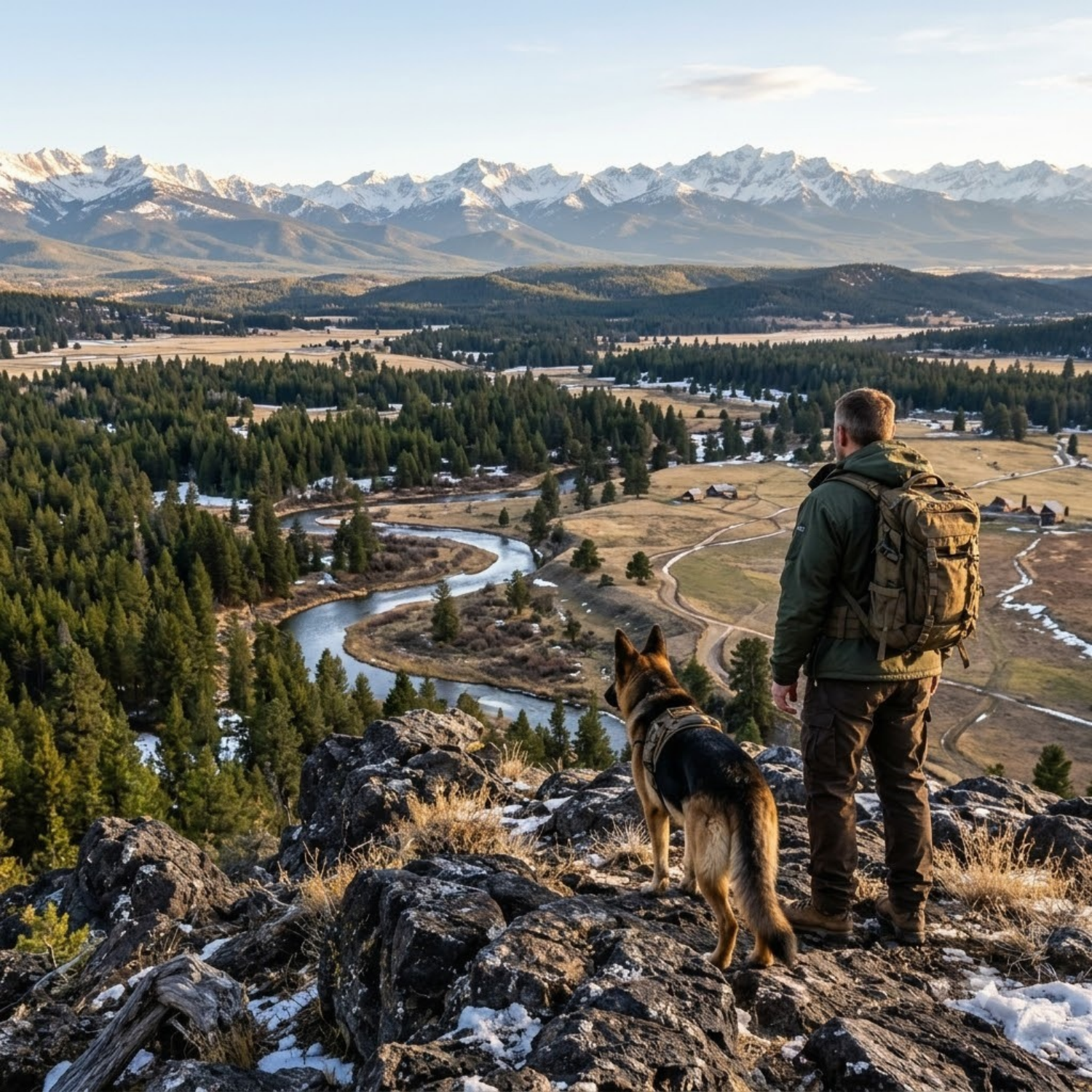
A Homeless Veteran and His German Shepherd Inherited a Ridge No One Wanted — 35 Feet In, They Found
The Office on West Broadway
At 11:20 a.m., the copier jammed again inside Howard and Kemp, Attorneys at Law. The sharp clicking sound echoed through the little reception office near West Broadway, followed by a burst of static from the old machine. Somebody in the back muttered a curse under their breath. The fluorescent lights overhead buzzed faintly like trapped insects.
Mason Reed stopped moving for half a second—not long enough for anyone else to notice, but Atlas noticed. The German Shepherd lifted his head from beneath Mason’s chair, amber eyes locking onto him instantly, one ear twitched forward, waiting. Mason’s hand had already tightened around the edge of the folder in front of him before he realized what he was doing.
Kandahar. Different sound, different year. Still close enough.
He loosened his grip slowly and rubbed his thumb against the scar near his wedding finger, though there hadn’t been a ring there in a very long time. Across the conference table, Travis Reed leaned back in his chair with the heavy confidence of a man who had spent his entire life standing on land that already belonged to him. At 53, Travis still had the thick shoulders of a rancher, his denim jacket smelling faintly of hay and diesel fuel. Beside him sat Cole Brier, Walter’s one-time land broker and a creditor on two family properties, dressed in a charcoal sport coat that probably cost more than Mason’s truck.
Cole crossed one polished boot over the other and checked his phone while Howard Kemp sorted papers near the window.
“Your father’s estate is to be distributed according to the final notarized amendment,” Howard said, adjusting his glasses. “Filed March 14th.”
Nobody spoke. Mason had pictured this meeting during the drive into town and had been wrong about every part of it. He had imagined a few signatures, an argument over equipment, then the clean relief of walking away. Instead, his father’s name sat on the folder in front of him, printed with the same unyielding capital letters Walter had used to label feed sacks and spare engine parts.
On the ranch, Walter had never found a comfortable way to say he was proud of anybody. He repaired a broken gate for you. He left a full tank in your truck. He asked whether you had eaten. Mason had spent years mistaking that language for indifference.
“The main Reed ranch property transfers to Travis Reed, including livestock rights and structures along Blue Mountain Road,” Howard read.
Travis nodded once. He had expected it.
Howard slid another folder across the table. “Cole Brier receives the commercial parcels adjacent to Reserve Street and the undeveloped acreage near Frenchtown in settlement of the outstanding land agreement.”
Cole smiled without showing teeth. “Appreciate it.”
Mason said nothing. Atlas rested his chin back on Mason’s boot, though the dog’s eyes stayed open. Howard hesitated before reaching for the final document. “And to Mason Reed…” The lawyer paused again. Something about it felt deliberate. “Your father left Parcel 18, commonly referred to as Dead Horse Ridge—30 acres in the foothills west of Lolo… together with whatever subsurface access rights the county records legally recognize. Those rights are subject to state water law.”
Atlas’s head came up immediately—not slowly, instantly. The dog stared toward Howard with sudden focus, ears rigid. It was the shift in Mason’s posture that had caught his attention, not any understanding of property rights.
Cole blinked once before a short laugh escaped him. “Jesus,” he muttered. “Thirty acres of wind and broken rock.”
Travis rubbed a hand across his jaw and looked toward Mason. “At least property taxes are cheap up there.”
Howard didn’t smile. He slid a paper across the table toward Mason instead. Past due amount: $4,217.83.
Mason looked at the number without reacting. The paper smelled faintly of toner ink and old cardboard. $4,000 might as well have been 40 million. Outside the window, a pickup rolled through slush near the courthouse intersection.
Cole leaned back farther in his chair. “I’m serious, though. That ridge is worthless. Nobody’s built up there since the 70s. Wind tears through that whole slope year-round.”
Mason finally looked up. “Maybe.” That was all Mason said.
Cole gave a little shrug. “Hell, if taxes get too ugly, I’ll buy it off you. Save you the headache.”
Atlas let out a low sound in his chest. Not a growl, exactly—a warning. Cole noticed it and lifted both hands slightly. “Easy there, Cujo.”
Mason placed one hand lightly against Atlas’s neck. The dog settled immediately. That got Travis’s attention more than the conversation had. “You still keeping him with you full-time?”
Mason nodded. “He sleeps better than I do.”
Nobody answered that. Howard shuffled another document quietly while the room settled into an awkward silence. Somewhere deeper in the office, the copier jammed again with another hard metallic snap. Mason’s shoulders tightened before he could stop them. He hated that. Hated how sound still reached him before logic did—a slammed tailgate, a dropped wrench, helicopter rotors overhead. The body remembered first; the mind caught up later.
When the meeting finally ended twenty minutes later, Howard handed Mason a small brass key attached to a faded red tag with no markings.
“Your father came here alone three weeks before he died,” Howard told him quietly, keeping his voice low. “He told me to give you this privately. He said, ‘You’d know where to use it.'”