A Homeless Veteran and His German Shepherd Inherited a Ridge No One Wanted — 35 Feet In, They Found
Road 614
By 1:18 p.m., Mason was heading south on Highway 93 with Atlas curled across the backseat of the Silverado. The truck heater barely worked unless the engine stayed above 50 mph, so cold air still leaked through the vents in thin streams that smelled faintly of rust and old antifreeze. The brass key sat in the cup holder beside a half-empty gas station coffee.
Traffic thinned past Reserve Street, giving way to long stretches of open Montana land washing gray beneath a low sky. Snow already dusted the higher ridges west of the valley. Winter was moving down early this year.
A text buzzed once on Mason’s cracked phone screen: Travis: You got enough gas money to get back.
Mason looked at it a while before locking the screen again. He didn’t answer.
The Silverado’s odometer rolled past 287,441 miles just outside Lolo. A faded sign for Travelers Rest State Park flashed by on the right, and then civilization started thinning fast. Mason turned west onto a narrow forest service access road marked with an old green sign half-covered in bullet holes: Road 614 – Seasonal Access.
Mud sucked softly at the truck tires as the road climbed higher into broken timberland. Snow lingered in shaded ditches where sunlight no longer reached. Atlas sat upright in the backseat, alert, his claws clicking against the rubber floor mat while he watched through the windshield.
“You smell something?” Mason asked.
The dog’s ears twitched once. Mason drove another two miles before the road narrowed enough that branches scraped both sides of the Silverado, leaving dry, whispering sounds against the glass. At 2:42 p.m., he finally saw it: Dead Horse Ridge.
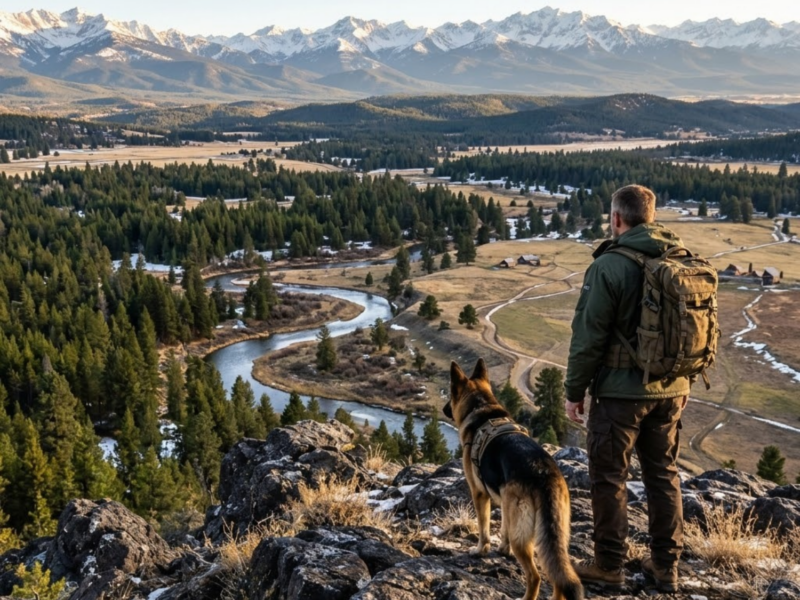
The place looked worse than he expected. Dark basalt shelves jutted from the mountainside like broken teeth. Wind bent the scattered lodgepole pines sideways along the ridgeline. There wasn’t a fence, a cabin, or even old utility poles—just black rock and open sky. Cole hadn’t lied about that part.
Mason parked beside the remains of an old fire road washed out by runoff years ago. The Silverado settled unevenly as one rear tire sank slightly into frozen mud. The engine ticked softly after he shut it off, followed by the true, heavy silence of the Montana wilderness.
Atlas jumped down first and immediately began circling the perimeter in widening loops, nose low, tail level and working. Mason grabbed his old canvas duffel from the truck bed and slung it over one shoulder. The movement pulled slightly at old scar tissue near his ribs—shrapnel reminders that ached every winter.
By 4:16 p.m., camp was standing, barely. A green tarp leaned low against a basalt wall with just enough room underneath for a folding cot, a carefully ventilated propane stove, and Mason’s gear. As daylight faded over the bitter valley, Mason heated a can of beef stew over the small stove, eating slowly from the dented metal can while Atlas kept watch.
Night settled fast after sunset. By 7:11 p.m., the temperature had dropped to 27 degrees. Frost coated the Silverado windows downhill. Mason rolled himself into an old military poncho liner on the cot while Atlas lay across the tarp entrance facing outward—always outward.
At 3:43 a.m., Mason woke instantly with his flashlight already in hand. No hesitation, no confusion. The tarps snapped violently overhead. Atlas was already standing, moving beyond the shelter entrance to stare uphill into a darkness thick enough to swallow a beam after twenty feet.
Beneath the wind came a low, hollow sound—almost like air moving through a pipe underground. Atlas began tracking, leading Mason nearly sixty yards east before stopping beside a cluster of fractured basalt near the ridgeline.
Mason crouched beside the rock formation and held one bare hand near a narrow crack between two basalt shelves. Warm air touched his skin—not hot, just noticeably warmer than the freezing mountain wind. Mason swept his flashlight beam into the sixteen-inch-wide opening. The rock inside disappeared downward instead of inward, deep and very deep. Down below, wedged between stone, something metallic caught the light.
And for the first time all day, Dead Horse Ridge no longer felt empty.