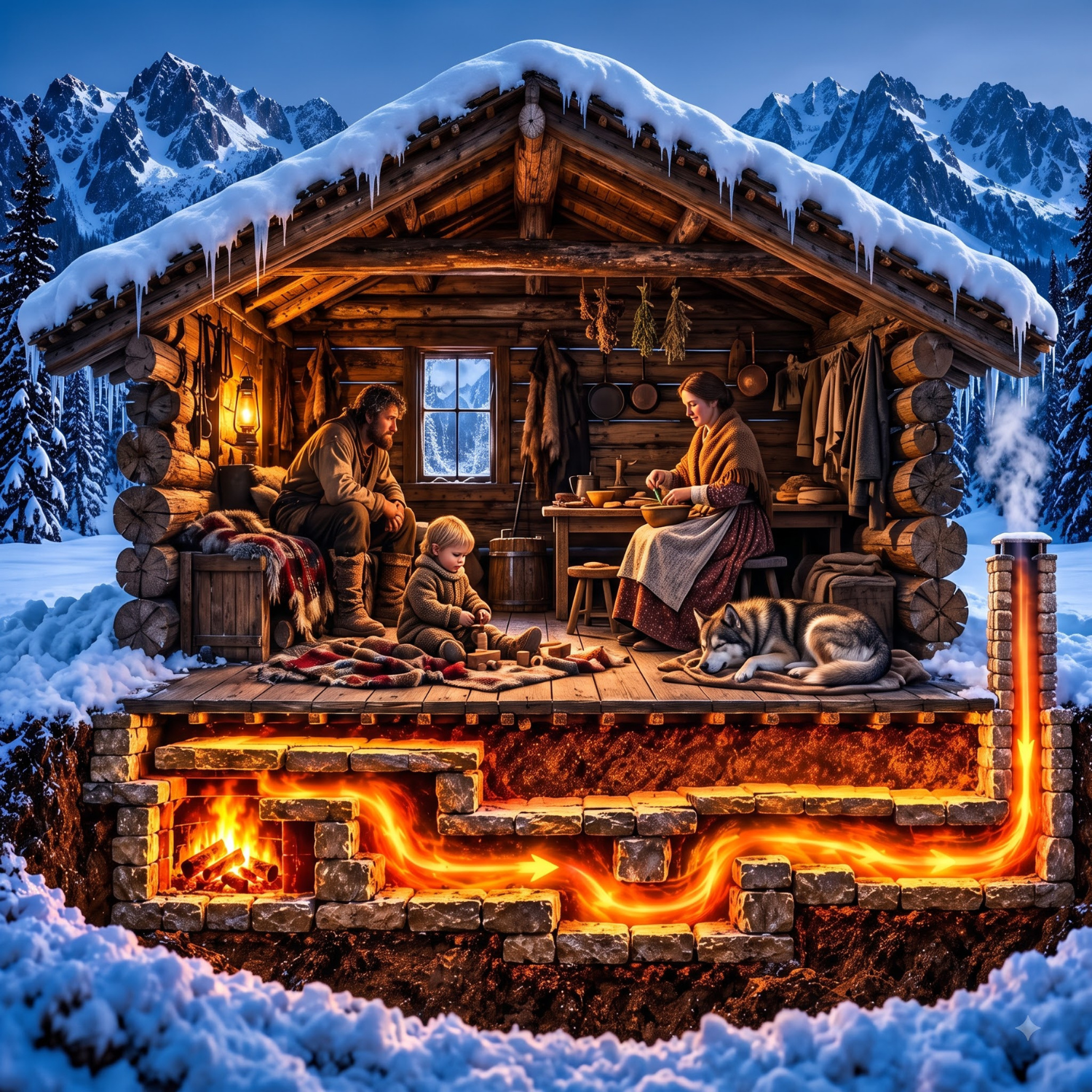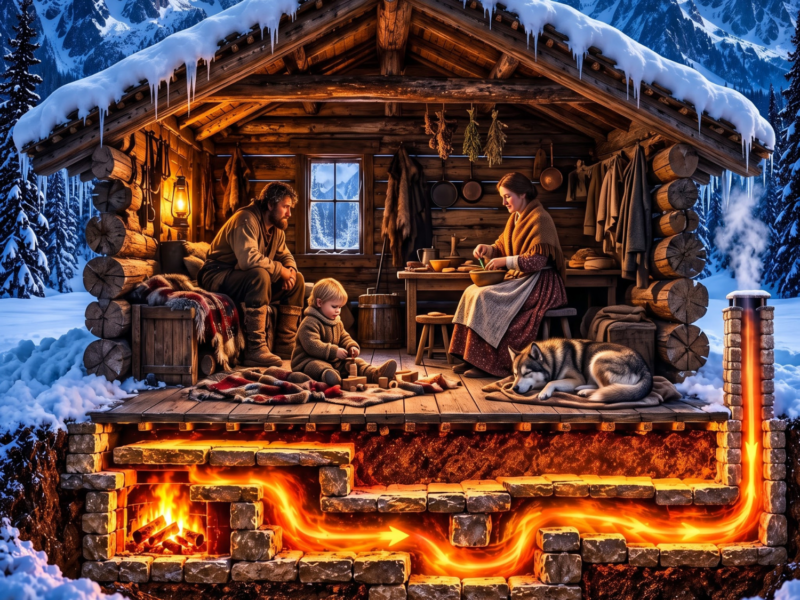
Did Mountain Men Really Build HIDDEN HEAT TUNNELS Under Their Cabins at -30°F With NO Electricity?
The Tyranny of the Hearth
Silas Vance was thirty-eight years old, which, in the mountains, made him an elder statesman of a violent profession. He had spent fifteen winters trapping beaver from the Yellowstone down to the Green River. His hands were a map of scars, and his joints predicted the snowfall with aching accuracy.
He was currently freezing to death inside a cabin he had built himself.
The structure sat in the throat of the Bitterroot Valley. It was a standard trapper’s winter hold: peeled pine logs, notched at the corners, the gaps stuffed with dried moss and river mud. At the far end roared a massive open fireplace built of river cobble.
Silas stood with his back to the flames. The canvas of his trousers was so hot it smelled of singed thread, scorching the backs of his thighs. Yet, his breath plumed white in front of his face, and the water in the tin cup resting on the table just six feet away held a solid crust of ice.
“Put another log on, Eli,” Silas grunted, pulling his buffalo robe tighter across his shoulders.
Eli, a twenty-year-old trapper from Ohio who was spending his first full winter in the high country, groaned from his cot. “I put three on not an hour ago, Silas. We’re burning through the pile.”
“Then we’ll freeze.”
Eli hauled himself up, grabbed a heavy split of seasoned pine, and tossed it into the hearth. A shower of orange sparks spiraled up the chimney.
Silas watched the smoke vanish into the black throat of the flue. A cabin, he had long ago realized, did not create heat. It only slowed heat from escaping. And an open fireplace was a cruel, inefficient master. It was brilliant at warming the specific patch of air immediately in front of it. It could cook a haunch of venison, thaw frozen boots, and make a miserable room feel briefly survivable.
But it had a fatal weakness. The heat was a temporary visitor.
Cold air bled in continuously through the microscopic fissures in the chinking, around the edges of the heavy door, and up through the hard-packed dirt floor. The hot gases from the fire rushed desperately up the chimney, taking eighty percent of the energy with them. Once the flames faded to embers, the comfort of the cabin vanished within the hour.
Silas did the grim winter arithmetic in his head. Every warm night required wood. Every single armload of wood had to be felled, bucked, hauled through waist-deep snow, split with freezing hands, and kept dry. Every hour spent playing nursemaid to the fire was an hour not spent repairing traps, stretching hides, hunting for meat, or resting a battered body. Wood was not just fuel. Wood was labor. Wood was time. And out here, time was life.
Silas looked down at the hearth. A large, flat river stone, which had fallen from the masonry the day before, lay partially out of the firebed. Silas nudged it with the toe of his boot. He reached down with a bare, calloused hand and pressed his palm against the stone.
The fire had died back from this particular rock hours ago, yet the stone was wonderfully, deeply hot. It radiated a slow, steady, heavy warmth.
Earth changes temperature more slowly than exposed air, Silas thought. A stone stays warm after the flame drops.
He didn’t know the word hypocaust, the system the ancient Romans used to heat their bathhouses through subterranean masonry pillars. He didn’t know the word ondol, the traditional Korean architecture that moved fire gases beneath a stone floor. He was just a mountain man staring at a hot rock.
But the seed of an idea, born of pure, freezing desperation, took root in the Bitterroot dirt.