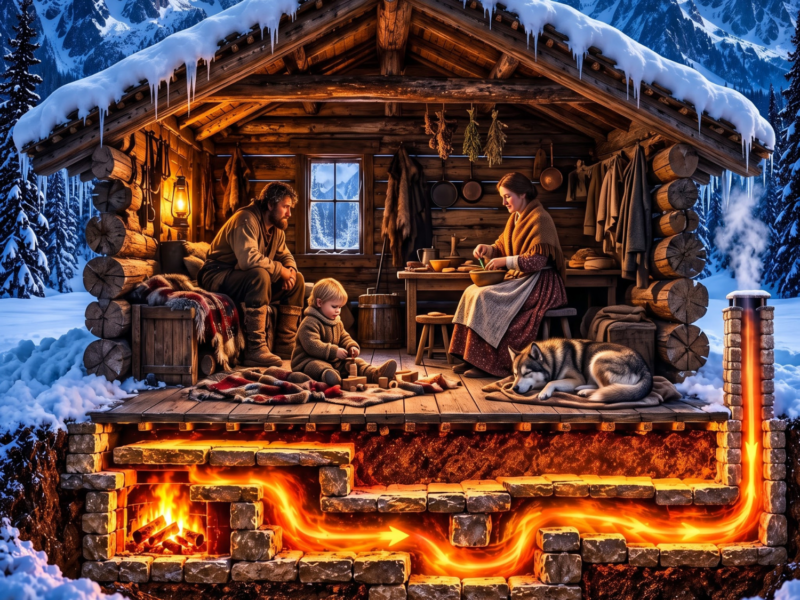
Did Mountain Men Really Build HIDDEN HEAT TUNNELS Under Their Cabins at -30°F With NO Electricity?
The Labor of Duration
For the next two months, the Bitterroot Valley was locked in an icy hell.
Storms rolled over the peaks in endless waves, burying the cabin to the roofline in snow. Trapping became impossible. Survival became the only occupation.
It was during these dark, brutal months that Silas learned the absolute truth of his underfloor heater, shedding the magic of the folklore for the gritty reality of frontier engineering.
The stone was not a magical battery. It could not produce heat; it could only store the energy Silas put into it. And the savings did not come from somehow creating extra energy out of nothing. The savings came from capturing the eighty percent of the heat that would have otherwise vanished uselessly up a vertical chimney.
But there was a catch, and it was a heavy one. If Silas wanted the floor to radiate heat for twelve hours, he first had to burn a very hot, very intense fire for three hours to charge the mass.
“It still takes wood, Silas,” Eli noted one afternoon as they hauled a felled pine back to the cabin.
“Yes,” Silas agreed, his breath pluming. “But we burn it fast, hot, and efficiently. We don’t have to keep a fire nursing twenty-four hours a day. We fire it once in the morning, once at night. The rest of the time, the stones do the work.”
There was also the maintenance. The hidden tunnel was a fragile machine. Soot accumulated quickly in the horizontal run, threatening to choke the draft. Every two weeks, Silas had to pry up a floorboard, open a clay seal, and drag a bundle of pine boughs tied to a long pole through the trench to sweep the chimney. The clay joints cracked under the stress of repeated heating and cooling, requiring constant patching.
If they had been mobile trappers, expecting to abandon the cabin come spring, the massive investment of labor to build and maintain the flue would have been utterly foolish. But they were trapped by the deep snow, living in a permanent winter station. The economics of their survival had changed. The labor of maintenance was worth the benefit of waking up to a warm floor.









