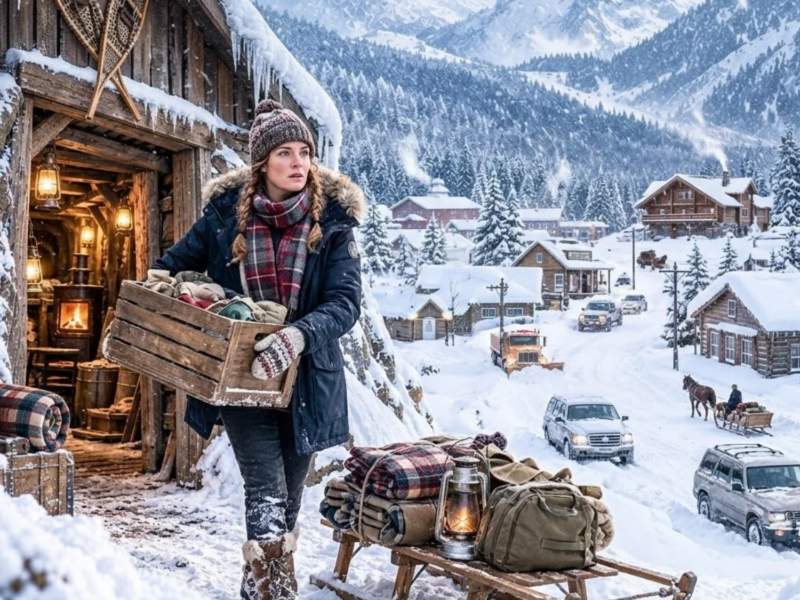
Thrown Out in November, She Moved Into a $40 Mine Tunnel — Then a 9-Day Blizzard Shut the Whole Town
Carving Out the Dark
The tunnel mouth sat a quarter-mile up the east cut of Beavenon Ridge—a black, forbidding arch of shot-rock framed by the company’s old timbering, gray as driftwood and hard as seasoned iron.
The first time Pam walked back into the dark with Orin Toiver’s heavy electric flashlight, her breath plumed up in thick clouds for the first forty feet. Then, just past where the passage bent sharply and the gray daylight gave way to absolute night, the air abruptly changed: it stilled, softened, and warmed.
It wasn’t warm like a kitchen; it was warm like a deep earthen cellar—the interior of a root. The mountain was holding its one steady thermal note while the world outside ran wild through seasonal scales.
Fifty-one degrees, read the mercury thermometer she promptly hung on a rusted iron spike driven into the rock wall. Orin had been off by one degree, entirely in her favor.
The immediate problem, however, started right at the mouth. A cave entrance facing northeast in the mountains of Montana acted as a natural vacuum throat for the winter winds to play through. The very first night she slept there—wrapped in a thin mattress, three scratchy wool blankets, and her heavy winter coat—the draft swept down the passage like an invisible predator. By morning, the water in her drinking jug had skinned over with a thick sheet of ice forty feet back from where she lay.
The entrance door, therefore, became her entire world.
She framed a bulkhead two feet inside the old rotting timbers where the rock pinched narrow, using rough pallet planks scavenged from behind the feed store. She carried them up the steep incline two at a time balanced on her shoulder—each grueling round trip taking forty minutes up and twenty minutes sliding down.
She quickly learned the sound of her own splitting maul that month: the sharp, pistol-crack of lodgepole pine letting go along its grain, bouncing off the sheer rock face and returning to her doubled, as if a second woman were hidden deep inside the mountain, matching her swing for swing.
She hung the oak planks double-thick on heavy iron strap hinges, stuffed the perimeter gaps with dense straw, and stretched a weathered canvas tarp over the entire face, lashing it tightly through brass grommets bolted directly into the stone. Her knuckles split repeatedly in the sub-zero air, freezing and bleeding, freezing and bleeding. At night, she rubbed thick lard into the open cracks of her fingers, biting down on a leather strap while they burned in the dark.
The woodstove nearly broke her body and her will. It was a fifty-gallon steel drum kit with cast-iron fittings bought from the hardware store down in Chateau, along with six joints of stovepipe.
The operational plan, designed by Orin, was deceptively simple: run the pipe straight up through a natural vertical rock seam above the entry. A crooked, pre-existing chimney the mountain had carved out eons ago, allowing the smoke to wind its way out so the heavy oak door could remain tightly sealed against the gales.
On her first firing, the rock seam breathed backward.
Thick, acrid smoke rolled down in a dense wave, filling the tunnel entry like dirty water pouring into a glass. Pam crawled out under the canvas tarp on her hands and knees, her eyes streaming tears, and collapsed into the frozen cheat grass, coughing violently until she wretched.
She sat out in the dead grass for a long time that evening, shivering as the lights of Dunore Creek flickered far below—warm, electric, and agonizingly easy. The rich smell of woodsmoke drifted up from proper chimneys on proper houses. Somewhere down there, Royce Tabour was flipping the diner sign and dropping her name for cheap laughs.
“Mole woman.”
Her hands would not stop shaking, and it wasn’t entirely due to the mountain cold. A terrifying thought whispered through her mind: Room 114 at the Pinewood Motor Lodge is still open. I could be warm by nine o’clock. All I have to do is crawl back and let them be right.
She spent that night shivering in the cab of the parked truck, too proud to drive down, too exhausted to crawl back inside.
In the morning, old Orin hiked up because Thursday was laundry day and she hadn’t appeared at the laundromat. Finding her gray-faced and hollow-eyed, he offered the oldest piece of wisdom known to underground men:
“Cold air sits in a hole like water, girl. You don’t fight a downdraft. You prime it. Burn a torch of dry newspaper up in the rock seam itself. Warm the rock throat first. Teach the air which way is out. Then light your stove.”
It worked.
God help her, it worked like a sacred hymn. The steel barrel ticked and pinged as the metal found its heat. The stovepipe drew with a low, steady sigh, and the flickering orange light dancing through the damper holes painted abstract shapes against the ancient rock walls—shapes that looked suspiciously like something waiting sixty years for a reason to dance.
She sat on an upturned bucket with her boots steaming, laughed out loud entirely alone, and heard the tunnel throw that laugh right back to her.









