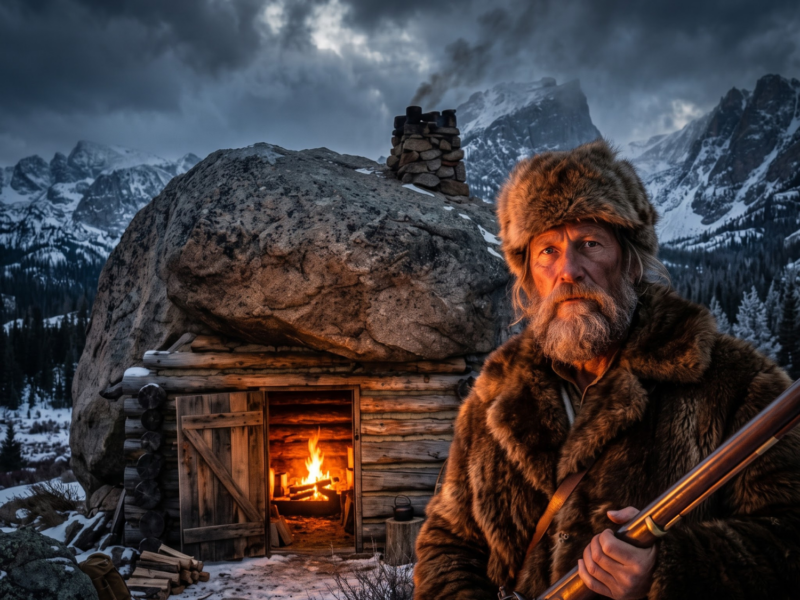
He Built a Cabin Inside a Giant Rock — It Stayed Warm While −50°F Froze Everything Outside
The Heart of Stone
Visitors occasionally stopped by as the summer heat baked the prairie. Most came to mock; a few offered genuine, pitying concern. But one man saw the truth.
Samuel Frost was a grizzled relic of the fur trade, a man who had spent twenty years trapping in the frozen wilderness of the Northern Territories. He walked around Lars’s three-foot-thick wall, running his gnarled fingers over the clay chinking.
“I’ve seen something like this before,” Frost murmured, his eyes scanning the structure with intense professional respect. “A French voyageur up in the Saskatchewan country. Dug right into a hillside and used the earth itself for a blanket. Warmest shelter I ever slept in. Folks called him a badger, just like they’re calling you.”
Lars felt a rare surge of warmth. “The earth, the rock… they store heat,” Lars explained. “In deep winter, even when the air is deadly cold, the rock temperature stays above freezing. It is a battery.”
Frost nodded slowly. “Most folks think a fire makes warmth, and that’s the end of it. They don’t understand mass. But you’re going to need a hell of a stove to warm all this stone.”
“Not a stove,” Lars corrected softly. “A heater.”
Deep inside the cave, where the natural dome sloped lower to trap rising air, Lars built his masonry heater. It was a design perfected in the brutal winters of Scandinavia. Instead of a standard open fireplace that sucked freezing air into the room and sent ninety percent of its heat uselessly up a chimney, Lars built a massive, multi-ton structure of creek stone and hand-fired clay bricks.
The firebox was small, designed to burn intensely hot and fast. The genius lay above the firebox: a labyrinth of internal channels that zigzagged through the massive stone body. The hot smoke was forced to travel through this maze, surrendering its heat to the stone before finally venting out of a natural crack in the cave ceiling that Lars had spent weeks carefully enlarging.
When he finally lit the first test fire, feeding dry pine into the small iron door, the magic began. Within an hour, the tons of masonry were warm to the touch. Six hours after the fire had completely burned out, the stone was still radiating a deep, gentle, ambient heat into the cavern.
By September, Lars had built a raised sleeping platform to avoid low-settling cold air, carved a root cellar deep in the back for stable year-round storage, and installed oil lamps that cast a golden, flickering glow against the curved granite. It had taken him four and a half months. A normal cabin took three weeks.
In mid-October, Thornton led a final “friendly visit” of seven settlers to inspect the finished work. They looked at the massive wall, the odd stone monolith inside, and Lars’s relatively small woodpile.
“That’s not enough wood, Lars,” Thornton stated flatly. “A man needs five cords minimum. You’ve got maybe two. You’ll be cutting timber in December, frozen half to death.”
“I will need less,” Lars replied. “The rock holds the heat.”
The men shook their heads and rode off to their drafty timber boxes, leaving the Swede to what they assumed was his icy fate.









