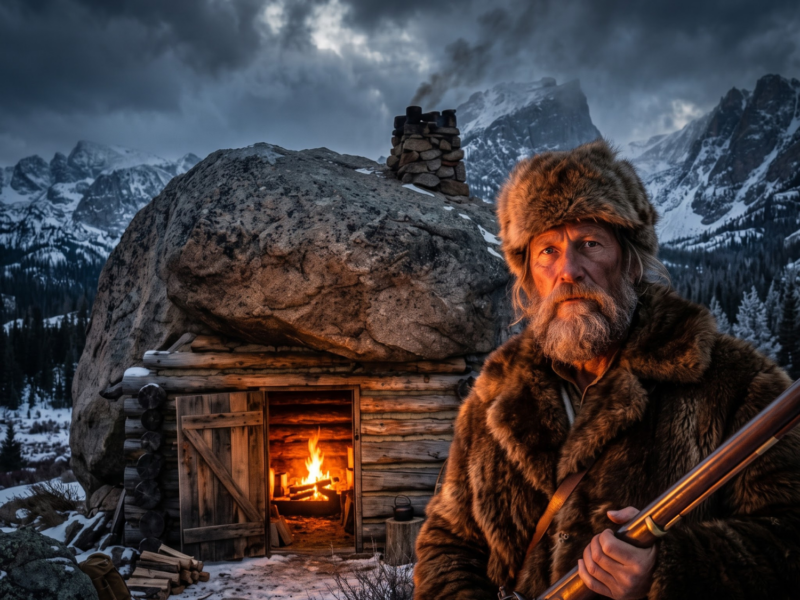
He Built a Cabin Inside a Giant Rock — It Stayed Warm While −50°F Froze Everything Outside
The White Death
The snow began in November—light at first, then heavy, wet, and relentless. By December, the temperature plunged into the abyss. Minus thirty. Minus forty.
The wind screamed down from the jagged peaks, driving snow horizontally across the prairie in blinding white sheets. It was a cold that snapped tree branches, froze water buckets solid in minutes, and killed livestock standing in the fields. The flimsy log cabins of the valley were besieged. The freezing wind found every hastily chinked gap, pouring icy air into the settlers’ homes. Men like Thornton burned massive logs day and night, watching their precious woodpiles vanish into ash just to keep the water in their cups from freezing indoors.
Inside Standing Stone, Lars Hendrickson walked barefoot across his smooth stone floor.
He wore only a light wool shirt. The temperature outside was forty-two degrees below zero. Inside, without a fire currently burning, it was a steady, comfortable forty-eight degrees.
When he lit a small fire in the masonry heater, burning perhaps five logs over two hours, the cavern warmed to seventy degrees. And it stayed there. For fifteen hours, the massive stone heater—and the millions of tons of granite surrounding him—slowly released the captured thermal energy back into the room. He was living inside the belly of a giant, sleeping beast that breathed warmth.
Outside, the wind howled, but through three feet of insulated wall and two hundred feet of solid granite, it sounded like nothing more than the distant rustle of dry leaves.
On December 23rd, the true test arrived. A storm trappers called the “White Death” descended upon the valley. The mercury plummeted to minus forty-five. Fifty-mile-per-hour winds created blizzard conditions so severe a man couldn’t see his own outstretched hand.
Three miles south, Jacob Thornton’s cabin was failing. The wind tore away the dried mud chinking. Despite a roaring fire that threatened to burn the cabin down, the interior temperature hovered below freezing. Thornton, his wife, and their two small children huddled beneath every blanket they owned, their backs to the frost-covered walls, pressed dangerously close to the hearth. By dawn, Mrs. Thornton’s fingers were pale and rigid with the onset of frostbite, and the youngest child’s breathing rattled with a deep, sickly cough.
Thornton looked at his vanishing woodpile, looked at his freezing family, and swallowed his pride. He hitched his strongest horse to a sled, wrapped his family in furs, and drove them into the blinding white maelstrom.
The three-mile journey was a descent into hell. By the time Thornton’s sled reached the leeward side of Standing Stone, the horse was failing and Thornton’s face was caked in ice. He pounded on the heavy, moss-insulated door with numb fists.
The door swung open.
Lars didn’t ask questions. He pulled the family inside, dragging the heavy door shut against the screaming wind, sealing the cavern with a heavy thud.
Thornton stood frozen in the entryway. He blinked against the warm, golden light of the oil lamps. He took a breath. The air didn’t burn his lungs. It was… hot. It was deeply, impossibly warm.
Mrs. Thornton collapsed to her knees on the stone floor, weeping uncontrollably as the heat began to thaw her frozen extremities. The children scrambled instantly toward the massive, radiating stone of the masonry heater, pressing their small, blue hands against the warm clay bricks.
Lars quietly boiled water on the small cookstove near the window, preparing hot tea and wrapping Mrs. Thornton’s hands in warm woolen cloths.
Thornton stood by the door, staring at the Swede, staring at the walls of solid rock that he had mocked for a solid summer.
“How?” Thornton’s voice cracked, raw from the wind and emotion. “How is it so warm in here? You barely have a fire going.”
“Thermal mass,” Lars said softly, handing Thornton a steaming mug of tea. “The rock is a battery. It stores the heat. It fights the winter for us.”
Thornton gripped the warm mug, tears cutting clean lines through the dirt and frost on his cheeks. “I called you a fool, Lars. I told everyone you were a fool.” He looked at his shivering, surviving children. “I’m the fool. I didn’t understand.”
“Most people learn from experience,” Lars said, clapping a heavy hand on Thornton’s shoulder. “Sit by the stone. Get warm.”









