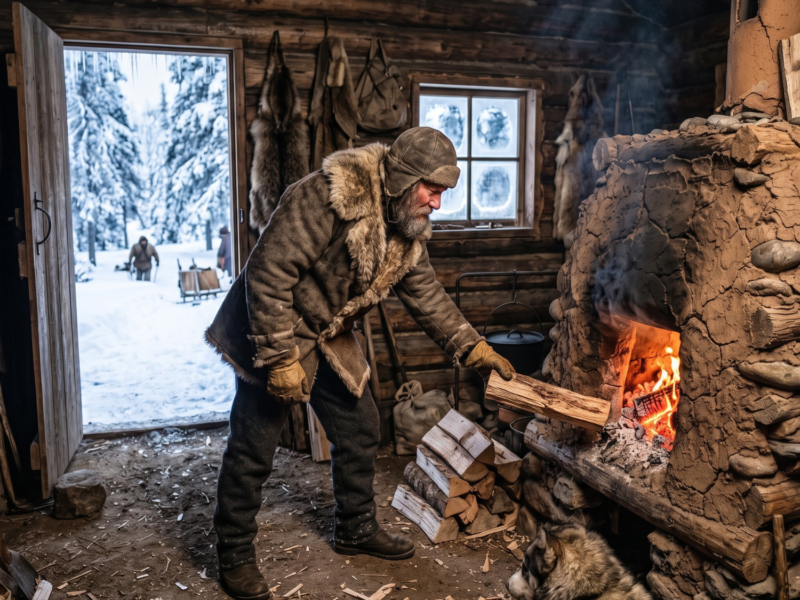
He Built a Mud Furnace From Scratch — One Log Reached 800°F While Others Froze
THE EIGHT-TON HEART
By late July, the exterior shell was complete. It looked bizarre—squatting on its high stone platform, flanked by a massive, windowed stone facade on the south and impossibly thick, bulging earth-and-grass ramparts on the other three sides.
The roof design added a final layer of strangeness. Eschewing the steep gables common in Nebraska—which helped shed heavy snow—Heinrich constructed a shallow-pitched roof designed to carry immense structural mass.
Heavy oak beams spanned the eighteen-foot width, overlaid with thick pine planks. Upon those planks, he spread six inches of dense clay mixed with sand and straw, and topped the entire assembly with thick sod blocks, grass-side up, creating a living prairie roof weighing several tons.
This massive roof provided superior overhead insulation, acting as an acoustic and thermal blanket. But the true heart of Heinrich’s thermal architecture was hidden inside the cabin: six tons of solid stone.
Heinrich had engineered the south-facing stone wall to extend continuously into the cabin’s interior. It didn’t stop at the indoor surface; it projected inward, creating a three-foot-thick interior masonry mass right in the middle of the living space. Furthermore, instead of wood or packed dirt, he laid a floor of flat, mortared stones smoothed to a fine finish.
This interior stone mass was a thermal battery.
During sunny winter days, sunlight streamed through the south windows and struck the unpainted stone wall and stone floor. The dark stone absorbed the radiant solar energy, heating up steadily over the course of the day. Once the sun set and the ambient air began to cool, that heated stone slowly released its stored thermal energy back into the living quarters.
Stone possesses massive thermal mass; it requires significant energy to heat, but once charged, it bleeds that heat back out sluggishly over many hours. Heinrich calculated that his eight tons of combined stone and floor, heated to ninety degrees by the winter sun, would continuously radiate warmth for twelve to sixteen hours into the night.
By August, the cabin was finished. The Zimmerman family moved in, and the township settled back to watch reality deliver its inevitable, freezing lesson.









