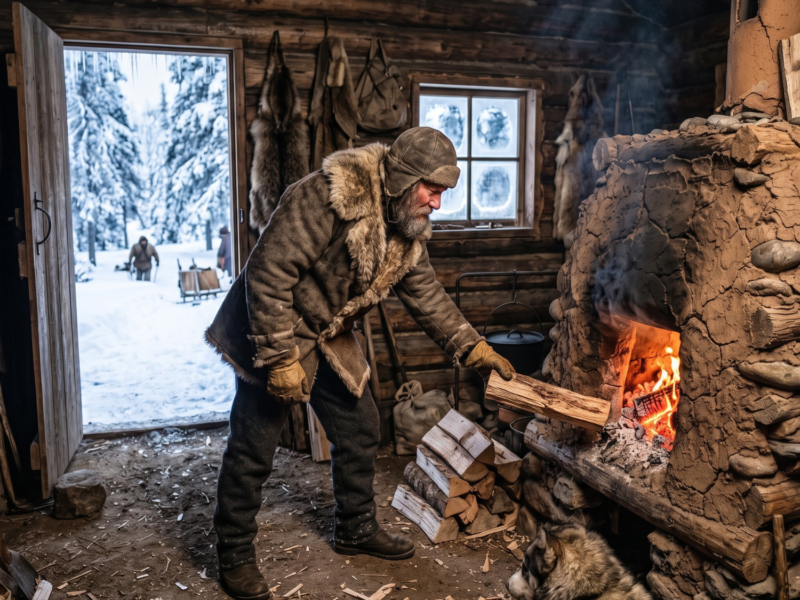
He Built a Mud Furnace From Scratch — One Log Reached 800°F While Others Froze
THE VINDICATION OF THE PLAINS
The realization slowly dawned on the gathered farmers. If Heinrich’s design worked—and the thermometer resting on the table proved indisputably that it did—then the entire foundational logic of frontier survival was flawed.
The endless, back-breaking labor of felling, hauling, and splitting firewood; the terrifying anxiety of running out of fuel in mid-winter; the constant, suffocating tending of hearths—all of it could be rendered obsolete through better architecture.
Within weeks, the story spread like wildfire across Nebraska. Delegations of farmers came from fifty miles around to touch the warm stone walls, inspect the triple-glazed windows, and verify the indoor climate.
While a few stubborn skeptics dismissed it as a temporary fluke or accused Heinrich of burning secret coal in the dead of night, the results spoke for themselves. Through January, February, and March, Heinrich lit his backup fireplace exactly five times during prolonged, multi-day blizzards when the stone battery finally exhausted its charge. Each time, a two-hour fire was all it took to restore equilibrium.
By Heinrich’s final accounting, he had consumed roughly one-tenth of the firewood burned by his closest neighbors.
When spring finally thawed the plains, a delegation of local farmers arrived at Heinrich’s doorstep not to mock him, but to beg for instruction. Heinrich spent days drafting measurements, explaining thermal mass, demonstrating how to pack the grass frames, and showing them how to orient a building to capture the winter sun.
Several families built improved variations of the design that very summer. While some cut corners—building thinner stone walls or smaller grass cavities—even their partial implementations yielded dramatic improvements in comfort and fuel economy.
One meticulous settler, a former schoolteacher named Daniel Cooper, replicated Heinrich’s design down to the last detail. In the winter of 1877–1878, Cooper’s cabin performed with identical brilliance, proving that Heinrich’s creation was no fluke of nature, but a reproducible scientific truth.
EPILOGUE: THE KNOWLEDGE THAT SURVIVED
In 1879, formal recognition arrived when Robert Fletcher, an engineer dispatched by the Department of Agriculture, spent three days meticulously measuring temperatures, airflow dynamics, and solar radiation inside Heinrich’s homestead.
Fletcher’s glowing report, published in 1880, validated the stonemason’s intuitive genius in formal engineering terms, detailing the exact mechanics of thermal mass, super-insulation, and passive solar gain.
Prompted by the growing interest, Heinrich sat by his lamp during the long winter evenings of 1880 and authored a comprehensive, twenty-page manual detailing his construction techniques, complete with precise dimensional drawings and instructions on solar orientation, air-lock entries, and grass harvesting. He distributed hand-copied pamphlets for free to anyone who asked.
Heinrich Zimmerman lived in his grass-walled sanctuary for thirty-two years, raising his children and watching them build lives of their own. He passed away peacefully in 1908 at the age of seventy-three.
His son Wilhelm inherited the homestead, living in it for another fifteen years before modernizing. Eventually, as newer building materials and cheap fossil fuels flooded the mid-twentieth century, the old grass house was abandoned. By 1942, the roof had collapsed, the stone was salvaged for other foundations, and the grass walls dissolved back into the rich Nebraska prairie soil, leaving almost no physical trace behind.
Yet, the core principles never died.
Decades later, when the energy crisis of the 1970s forced architects to reinvent passive solar architecture, modern engineers independently rediscovered the exact thermodynamic equations Heinrich had carved out with a stonemason’s intuition on the raw frontier. The Trombe wall—a standard modern passive solar heating element consisting of a glass layer placed in front of a high-mass masonry wall—is, in structural essence, a direct descendant of Heinrich’s south-facing stone hearth.
The world laughed at the grass house when it first rose against the skyline. They called it a fool’s palace. But when the blizzards screamed across the plains and the thermometer inside held firm at seventy-two degrees without a single stick of wood burning in the hearth, the laughter died away forever.
Heinrich Zimmerman proved a timeless truth: comfort does not require complexity, efficiency does not demand expensive technology, and sometimes the person everyone calls a fool is simply the only one who has bothered to think things through.









