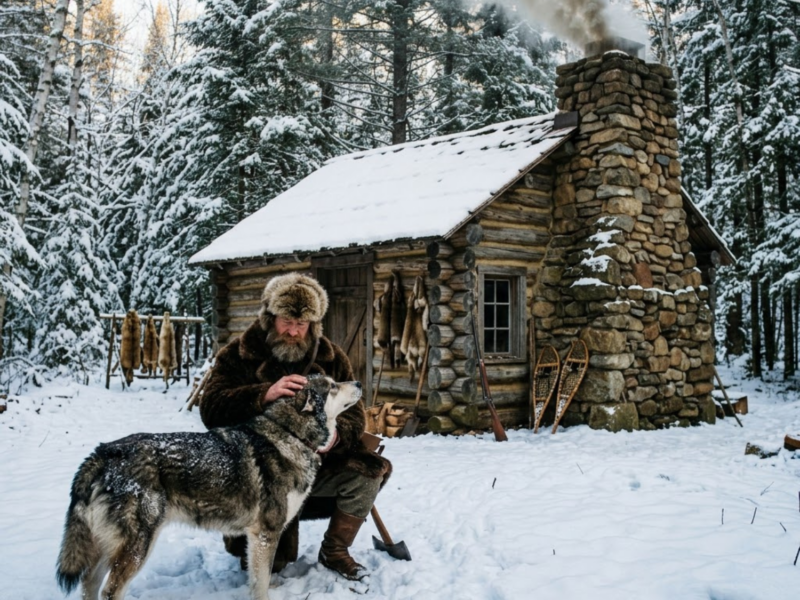
He Built an “Ugly” Chimney Everyone Mocked — His Cabin Heated Twice as Fast
The Architecture of the Earth
The labor that followed was monumental. It was a quiet, methodical crusade undertaken alone in the fading light of the rapidly shortening days.
Ara began by clearing the decades of debris. She hauled bucket after heavy wooden bucket of loose earth, collapsed clay, and rotted, fungal wood up a makeshift wooden ladder she built from scrap lumber. Her hands grew heavily calloused, her knuckles bruised and battered against the rock, but she worked with a relentless, rhythmic determination that left her completely exhausted by nightfall.
Once the massive space was finally cleared to its original dirt floor, she faced the terrifying challenge of stabilization.
She knew that simply leaving the bare dirt walls exposed would invite a catastrophic collapse, especially as the moisture in the upper layers of the soil froze and violently expanded during the winter. She needed retaining walls that could bear the weight of the earth and absorb heat.
She turned to the abundant, heavy fieldstone that littered the edges of her property—stones that had been cursed by generations of farmers trying to plow the land and breaking their blades. For Ara, these nuisance stones were the crucial, foundational component of her entire design.
Fieldstone possesses incredible thermal mass. It is remarkably dense, heavy, and physically capable of absorbing, storing, and very slowly releasing large amounts of heat.
She spent three agonizing weeks hauling these heavy stones, one by one, using a heavy leather sling and a block-and-tackle system of pulleys she meticulously rigged to the barn’s heavy roof rafters.
She began at the very bottom of the cellar, carefully laying the heavy stones in a traditional dry-stack method. She interlocked their irregular shapes with meticulous precision, trusting gravity and friction over cement. She deliberately did not use mortar, knowing intuitively that the slight, natural flexibility of a dry-stacked wall would allow it to shift and settle safely with the subtle, microscopic freezing movements of the earth without cracking catastrophically.
As she built the stone walls upward, sweating in the cool earth, Ara implemented a critical, deeply misunderstood physical principle: the cold sink.
She did not build the entrance as a simple, flat door at the top of the stairs, which would allow cold air to pour directly into the room. Instead, she excavated a deeper, secondary trench leading down to the cellar floor, creating a pronounced, U-shaped vestibule at the bottom of the stairs before the main doorway.
The physics behind this design were elegant and absolute. Cold air is significantly denser and heavier than warm air. It behaves much like water, flowing downward and pooling relentlessly in the lowest available spaces.
By creating a deep trench before the actual entrance to the living space, Ara ensured that any freezing air that entered through the upper barn doors and fell down the stairs would cascade into the vestibule and pool harmlessly at the bottom of the “U,” rather than flowing over the threshold into the main chamber. The warm air within the cellar, being lighter and more buoyant, would remain trapped securely in the upper portion of the room, completely undisturbed by the freezing currents pooling below its feet.
Next, she engineered a passive ventilation system. Recognizing that a perfectly sealed underground room would quickly become damp, stagnant, and deadly with carbon dioxide, she needed the room to breathe.
She drove two heavy iron pipes horizontally through the earth to the surface outside the barn walls. One pipe was angled to extend all the way down to the floor of the cellar; this was designed to draw in heavy, fresh outside air. The other pipe terminated near the highest point of the cellar ceiling, serving as an exhaust for the lighter, stale air and human moisture.
She capped the exterior of the upper exhaust pipe with a rotating, wind-driven metal cowl she bartered for in town. The wind spinning the cowl created a slight negative pressure in the pipe, gently and continuously pulling stale air up and out of the space without creating the violent, heat-stealing floor drafts caused by a roaring iron stove. The earth would temper the incoming air before it ever reached her.
While Ara toiled in the quiet, dusty shadows of her barn, the community of Blackwood observed her strange actions with a mixture of confusion, amusement, and eventually, highly vocal skepticism.









