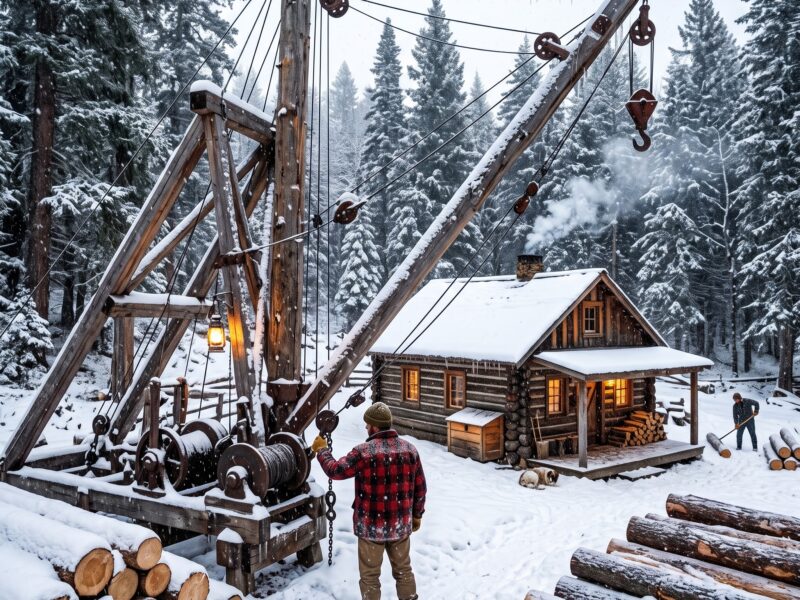
He Built His Cabin Beneath an Abandoned Timber Crane—The Blizzard Buried Everything but His Roof
CHAPTER TWO
The memories always returned when the earth smelled damp.
As Arthur leveled the deep bed of gravel inside the crane’s footprint, his mind slipped back to the Argonne Forest in 1918. He felt the terrifying, claustrophobic weight of the mud. He remembered the timber bunker his engineering squad had hastily built under artillery fire. He remembered telling his commanding officer that the roof beams were improperly spaced for the saturated soil load. He remembered being ordered to ignore it.
He remembered the sound of the wood tearing at midnight, the suffocating crush of wet earth, and the silence that followed.
Arthur shook the ghost away, driving his rake into the gravel. He would never again sleep under a roof fighting a losing war against gravity.
The Cascades didn’t get dry, fluffy snow. They got “Cascade Concrete”—heavy, wet, cement-like snow that fell by the foot and gained mass with every passing hour. Last winter, the ridge beam of their traditional cabin had bowed so violently under four feet of snow that Arthur had spent three desperate days rigging support posts inside, turning their living room into a claustrophobic forest of bracing timbers.
He had burned six cords of wood trying to keep the ambient temperature above forty degrees, watching his daughters sleep in their heavy coats.
Never again.
He wasn’t going to fight a superior force head-on. He was going to get out of its way.
By late October, the $75 government-surplus Quonset hut was fully assembled. It looked like a silver metal tube nestled neatly between the giant legs of the crane. But Arthur wasn’t finished. He built a second, shallow-pitched roof directly above the Quonset hut, connecting it to the inner legs of the crane structure itself.
Mary brought him a tin cup of hot coffee as he fastened the final cedar shake to the weather roof.
“I don’t understand, Artie,” she said, looking up at the bizarre three-foot gap between the curved metal hut and the shallow wooden roof above it. “Why build a second roof if the crane is supposed to catch the snow?”
Arthur climbed down the ladder, wiping grease from his hands. “The crane catches the weight. The weather roof catches the runoff. But that gap in between… that’s the secret.”
He took a stick and drew a diagram in the dirt.
“Still air insulates,” Arthur explained, his voice low and steady. “A snowdrift on top of the crane is mostly trapped air. The air between the crane and our weather roof will stabilize. It’ll be a cold, still pocket of air. Because there’s a gap, the heat from our stove won’t warm the snow on the crane. No heat transfer means the snow won’t melt from the bottom and refreeze into ice dams. No ice dams mean no leaks. It’s a buffer zone.”
Mary looked at the drawing, then at the rusty monstrosity towering over their new home. “And the wind?”
“The crane directs the load down into the footings. The Quonset hut just deflects the wind over its curve. We aren’t fighting the winter, Mary. We’re hiding under it.”
A crunch of wagon wheels on the gravel interrupted them.
It was Mary’s brother, Thomas, driving up from town. Thomas was a successful merchant, wearing a pressed suit entirely unsuited for the mountain mud. He tied off his horse and marched toward them, his face flushed with embarrassment and anger.
“Mary, pack the girls’ things,” Thomas said, not even looking at Arthur. “You’re coming to stay with me in town.”
“Thomas, what are you talking about?” Mary frowned.
“I’m talking about the fact that half the county thinks your husband has lost his mind,” Thomas spat, finally turning his glare on Arthur. “At the general store, Gus the logger is calling this place the ‘Tin Can Tomb.’ They think you’re too poor to buy real lumber, or too stubborn to admit you failed. It’s an embarrassment, Arthur. You’re scaring your wife and endangering your children.”
Arthur’s jaw tightened. In a world where a man was judged entirely by the shelter he provided, Thomas had just struck the deepest possible nerve.
“I’m not trying to impress anyone, Thomas,” Arthur said softly. “I’m trying to keep them warm.”
“Under a rust bucket?” Thomas scoffed. “If you don’t send her back with me, Arthur, I’ll petition the sheriff to remove the girls as a ward of the state. This structure isn’t safe.”
Arthur stepped forward. He didn’t raise his hands, but his presence was suddenly immense, the quiet, lethal stillness of a soldier. “You take one step toward my daughters, Thomas, and you’ll find out exactly what I’m capable of building.”
Thomas paled, backing away. He climbed into his wagon. “When that thing collapses, Arthur, don’t come begging to me to dig you out.”
As Thomas rode away, Arthur walked over to the northern support leg of the crane. He knelt in the mud. The hacksaw cut he had discovered weeks ago was deeper now. Someone had returned in the night.
Arthur ran his thumb over the freshly sheared metal. Silas Croft might have thought the crane was a death trap, but someone else in the valley was actively trying to make sure of it.









