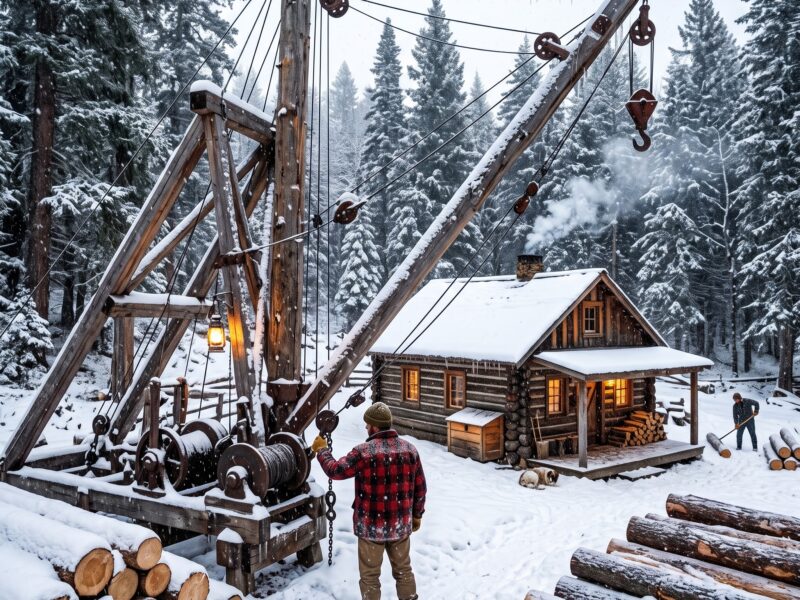
He Built His Cabin Beneath an Abandoned Timber Crane—The Blizzard Buried Everything but His Roof
CHAPTER SEVEN
The siege finally broke in mid-January.
When the winds died and the sun emerged, the valley was devastated. But the stories that trickled out of the snowdrifts were miraculous.
Word spread fast. By March, half the county knew that the crazy man in the tin can hadn’t just survived the blizzard—he had completely conquered it.
Mr. Albright, the man from the county land office, returned in April. He wasn’t there to issue a citation. He brought a calibrated thermometer and a surveyor’s notebook. He spent two days with Arthur, meticulously measuring temperatures, documenting fuel consumption, and taking detailed notes on the air-gap construction.
But the true vindication came at the spring town hall meeting.
The room was packed with exhausted, traumatized ranchers and loggers trying to figure out how to rebuild their crushed roofs.
Silas Croft walked to the front of the room. He didn’t boast about his lumber. He didn’t offer his usual arrogant advice.
He pointed directly to Arthur Vance, who sat quietly in the back row with Mary.
“We’ve been doing this wrong for a hundred years,” Silas told the silent room, his voice carrying the heavy weight of a humbled man. “We’ve been fighting the snow. Arthur stepped out of its way. If you have a brain in your head, you won’t buy my roof beams this summer. You’ll ask Arthur how to build a canopy.”
The adoption began that summer.
The first convert was the Peterson family, who had lost their entire second floor to the snow load. Arthur didn’t lecture; he walked their property. He showed them how to build a massive, independent post-and-beam framework over their existing cabin—a separate, load-bearing superstructure with a vented air gap.
It looked like the skeleton of a barn built right over their house. It was ugly as sin, but it was invincible.
When the next winter came, bringing another four feet of snow, Peterson’s weak original roof saw nothing but calm, cold air. They burned half the wood they used to.
Seven families built variations of the “Vance Canopy” that summer. Twelve more the following year. By 1928, nearly thirty homes in the county had adopted the principle.
In the fall of 1925, the state agricultural extension office published a bulletin titled An Experimental Approach to High-Altitude Snow-Load Management. It didn’t mention Arthur Vance by name, referring only to a “farmer in Skagit County,” but it contained all of his data and drawings.
The institutional skeptic had become the official document. The idea spread to timber camps in Oregon and mining towns in the Rockies.
Arthur never patented the idea. He never charged anyone for his advice. When reporters from a Seattle newspaper finally tracked him down to write a story on the eccentric inventor, Arthur was polite but terse.
“This isn’t new,” Arthur told them, gesturing to the towering evergreens around his clearing. “The principles are all right here. Trees shed snow. Things that stand up to weight are strong at the bottom. I just built what made sense.”
Years later, Arthur’s structure still stood. The Quonset hut was eventually replaced by a beautiful, permanent timber home, but the massive 60-foot steel gantry crane remained towering over it—a silent, rust-colored monument.
Local hikers sometimes stumbled upon its massive concrete footings, wondering what giant machine once worked in this quiet corner of the forest. They didn’t know they were standing on the exact spot where one man’s quiet observation had proved more resilient than a century of stubborn tradition.
The frontier didn’t reward doing things the way they had always been done. It rewarded what worked. It rewarded humility in the face of overwhelming force.
Arthur Vance knew he couldn’t beat the snow. So he simply refused to fight it.









