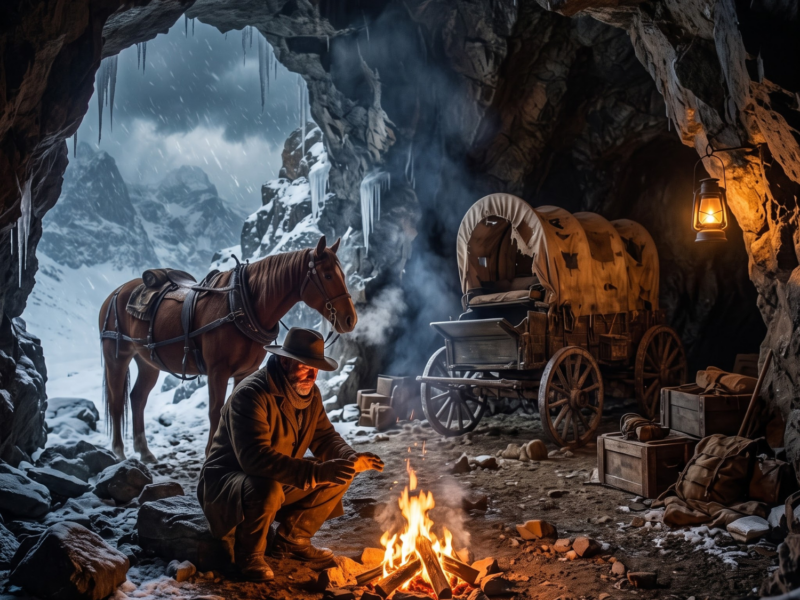
He Pulled a Wrecked Wagon Into a Rock Hollow and Sealed Every Gap — The Storm Never Touched Him
THE FIRST IMPACT
Darkness settled inside the hollow much faster than Pierce had expected. It wasn’t ordinary darkness; it was a heavy, suffocating kind of dark—the kind born when snow, canvas, stone, and wood closed over the world from every conceivable direction at once.
The smells inside the shelter thickened and tangled together in the stagnant air: the mineral tang of cold basalt, the pungent musk of horse sweat, wet leather, and the earthy iron scent of frozen mud packed into the seams by bleeding hands.
Brim shifted once behind him in the dark, then went completely still again. A slow plume of warm breath rolled through the hollow and faded away into the blackness.
Pierce lowered his tired body against the cold stone wall beneath the overhang. For the first time since spotting the storm on the northern horizon, he could no longer see even the smallest fragment of the sky. There was no loose knot left to tighten, no seam left to pack, no stray board left to move into place. The shelter was complete, which meant that his work was finished—and the work of the blizzard had begun.
Outside, the first deep, concussive impact of the wind rolled across the ridge like distant artillery fire moving underground.
Pierce closed his eyes for a moment. It wasn’t out of fear, and it wasn’t in prayer; it was pure, unadulterated exhaustion. Somewhere beneath the mounting weight of the coming storm, he realized something he hadn’t permitted himself to feel in months.
Ever since Clara’s death, every single day had felt like another frantic, losing attempt to hold together a life that was already coming apart piece by piece, seam by seam.
Yet here, beneath the basalt ridge, with the fourth wall sealed tight against the mountain wind, there remained only one thing left in the universe to protect until morning: himself.
The blizzard did not arrive with a gradual build. It struck the ridge like a physical blow.
One moment there was only the oppressive, mounting pressure building beyond the basalt walls; the next, the entire mountain seemed to absorb a single, violent impact that rolled straight through the stone beneath Pierce’s back with the force of colliding iron rail cars.
He never actually saw the storm. Inside the sealed darkness of the hollow, he heard it instead—a long, roaring howl that swept over the ridge and crashed against the shelter hard enough to shake loose a fine rain of dust from the basalt ceiling.
The oil tarp snapped wildly overhead. The wind hammered the wagon boards in heavy, concussive bursts that sounded almost alive, as if a sentient beast were clawing at the wood to get at the warmth inside.
Fine snow dust forced itself through the microscopic flaws in the seams, shooting into the darkness in thin, ghostly white streams that twisted like smoke from an unseen fire. The pressure against the shelter became physical—not just cold, but weight. It pushed against the makeshift fourth wall with such raw intensity that Pierce could actually feel the wooden wagon frame trembling beneath the soles of his boots.
Brim jerked once behind him, letting out a low, uneasy snort, and stamped a heavy hoof hard against the stone floor.
Outside, the storm shrieked across the mountain pass. Inside, the hollow groaned under the immense strain, but the wagon bed did not give way. The basalt walls held steady. The anchored tarp stayed pinned beneath the overhang.
And slowly, listening to the wind search frantically along every single seam and corner of the shelter, Pierce understood the fundamental truth about blizzards that men always misunderstood:
The storm was not trying to break the walls apart. It was simply trying to find a way inside.









