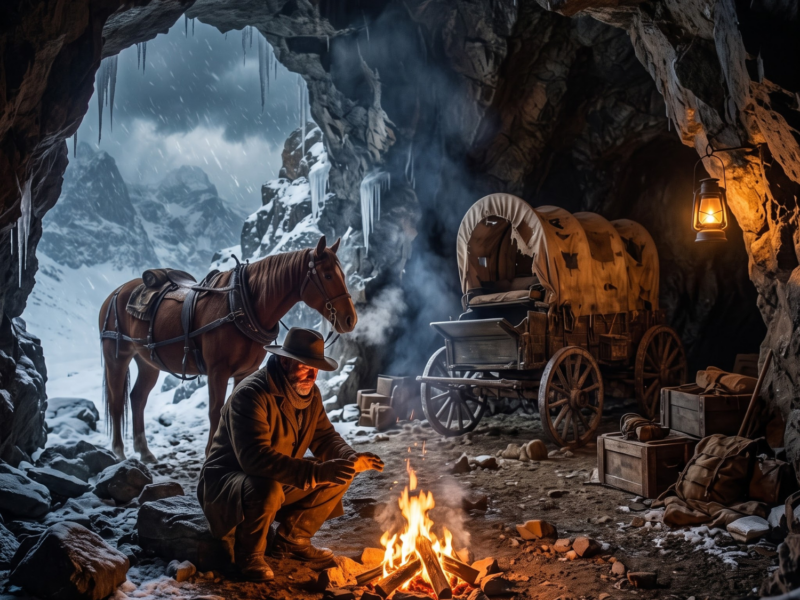
He Pulled a Wrecked Wagon Into a Rock Hollow and Sealed Every Gap — The Storm Never Touched Him
THE WHITE SILENCE
A thin, pale line of real daylight finally appeared along the frozen, upper edge of the tarp.
Pierce stared at it for several seconds before his mind fully comprehended what it meant. The storm had passed. The night was over.
He pushed himself upright slowly, his muscles protesting every inch of the way, and began digging at the packed drift sealing the shelter shut—first with bare, scarred hands, and then with the broken wooden handle of his old shovel.
Snow collapsed inward in heavy, glittering white chunks. Frigid air spilled through the expanding opening, but it came without the viciousness of the night before.
When Pierce finally crawled out from beneath the basalt overhang, the world looked as though it had been completely erased and redrawn by an indifferent hand.
The freight trace was entirely gone. The rolling sagebrush flats had vanished beneath miles of smooth, blinding white drifts that rolled toward the horizon like frozen ocean swells. Even the sharp lines of the distant ridges seemed softened into pale, curved shapes beneath the immense snowpack.
Nothing moved.
Brim climbed out from the hollow a moment later, shaking the loose snow from his heavy mane. The old horse stopped beside the buried shelter and breathed out into the frozen morning air.
The white cloud hanging from the animal’s nostrils stayed suspended for a long moment in the utterly motionless atmosphere, looking like smoke from a cabin chimney with nowhere left to go.
Standing there beneath the blank, silent white canvas left behind by the storm, Pierce felt something strange bloom in his chest for the first time in months. The cold was still deeply present, biting and merciless, but it was no longer chasing him.
He turned back to look at the hollow beneath the basalt ridge.
The shelter had nearly disappeared. Snow had buried the wagon bed almost to its top edge. The oil tarp had frozen so stiff against the drift that it looked less like canvas and more like an unnatural layer of pale stone welded directly onto the mountainside.
Every single seam had vanished beneath the packed snow. From a distance, no passing traveler or weary teamster would ever have recognized it as something built by human hands. It looked simply like a natural part of the ridge—a dark wound in the basalt that winter had half-swallowed and sealed away.
Pierce stepped closer and rested one gloved hand against the frozen wagon board. The wood felt remarkably solid beneath the sheet of ice.
He remembered Eli Mercer laughing beside the muddy freightyard in Garnet Basin, calling the wagon nothing more than a pile of rotting firewood waiting to collapse. He remembered Clara sitting on that very same wagon seat during the final autumn before her sickness worsened, wrapped in a faded wool blanket against the evening chill while Brim pulled them slowly through the falling leaves outside town.
Now, that same wrecked, condemned wagon stood buried deep beneath the snow, having successfully survived a mountain blizzard strong enough to kill seasoned men across the ridge.
The cracked boards had held. The broken thing had become the wall between life and death.
Pierce stood there for a long, silent moment without speaking. Then he lowered his hand from the frozen wood, took a firm hold of Brim’s lead rope, and started walking south through the immaculate white silence.
EPILOGUE: THE LESSON OF THE SEAMS
It took Pierce four more days of grueling travel to reach his cousin’s ranch in the valley south of the Bitterroots.
The storm had completely rewritten the geography of the country behind him. Along the trail, he passed abandoned freight sleds half-buried in colossal drifts. One dead horse stood frozen upright beside a split-rail snow fence, its mane locked solid in ice, its head lowered toward the earth as if still searching for grass beneath the white crust.
Twice, Pierce crossed the tracks of organized recovery crews hauling frozen bodies down from the higher ridges toward the valley settlements. The blizzard had claimed the lives of freight men all across the mountain routes, and news of the disaster had traveled faster than the survivors.
By the time Pierce finally rode into his cousin’s ranchyard near dusk, the valley already knew the grim toll of how many teams had failed to come through the passes.
His heavy coat was stiff with frozen armor; ice covered his beard almost to the collar. Brim looked noticeably thinner than when they had left Garnet Basin, his ribs faintly visible beneath his winter coat.
Pierce’s cousin stepped out from the wide barn door, took one look at them, and stopped dead in his tracks—not with the casual surprise of a neighbor, but with the stunned, disbelieving stare of a man watching someone climb back out of a grave already closed in his own mind.
Inside the warm ranch house, with stove heat cracking softly through the black iron seams of the hearth, Pierce explained the shelter piece by piece: the basalt hollow, the wagon wall, the packed mud seams, and the still pocket of trapped air resting beneath the drifted snow.
His cousin listened in absolute silence without interrupting until the story finally ended. Then he leaned back slowly in his wooden chair and asked the only question that truly mattered:
“How’d you know it would hold?”
For a fraction of a second, Pierce saw old Amos Vaughn again beneath the timber freight bridge years ago—lantern smoke sliding quietly through cracked planks into the winter darkness. Then he looked toward the frost slowly melting from Brim’s harness near the stove door and answered in a quiet, steady voice:
“Didn’t need it strong.”
He paused for a beat before finishing the thought.
“Just needed it closed.”
And in that singular moment, his cousin understood something most men in the mountains never grasped about survival. Pierce hadn’t beaten the blizzard; you couldn’t beat a mountain storm any more than you could stop an avalanche with your bare hands. He had simply built a place where the wind could no longer find him.
For years afterward, people in the southern valleys still spoke in hushed tones about the freight hauler who had survived the bitter blizzard by pulling a wrecked wagon into a basalt hollow and sealing himself beneath the snow.
The story never appeared in the newspapers. No railroad company recorded the event in their ledgers, and no county clerk bothered preserving the details. It lived the way true frontier knowledge survived in those years—carried forward by human memory instead of ink.
Men repeated it beside trading posts while warming frozen hands around coffee tins. Ranchwives mentioned it after church suppers whenever hard winters returned to test the passes. Teamsters crossing the bitter trails told younger, reckless drivers to watch the wind along the basalt ridges and remember the man who survived because he understood seams far better than he understood walls.
Different versions of the tale inevitably spread over time. Some swore Pierce had used heavy mining canvas thick as buffalo hide; others insisted the hollow had once belonged to outlaw trappers decades earlier. A few stubborn locals even claimed the storm had buried him completely alive for three full days before he clawed his way back out into the sun.
But every single version kept the exact same ending.
The blizzard killed stronger men in better, newer wagons simply because they tried to fight winter head-on in the open. Pierce Halbrook had survived because he found stillness where the wind could not follow.
And in the high, unforgiving country, that simple lesson lasted far longer than the man himself.
The story of Pierce Halbrook was never really about a wagon, or basalt stone, or even winter survival in the bitter north. It was about what remained after a life had already started coming apart at the seams. An axle cracked under too much weight. A canvas tarp torn loose by the relentless weather of years. Savings drained away one coin at a time beside a sickbed that no amount of medicine could ever save.
Most men on the frontier understood broken things. What they truly feared was the exact moment when too many broken pieces failed all at once.
Pierce had understood something much simpler than strength. When the storm arrived, he hadn’t wasted precious time wishing for better lumber, thicker walls, or another life entirely.
He had simply taken what remained of his shattered world, pulled the pieces into place, and sealed the gaps one by one. And inside that rough, makeshift shelter beneath the basalt ridge, he had built a pocket of stillness large enough to keep life alive until the morning light broke over the snow.
That was all there was to it. The mountain blizzard didn’t care whether the walls were beautiful. It didn’t care whether the wagon had once been worth a fortune or whether the tarp had been tearing apart long before the first snowflake fell.
The mountain only ever asked one fundamental question: Can the wind get in?
And that night, beneath the buried ridge, it could not. Which was why the blizzard never truly found him at all.
Because not every survivor defeats the winter. Some men simply manage to build four walls strong enough—and close enough—for the storm to pass harmlessly around them, instead of tearing straight through them.









