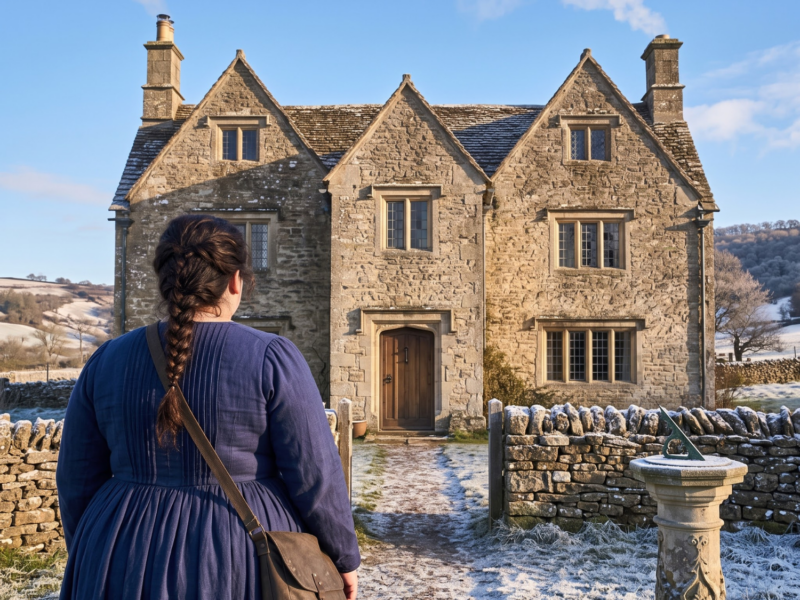
Her Sisters Left Her Only An Old Cottage—Until She Found What Her Mother Hid Inside
Her Sisters Left Her Only An Old Cottage—Until She…
Her Sisters Left Her Only An Old Cottage—Until She Found What Her Mother Hid Inside
The heavy oak doors of the Laramie County Courthouse slammed shut, the sound echoing like a gunshot across the dusty Wyoming street.
Eleanor Whitmore didn’t flinch. She pressed her back against the cold limestone wall and let her sisters walk past her. She didn’t cry. She didn’t beg. She stood there, all two hundred and sixty pounds of her, clutching a single iron key and a worn leather bag, watching two women divide a empire that had once belonged to all three of them.
“You understand, don’t you?” Clara said.
Clara had stopped at the bottom of the steps, adjusting her silk gloves. She had their father’s high, aristocratic cheekbones and their mother’s terrifying ability to make cruelty sound like a favor.
“Father always worried about what would happen to you,” Clara continued, her voice smooth, meant for the bystanders on the street. “He knew you couldn’t manage the cattle operations. He was trying to be practical.”
“He was practical,” Eleanor said. Her voice was low, resonant, and entirely stripped of the tremor Clara was fishing for.
“And the Holloway cottage,” Clara offered a tight, sympathetic smile. “Well, Mother used to talk about it. It was hers from before she married Father. You know how sentimental she was. It’s been empty for twelve years, Eleanor. The roof is probably gone.”
“Probably,” Eleanor said.
Doy, the middle sister, shifted uncomfortably. She was softer than Clara, though not kinder—just less confident in her betrayals. She had just inherited the family manor and all the bank accounts. “You could sell it,” Doy murmured, looking at the dirt. “If the land is worth anything, you could get two, maybe three hundred dollars. Enough to board somewhere. Find a position. As a cook, maybe. You’re… quick with your hands.”
Eleanor looked at Doy. Really looked at her. She saw the guilt, bright and frantic, hiding behind her sister’s eyes.
“I’ll keep the property,” Eleanor said.
Clara’s smile remained fixed, but the muscles in her jaw tightened. “Eleanor, be reasonable. You’ve never run a household alone. You don’t know the first thing about business, or managing land, or—”
“I appreciate your concern,” Eleanor interrupted, picking up her leather bag. “I truly do. But I will keep the property.”
She walked down the courthouse steps, her boots striking the wooden boards with heavy, measured rhythm, and stepped into the dry, wind-scoured afternoon of Cedar Hollow. She did not look back. If she had, she would have seen Clara exchange a sharp, panicked look with a tall, well-dressed man stepping out from the shadows of the courthouse pillars. Caleb Thornton. The wealthiest rancher in the valley.
Eleanor didn’t know it yet, but her father hadn’t left her the Holloway property out of pity. He had left it to her because he thought she was too stupid to realize what was buried beneath it.
The road to Holloway was five miles of packed dirt. Eleanor walked it alone. Her legs burned, her breath pluming in the crisp 1887 autumn air, but she didn’t stop. Her body moved at its own deliberate pace—solid, enduring, and entirely her own.
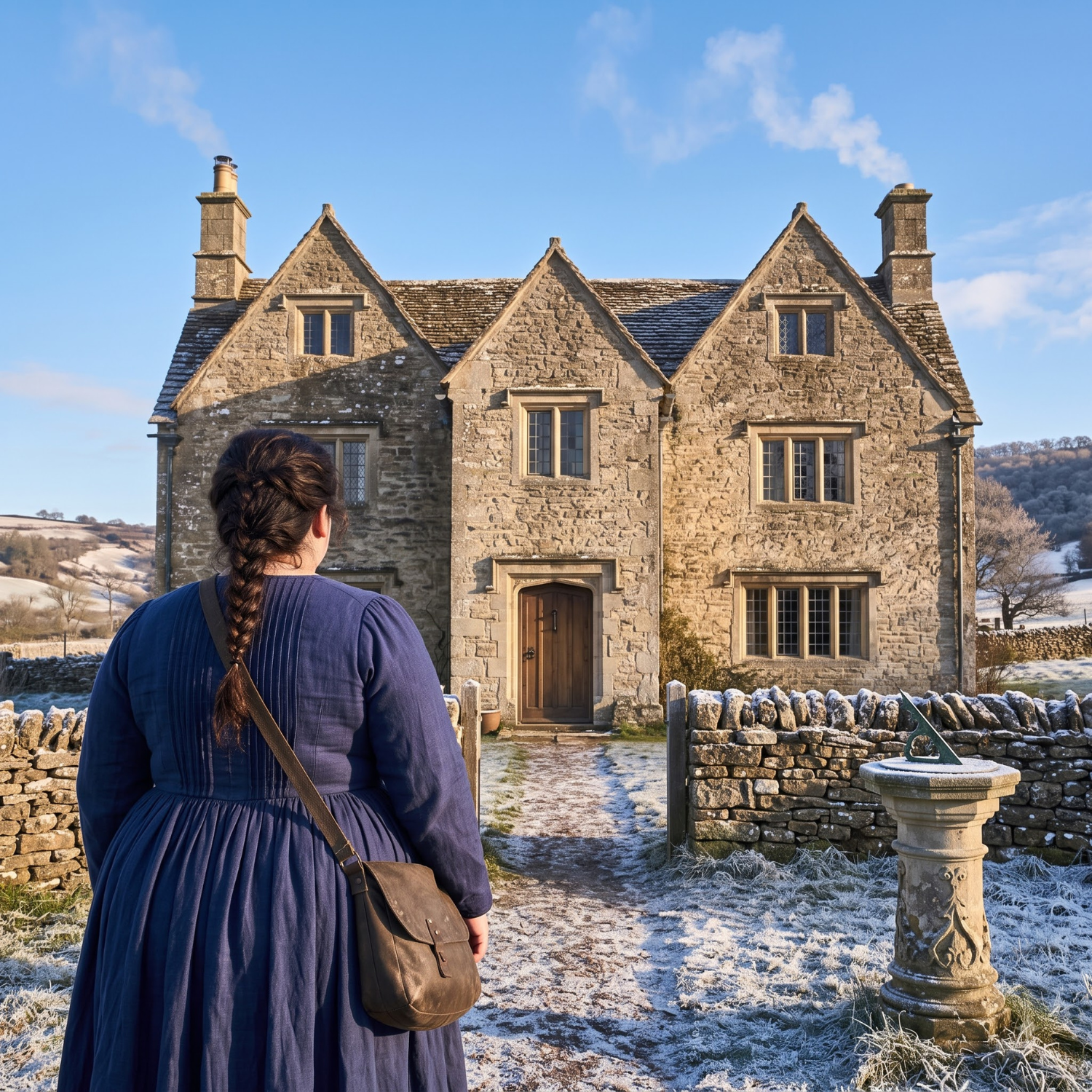
The cottage appeared at the end of a long drive marked by two stone posts. It was a ruin. The roof was curling back like dry leaves, the porch was rotting, and the surrounding fields had surrendered to wild scrub brush.
Eleanor climbed the steps, testing the wood. She slid the heavy iron key into the lock. The mechanism ground its teeth, then yielded.
She pushed the door open.
The smell hit her instantly. Not the suffocating stench of rot she expected, but the sharp, clean scent of dried thyme, cedar, and linseed oil.
She stepped inside and stopped dead.
The dust on the floor was thick, untouched for perhaps a year. But the kitchen—visible from the entryway—was not abandoned. It was waiting.
On the far wall, sturdy wooden shelves groaned under the weight of dozens of mason jars, meticulously sealed in wax: preserved peaches, green beans, pickled carrots. Beneath the counter sat an iron skillet, oiled to a black shine, and a sealed tin of baking powder. Folded tightly in a cedar chest by the window were three heavy wool blankets.
Eleanor’s vision blurred. Her chest tightened so fiercely she had to press her hand against her sternum.
Someone has been here.
She walked to the kitchen table. Sitting squarely in the center, weighed down by a smooth, dark river stone, was a leather-bound notebook.
Eleanor recognized the handwriting on the cover before she even touched it.
Margaret Whitmore. Her mother. The woman who had died three years ago, consumed by a sudden fever.
Eleanor’s hands shook as she opened the cover.
My dear Eleanor,
If the day comes when they tell you that you have nowhere to go, I want you to remember this: This place was always yours. I have been preparing it for you in secret. Do not be afraid of what needs work. Everything worth having needed work once.
Start with the kitchen. You always think best when you are cooking. The rest can wait. Look behind the loose panel in the bedroom wall. The one third from the window. I left you something there that nobody else knows about.
Be careful, Eleanor. You are worth more careful than you know. Mama.
Eleanor didn’t cry. The feeling rising in her was too vast, too ancient for tears. It was the terrifying, magnificent realization that she had never been unloved.
She walked to the back bedroom. The floorboards groaned. She counted the panels from the low, east-facing window. One. Two. Three. She pressed her palm against the wood. It gave slightly.
She wedged her fingernails into the seam and pulled. The panel cracked open, revealing a dark, hollow cavity in the wall.
Inside sat a plain pine box.
Eleanor pulled it out and set it on the dusty mattress. Inside lay a stack of cash—four hundred and twenty dollars in crisp bills, bound with twine. Beneath that, a county deed stamped with the official Laramie seal.
It proved the Holloway property was purchased in 1881 by Margaret Whitmore using her premarital inheritance. It had never belonged to Harold Whitmore. It had never been his to give away in a will. It belonged solely to Eleanor, free and clear.
But it was the document at the very bottom of the box that made the breath catch in Eleanor’s throat.
It was a geological survey dated 1883.
Eleanor traced the heavy black ink circling the northwest quadrant of the property map. There was a handwritten note from her mother in the margin: Subsurface water source identified. Artesian Spring. Estimated flow rate sufficient for sustained agricultural and livestock use for the entire valley. Caleb Thornton has been searching for this for five years. He must never know you have it until you are ready.
A floorboard creaked.
It wasn’t a house-settling creak. It was the heavy, deliberate shift of weight on the front porch.
Eleanor froze, her hand still resting on the survey.
Someone was standing right outside her front door.
Related Articles

They Mocked the Widow’s Dirt Cellar—Then the Freeze Left Every Cabin Cold but Hers Warm
They Mocked the Widow’s Dirt Cellar—Then the Freeze Left Every Cabin Cold but Hers Warm…

A Homeless Veteran and His German Shepherd Inherited a Ridge No One Wanted — 35 Feet In, They Found
Chapter 1 / 7 A Homeless Veteran and His German Shepherd Inherit… A Homeless Veteran…

Neighbors Laughed When He Built A Cabin Inside An Old Barn—Until It Kept His Home 35 Degrees Warmer
Chapter 1 / 8 Neighbors Laughed When He Built A Cabin Inside An… Neighbors Laughed…

His Sod House Had No Woodpile in January – Until the Trains Stopped and the Town Came Begging
Chapter 1 / 10 His Sod House Had No Woodpile in January – Until t……

She Built Her Cabin Over the Woodshed and Never Burned Wet Wood Again
Chapter 1 / 8 She Built Her Cabin Over the Woodshed and Never Bu… She…

The Duke Abandoned Her on Their Wedding Day—Years Later, He Discovered What He Had Lost
Chapter 1 / 7 The Duke Abandoned Her on Their Wedding Day—Years… The Duke Abandoned…

He Wedged a Tiny A Frame Into a Crevice Before Winter and His Family Slept at 75°F While Town Hit
Chapter 1 / 7 He Wedged a Tiny A Frame Into a Crevice Before Win……

He Was Too Old to Ride—So He Bought the Ruined Ranch and Found the Room Behind the Fireplac
Chapter 1 / 5 He Was Too Old to Ride—So He Bought the Ruined Ran……

Settlers Laughed at His Underground Heat Recovery Duct — Until It Kept His Cabin 71°F Warmer
Chapter 1 / 9 Settlers Laughed at His Underground Heat Recovery… Settlers Laughed at His…

A Navy SEAL Built a Home Inside a Mountain—Then His Dog Warned Him Before the Storm
Chapter 1 / 5 A Navy SEAL Built a Home Inside a Mountain—Then Hi… A…