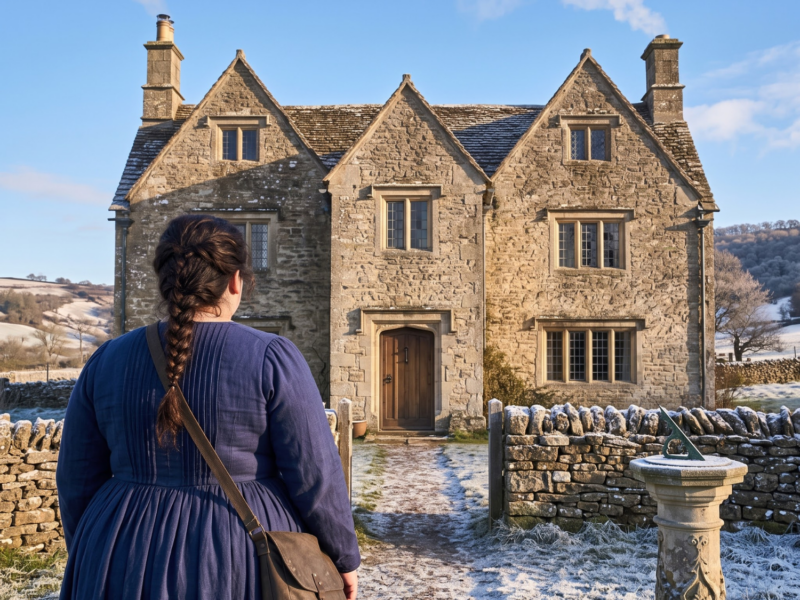
Her Sisters Left Her Only An Old Cottage—Until She Found What Her Mother Hid Inside
THE INHERITANCE OF DUST
Eleanor didn’t panic. Panic was a luxury for small, fast things. Eleanor was a mountain, and mountains do not run.
She slid the documents back into the pine box, shoved it into the wall cavity, and snapped the wooden panel shut. She moved quietly to the kitchen, wrapping her fingers around the heavy iron handle of the oiled skillet.
She stepped into the entryway just as a heavy fist rapped on the doorframe.
“Hello the house!” a voice called out. A man’s voice. Deep, unhurried, rough at the edges.
Eleanor pulled the door open, keeping the skillet hidden behind the doorframe.
A man stood on the bottom step of the porch, holding the reins of a massive dark bay horse. He was in his mid-thirties, wearing a trail-dusted coat and a hat pulled low over eyes that were the color of slate. He didn’t have the soft, well-fed look of the townsmen. He looked like something carved out of the Wyoming bedrock.
He didn’t flinch at her size. He didn’t look past her. He looked her dead in the eye.
“Miss Whitmore,” he said, touching the brim of his hat.
“Who’s asking?” Eleanor said, her voice steady.
“James Callaway. I run the spread two miles north of the ridge.” He held out a bundle wrapped in checkered cloth. “Saw smoke from your chimney. My housekeeper sent this over. Biscuits. She makes more than any sensible person can eat.”
Eleanor didn’t take the bundle. “You ride two miles out of your way to deliver biscuits to strangers, Mr. Callaway?”
The corner of his mouth twitched. “No, ma’am. I ride two miles to see who’s lighting fires in a house that’s been empty for a decade. But when I realized it was Margaret Whitmore’s daughter, the biscuits seemed appropriate.”
Eleanor’s grip on the skillet loosened slightly. “You knew my mother?”
“I knew of her,” Callaway corrected, his eyes drifting over the ruined roof, then back to her. “She came out here a few times over the years. Never brought a hired hand. Never asked for help. Seemed like a woman who had a reason for everything she did.”
“She did,” Eleanor said, finally stepping forward to take the bundle. The warmth of the bread seeped through the cloth into her cold hands.
“Miss Whitmore,” Callaway’s voice dropped an octave, the conversational tone vanishing. “The valley can be unfriendly to newcomers. Especially to those sitting on land they think is abandoned.”
“I’m not a newcomer, Mr. Callaway. This is my land.”
Callaway looked at her for a long, silent moment. The slate-gray eyes assessed her, weighing her resolve against the brutal reality of the Wyoming territory. “If you’re staying,” he said quietly, “you’ll have a fair neighbor in me. For whatever that’s worth.”
He tipped his hat, mounted his horse in one fluid motion, and rode off.
Eleanor watched him go. She locked the door, set the biscuits on the table, and pulled out her mother’s notebook. She had work to do.
For seven days, Eleanor worked from the moment the sky bruised purple in the east until the stars burned like ice in the black night. She replaced the porch boards, swinging an iron pry-bar like a hammer until her palms blistered and bled, then calloused over. she cleared the scrub from the garden, her broad shoulders absorbing the agonizing labor without complaint.
On the eighth day, the war began.
Eleanor walked the five miles into Cedar Hollow to register her deed at the county clerk’s office.
The clerk, a reedy man named Perkins with a collar that choked his neck, stared at the deed as if it were coated in poison.
“Miss Whitmore,” Perkins sneered, pushing his spectacles up his nose. “This property was listed as part of Harold Whitmore’s estate. I processed the paperwork for your sister just last month.”
“Then you made an error,” Eleanor said pleasantly, placing her palms flat on the counter. “Because this deed predates my father’s death by six years. It was purchased with my mother’s private inheritance. I’d like it formally recorded.”
Perkins’ eyes darted toward the back office door. It was a microscopic movement, but Eleanor caught it. He’s waiting for someone.
“I’ll have to… review the county index,” Perkins stammered, pulling a heavy ledger toward him. He scribbled her name down, but he didn’t stamp the deed.
Eleanor snatched the original document back, folding it into her leather bag. “I expect the records to reflect the truth by tomorrow, Mr. Perkins.”
She stepped out of the office and nearly collided with a wall of solid muscle.
Two men blocked the wooden sidewalk. Both wore rancher dusters. Both had the hardened, predatory look of men who were paid to break things.
Behind them stood Caleb Thornton.
Thornton was a handsome man in his late forties, dressed in a tailored wool suit that screamed East Coast money wrapped in frontier ruthlessness. He looked at Eleanor the way a wolf looks at a particularly slow sheep.
“Miss Whitmore,” Thornton said, his voice like oiled silk. “I was just coming to find you.”
“Mr. Thornton,” Eleanor replied, not taking a single step backward.
“I heard the unfortunate news about your father’s will. A terrible oversight.” Thornton signaled his men, who shifted slightly, boxing Eleanor in against the railing. “I know the Holloway property. It’s barren. The soil is dead. A woman alone out there… it’s a tragedy waiting to happen. I’m prepared to offer you five hundred dollars for the parcel today. Cash. You could take the train back East. Live comfortably.”
“The land isn’t for sale,” Eleanor said.
Thornton smiled, but his eyes went dead. “I don’t think you understand the realities of Cedar Hollow, Eleanor. The winters are unforgiving. And the valley… well, the valley can be very hostile to those who aren’t practical.”
“I am entirely practical, Mr. Thornton,” Eleanor said, her voice dropping to a low, carrying timber that made the two hired men shift uneasily. “My mother spent years preparing that property for me. She didn’t do it so I could hand it to a man who already owns six miles of the valley. Move your men.”
Thornton didn’t move. He leaned in, lowering his voice so only she could hear. “Harold Whitmore owed me a great deal of money, Eleanor. Clara knows this. That’s why she gave up the land. You think you’re fighting for a home. You’re actually standing on a battlefield you can’t even see.”
“Move,” Eleanor commanded.
Thornton stared at her. For a fraction of a second, the mask slipped, revealing a flash of pure, unadulterated rage. Then, he chuckled, stepping aside. “Have it your way, Miss Whitmore. I hope you’re good with a shovel.”
Eleanor walked past them, her spine rigid.
She made it back to the Holloway property just as the sun dipped behind the ridge. She was exhausted, her legs shaking from the five-mile walk and the adrenaline crash.
She walked toward the house, but stopped.
The front door was ajar. The lock had been smashed inward.
Eleanor dropped her bag. She sprinted up the steps with terrifying speed for a woman her size, her hand instantly going to the heavy iron bar she left on the porch.
She burst into the house.
The kitchen had been ransacked. The mason jars were shattered across the floor, preserved peaches and glass glittering in a sticky, ruined mess. The cedar chest was overturned, the blankets slashed.
But it wasn’t a blind robbery.
Eleanor ran to the bedroom. The bed was flipped. The walls had been struck with crowbars. They had been looking for something.
She dropped to her knees, her heart hammering against her ribs, and felt the third panel from the window.
The wood was cracked, but the hidden latch remained untouched. They hadn’t found the cavity. The deed and the survey were safe on her person.
But as she knelt there in the wreckage of her mother’s love, Eleanor realized something cold and absolute. Thornton hadn’t just tried to buy her out. He was terrified. He knew about the spring.
A shadow moved in the doorway.
Eleanor spun, raising the iron bar like a club.
James Callaway stood in the ruin of the hallway, a Winchester rifle gripped loosely in his right hand. He looked at the shattered jars, the slashed blankets, and finally, at Eleanor, kneeling in the center of the destruction, her knuckles white around the iron bar.
“I saw riders leaving your property in a hurry,” Callaway said, his voice deadly quiet. He didn’t offer pity. He didn’t ask if she was okay. He looked at her like a soldier assessing a fellow commander after a bombardment. “Do you have a gun?”
“No,” Eleanor breathed.
Callaway flipped the Winchester in his grip and held it out to her, stock first.
“You do now.”









