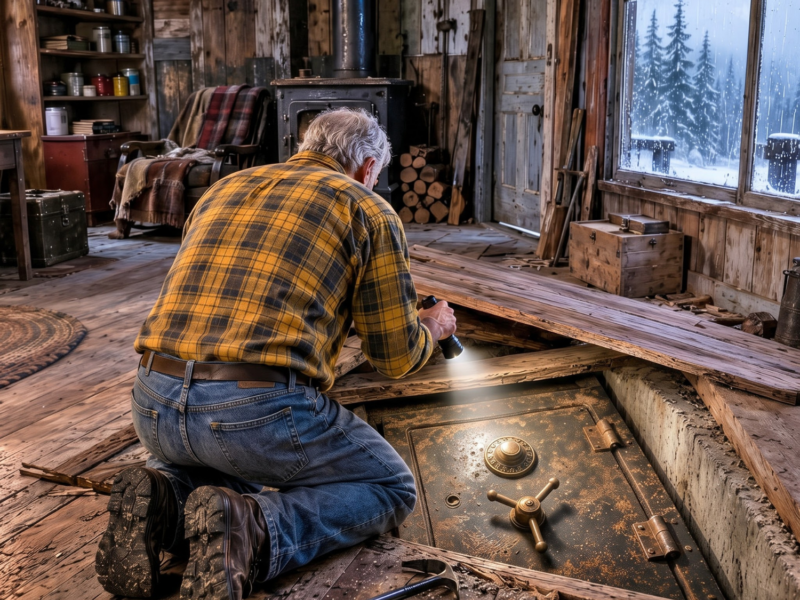
His Family Sold His Home While He Was in Hospital—So He Moved Into a Shack With a Hidden Safe
The Ridge
Black Bear Ridge was not a residential neighborhood by any stretch of the imagination. It was a heavily wooded, unforgiving, and jagged stretch of mountainous terrain sitting twenty miles outside the Portland city limits. The air up there was perpetually thin, damp, and choked with the thick scent of rotting pine needles and wet earth.
Owen had inherited a two-acre parcel there from his deeply eccentric uncle, Henry, nearly thirty years ago. Owen had never developed it. In truth, he had barely even visited it since the late eighties. All that sat on the property was an old, dilapidated hunting shack that had not seen a fresh coat of paint since the Carter administration.
When Greg’s battered truck tires finally crunched onto the heavily overgrown gravel driveway, tearing through waist-high weeds and thorny blackberry bushes, the devastating reality of Owen’s new situation truly set in.
The shack was an absolute tragedy of rotting timber and rusted corrugated metal. Half of the front porch had completely collapsed beneath the accumulated weight of decades of wet autumn leaves and heavy winter snows. The windows were entirely opaque, caked with thick layers of grime, cobwebs, and bird droppings. The front door, constructed of cheap, warped pine, was hanging perilously off a single, heavily rusted iron hinge.
The surrounding, towering Douglas fir trees loomed over the tiny structure like silent, judging mourners, casting long, freezing shadows in the waning late-afternoon sun.
Greg killed the engine, and the ensuing silence was heavy and oppressive. He turned to his friend, his face pale with shock.
“Arty, you can’t stay here,” Greg said, his voice thick with genuine fear and concern. “This place is a death trap. You just had a major coronary event. Come sleep on my couch. My wife won’t mind, I promise you. We can set you up in the den.”
Owen tightened his grip on the smooth wooden handle of his cane until his knuckles turned white. His pride—the absolute last shred of dignity he had left to his name—flared up like a sudden grease fire.
“No, Greg,” Owen replied, his voice raspy, but firm. “You have a full house with your grandkids running around. I won’t be a burden to your family. Not after everything. This is my land. I’m a general contractor. I know how to fix things. I can make this work.”
Reluctantly, seeing the immovable, stony stubbornness hardening in Owen’s eyes, Greg sighed and helped him out of the truck.
Together, they spent the next grueling hour clearing the worst of the toxic debris from the interior. The inside of the shack smelled overwhelmingly of mildew, wet dirt, and animal decay. There was a rusted cast-iron wood stove sitting in the far corner, a violently sagging canvas cot, and a pathetic small kitchenette with a hand-pump sink that hadn’t drawn a single drop of water in over forty years. It was barely a marginal step up from sleeping under a freeway overpass.
Refusing to leave his friend with nothing, Greg drove back down the treacherous mountain road to a local hardware store. He returned two hours later in the dark, the bed of his F-150 loaded with survival supplies. He carried in a stack of seasoned firewood, a portable propane heater with four extra tanks, thick, heavy military-grade wool blankets, a case of canned beef stew, bottled water, a battery-powered lantern, and a basic contractor’s tool kit.
“I’ll be back tomorrow afternoon to check on you,” Greg promised, clapping Owen gently on the shoulder, acutely aware of the fragile, prominent collarbones beneath his friend’s flannel shirt. “Keep that heater running.”
When the red taillights of Greg’s truck finally disappeared down the dark, winding mountain road, the ensuing isolation was deafening.
Owen sat heavily on the edge of the musty canvas cot, pulling the scratchy wool blanket tightly around his trembling shoulders. The cold was deeply pervasive. It seeped through the thick leather of his boots and settled aggressively into his aching, tired bones. His chest throbbed with a dull, rhythmic pain right down the center of his sternum—a stark, terrifying reminder of his physical fragility.









