His Family Sold His Home While He Was in Hospital—So He Moved Into a Shack With a Hidden Safe
The Hollow Thud
For the first three weeks, Owen lived entirely in primitive survival mode.
He spent his short, precious daylight hours sealing the drafty, cracked windows with thick plastic sheeting and heavy-duty duct tape. He climbed a rickety stepladder, his breath coming in shallow, painful gasps, to patch the worst holes in the corrugated metal roof with aluminum scrap and roofing tar. He chopped small bits of kindling, carefully monitoring his heart rate, terrified that another attack out here would mean a slow, lonely death.
His anger at his daughter Beatrice and his son-in-law Richard was a slow-burning, molten coal in the pit of his stomach. It kept him warm when the propane heater inevitably ran out in the dead of night. It gave him the terrifying adrenaline required to push through the intense physical agony of cardiovascular rehabilitation without the aid of a nurse or physical therapist.
In the darkest, coldest hours of the night, he found himself talking out loud to his late wife, Martha.
“They took it all, Marty,” he whispered one bitterly cold Tuesday, watching the orange embers slowly die in the belly of the rusted wood stove. “Our memories. The rose garden you planted by the driveway. The porch where we drank our coffee. Everything. And my own flesh and blood left me here in the dirt to freeze.”
But Owen Pendleton was not a man who surrendered to despair easily. He was a builder, and builders inherently look for structure.
As he began to thoroughly clean the single open-concept room, scrubbing away decades of accumulated dust, dead insects, and rat droppings, his seasoned contractor’s eye began to notice something highly peculiar about the shack’s floor plan.
The structure was roughly twenty-by-twenty feet on the outside. A perfect square. But the interior dimensions simply didn’t line up with the exterior footprint. There was a raised, partitioned section in the back corner, right beneath the only window that faced the dense, impenetrable pine forest.
Owen had initially dismissed it as a warped, failing foundation, assuming the soft mountain earth had simply settled unevenly over fifty years, pushing the floor joists upward.
But then came a violently bitter evening in late January.
A massive winter storm was howling through the pines, driving freezing, crystalline rain against the patched tin roof like handfuls of gravel. The temperature had plummeted below freezing, and the propane heater was struggling to keep up. Owen was aggressively pacing the small room, rubbing his arms, desperately trying to keep his blood circulation flowing to his extremities.
As his heavy steel-toed work boot stepped onto the raised section of the floorboards in the back corner, it landed with a sound that stopped him dead in his tracks.
Thud.
It didn’t sound like solid oak resting over packed dirt or foundation blocks. It sounded distinctly hollow. It was a deep, resonant, echoing vibration that traveled up through the rubber soles of his boots.
Owen narrowed his eyes. He tapped the floorboard sharply with the heavy brass tip of his walking cane.
Clack, clack. Thud, thud.
His heart rate immediately picked up, the phantom monitor in his memory beeping a little faster. He carefully dropped to his knees, ignoring the sharp, stabbing pain in his arthritic joints. He pressed his ear flat against the cold, rough-hewn floorboards and knocked hard with his knuckles.
There was zero doubt in his mind. There was a distinct, completely empty cavity beneath this specific three-foot square section of the floor.
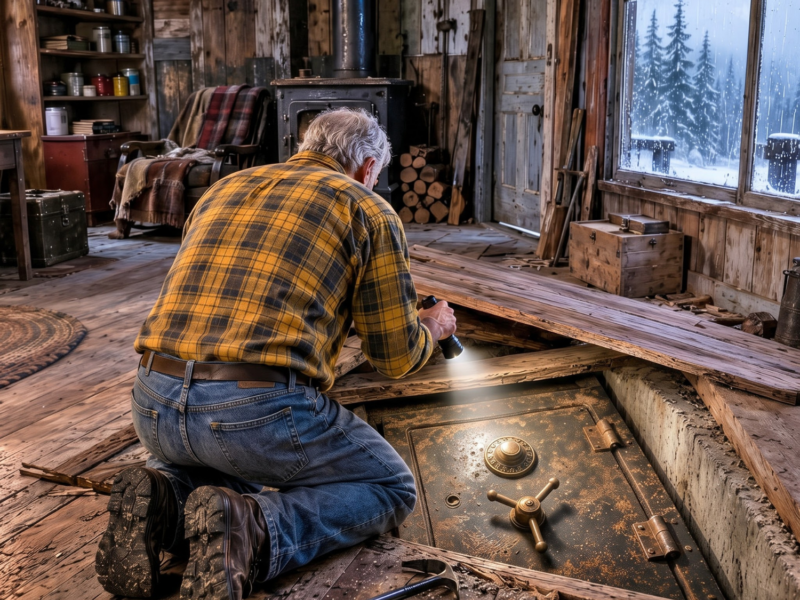
He quickly fetched his heavy-duty flashlight and the solid steel crowbar from the toolkit Greg had bought him. The wood here was incredibly old, swollen tight with years of trapped moisture, and nailed down flush with old-fashioned, square-headed iron nails.
Owen wedged the flattened, forked edge of the heavy crowbar deeply into a tight seam between two of the thickest boards. He took a long, deep breath, braced his boots hard against the adjacent wood for leverage, and pulled back with absolutely all of his remaining physical strength.
The ancient wood groaned in loud, violent protest. The rusted iron nail shrieked like a dying animal as it was forcefully ripped from its fifty-year resting place. With a loud, echoing crack that startled him, the thick floorboard splintered dramatically and popped upward.
A sudden rush of incredibly stale, bone-dry air wafted up from the pitch-black darkness below, smelling distinctly of machine oil and dust.
Owen clicked on his flashlight and shone the bright LED beam directly into the newly created gap. His breath caught sharply in his throat, his chest tightening.
He wasn’t looking at packed dirt. He wasn’t looking at wooden support beams or poured concrete foundation blocks. Or even a hidden root cellar.
He was looking at solid, meticulously forged, rusted steel.









