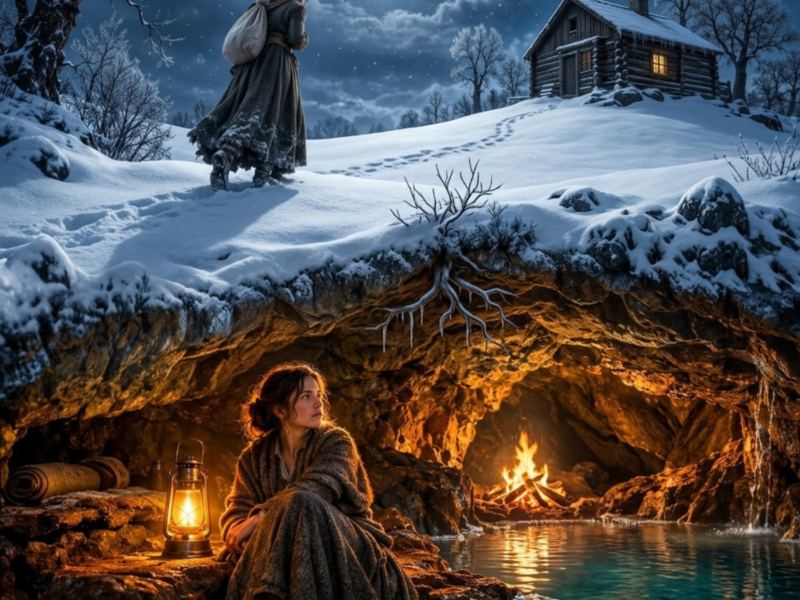
Kicked Out in November, She Discovered a Hot Spring Cave—and Never Burned a Single Log
The Veins of the Earth
Day 2
That freezing morning, moving like a ghost through the timberline, Mara noticed three highly unusual things.
First, a long, narrow strip of ground at the base of a towering ridge held absolutely no frost, while the earth everywhere else was painted white. Second, fresh elk tracks—dozens of them—crossed this specific strip repeatedly, pacing back and forth. And third, as she approached a massive, jagged formation of black basalt rock, the freezing air suddenly smelled faintly of deep earth and heavy minerals.
Mara stopped. She dropped to her knees.
The soil under her worn leather boots was darker than the frozen ground surrounding it, and when she pressed her cracked fingers into it, it was yielding and soft beneath the morning frost.
She spent the next two agonizing days refusing to move on, desperately trying to understand the strange, warm patch of earth. It was not warm everywhere. If she took ten steps north, the prairie grass was brittle and covered in thick frost. If she took ten steps south, the soil rang hard like iron beneath her heel. But along one specific, narrow fault line leading up to the black rock, the frost simply melted away before dawn.
Every morning, she dug with a simple metal spoon. Three inches down, the soil was inexplicably damp and warm. Farther uphill, tucked beneath dense brush, she found patches of emerald-green moss that should have died a month ago.
She followed the elk tracks until they vanished between two massive boulders, and there she found them clustered beside a tiny, crystalline ribbon of water running quietly beneath a sheet of surface ice.
She stripped her glove and touched the water. It was not hot. It was barely above freezing. That confused her terribly. If a geothermal spring was warming the ground from below, why was the surface stream almost frozen?
She searched anyway, driven by an instinct she couldn’t name. At dusk on the second day, she found a low spot sheltered from the biting north wind and built a second lean-to. This time, she worked in the correct, agonizing order Elias had taught her: Shelter first. Fuel second. Fire last.
The fire lasted two hours before the wet wood defeated it. Then, the heavy snow began to fall.
By morning, the sheer weight of the snow collapsed one wall of her lean-to. Mara’s right hand was dangerously swollen from dragging heavy pine branches, the joints screaming in pain. She sat in the snow and stared at the dead, wet coals of her fire. Once again, all that brutal, exhausting work had bought her only a few hours of shivering life.
On the third afternoon, desperate and aching, she returned to the black rock formation.
A snowshoe hare darted out from the pines and vanished instantly into the dense brush directly above the strip of unfrozen earth. Mara pushed through the thorns.
Hidden behind the brush was a jagged vertical crack in the basalt, barely wide enough for her shoulders to pass through. She placed her bare, swollen hand near the fissure.
A ghost of warm air touched her fingers. It was not hot like a stove, and it was not a strong draft, but it was unmistakably, distinctly warmer than the vicious wind howling at her back.
Mara crouched there, mesmerized. The crack in the stone seemed to literally breathe. Warm, damp air drifted out, stopped for a moment as the atmospheric pressure shifted, and then exhaled again.
She began tearing away the dead branches and vines, revealing total, impenetrable darkness behind them. For the first time, she wondered if the impossible warmth came not from the soil, but from deep inside the hill itself. The opening was far too narrow and treacherous to enter safely before dark. She marked the entrance by driving three long branches upright into the snow.
Then she returned to her freezing, collapsed shelter. All night, while her teeth chattered, she thought about the warm breath coming from the stone beneath the snow.









