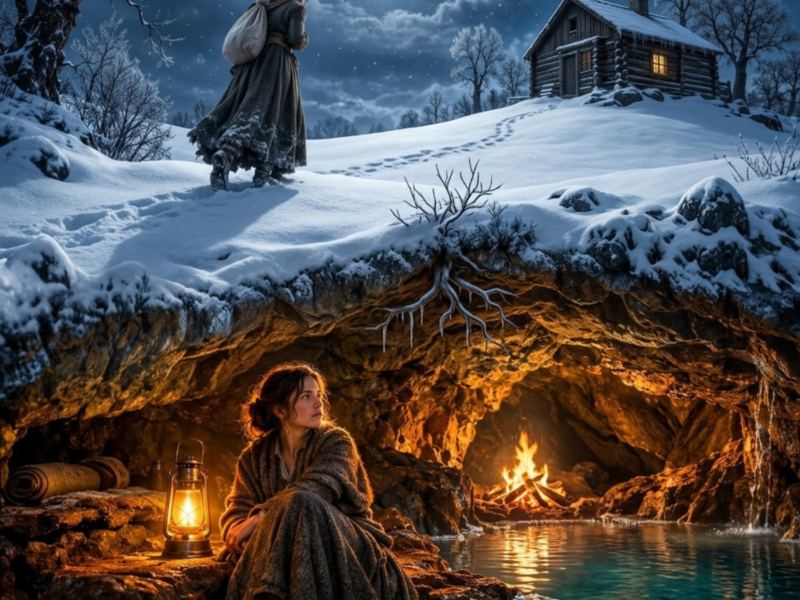
Kicked Out in November, She Discovered a Hot Spring Cave—and Never Burned a Single Log
The Test
Late January
By late January, the situation in the valley became desperate.
Dry wood was impossibly hard to find beneath the massive drifts. Desperate families began burning green, sappy branches and tearing up old cedar fencing to feed their stoves. Noxious, blinding smoke filled the kitchens of Bitterroot, causing rampant lung sickness.
Then, riders from the northern ranches carried a terrifying warning into town: the coldest arctic air mass of the entire winter was moving south. It would be a killing freeze.
Two days later, Hale returned to Mara’s marker poles.
This time, he was not alone.
Trudging through the snow behind the landlord came six people, including two young children, carrying wool blankets and almost nothing else. The real, apocalyptic cold had arrived, and Hale needed her answer now. His own stove had cracked, and he had nowhere else to turn.
By nightfall, nine people were crowded inside the cavern.
The youngest child was six, weeping silently from the cold. The oldest woman, a grandmother with frail bones, could not stop violently shaking. Their cabin stove had catastrophically cracked after weeks of burning expanding, damp wood. Another family in the group had completely run out of fuel, their woodpile buried under ten feet of ice.
Mara’s cave had never held so many living bodies. And bodies meant biology, which created entirely new, terrifying problems.
Nine wet, snow-covered coats made the ambient air incredibly damp. The heavy, panicked breath of nine people instantly fogged the chamber, raising the humidity to dangerous levels. Outside, the blizzard raged, and snow packed densely around the entrance. The heat of their bodies began melting the snow they had tracked in, and the drainage channel suddenly began carrying muddy water from their boots directly toward the pristine geothermal pool.
Standing in the center of the chaos, Mara felt the old, paralyzing fear from October creeping back into her chest.
Then, she stopped looking for a single, magical answer. She breathed out, and she used every single agonizing lesson the winter had forced her to learn.
She took absolute command.
The children and the old woman were immediately moved to sleep on the middle, driest shelf. All wet coats and boots were confiscated and hung high near the ceiling where the cross-ventilation was strongest. All meager food supplies were hoisted above the flood line.
She assigned two able-bodied adults to take strict, rotating shifts clearing the ventilation gap with a stick, ensuring they didn’t suffocate. She forbade anyone from blocking the spring outlet with their gear. She commanded that absolutely nobody sleep on the stone floor. And when Hale suggested lighting a small brush fire for extra warmth, she forcefully forbade it, knowing the smoke would choke them all in the damp air.
Outside, the wind screamed against the mountain, a sound like tearing metal.
Inside, the spring kept moving. The ancient rock absorbed their body heat and combined it with the geothermal warmth. The ventilation held. The cave breathed.
At dawn, the wind finally died. Hale stepped outside the narrow entrance and stared down across the vast, frozen valley.
A sickly, thin smoke hung low and stagnant over Bitterroot. Through the clear, freezing air, he could see that the wooden fence rails had completely disappeared from several properties, burned in a desperate bid to stay warm. Later that week, the thermometer at the general store would confirm what they all felt: it was the coldest recorded morning in twelve years.
Inside the cave, the water still flowed perfectly. Nine people were alive, warm, and breathing.
Mara walked over to the dry rock shelf and reached for the small matchbox resting beside her lamp. She opened it.
Only nine matches were missing.
They were the exact nine matches she had wasted on her first, freezing, arrogant night in the forest, before she had found the cave.
Hale turned back from the entrance. He looked at the tiny matchbox in her hand, then looked around at the people waking up comfortably behind him.
In October, he had locked her door and told her that nobody survived a Bitterroot winter without a roof and a massive wood pile.
Now, the wealthy landlord finally lowered his head and shook it slowly. “I was wrong, Mara.”
Mara closed the matchbox with a soft click. She did not need to answer him. The mountain had already answered for her. The absolute worst night of the winter had tested every single rule she had painfully learned, and not one of them had failed when it mattered most.
EPILOGUE: The Thaw
Spring
The snow finally began to shrink back from the southern slopes in late March, revealing the black earth beneath.
When Mara Vance walked back down the trail into Bitterroot, nobody laughed at her.
People stopped in the muddy streets. They asked frantic, eager questions about the cave. How warm was the water? How did you keep the blankets from rotting? What happened when the spring rose during the thaw? Why on earth did you keep the entrance open during a blizzard?
Mara answered them all, patiently.
She never once called the cave safe. She called it a machine that was extremely useful, but only if perfectly understood.
Hale, humbled and indebted, offered her the old cabin back, rent-free for a year. She politely refused.
Instead, utilizing the money the grateful families had given her, she built a small, sturdy home near the foothills, nestled into a depression that was naturally sheltered from the vicious north wind she had charted all winter. In time, she bought a good cast-iron stove, but fire was never again the center of her survival plan. It was merely an addition.
The cave stayed marked. The families of Bitterroot learned the route up the mountain. Children were taught the rules of the cavern and strictly warned never to enter alone. The tall wooden poles that once existed only to guide a desperate Mara home became permanent markers for everyone in the valley, leading to a sanctuary when the woodpiles failed.
Years later, when the town expanded, people told the story of the Widow Vance as if blind luck had saved her.
Mara never agreed.
Luck had simply showed her a strange patch of earth without frost. Luck had put a breath of warm air behind a black rock. Everything after that required ruthless attention and agonizing failure.
The soaked, heavy blanket had taught her where not to sleep. The collapsed lean-to had taught her to build shelter before gathering fuel. The suffocating, blocked vent had taught her never to confuse trapped heat with safety. The rising, flooding spring had taught her to prepare for changing conditions before they occurred. The broken boot had taught her to stop depending on the town’s supply lines.
And the final, apocalyptic freeze had taught everyone else exactly what Mara Vance had learned in the dark.
At the beginning of that October, she had truly believed that staying alive meant frantically making enough heat to fight the cold. By the spring thaw, she understood something infinitely simpler, and far more profound.
Sometimes, staying alive doesn’t mean fighting the mountain. It means having the patience to notice the heat that is already there, and then fiercely protecting it, using it, and building your life around it.
The mountain had been offering its warm breath to the valley for thousands of years before she arrived. Everyone else had just been too busy chopping wood to stop and feel it.









