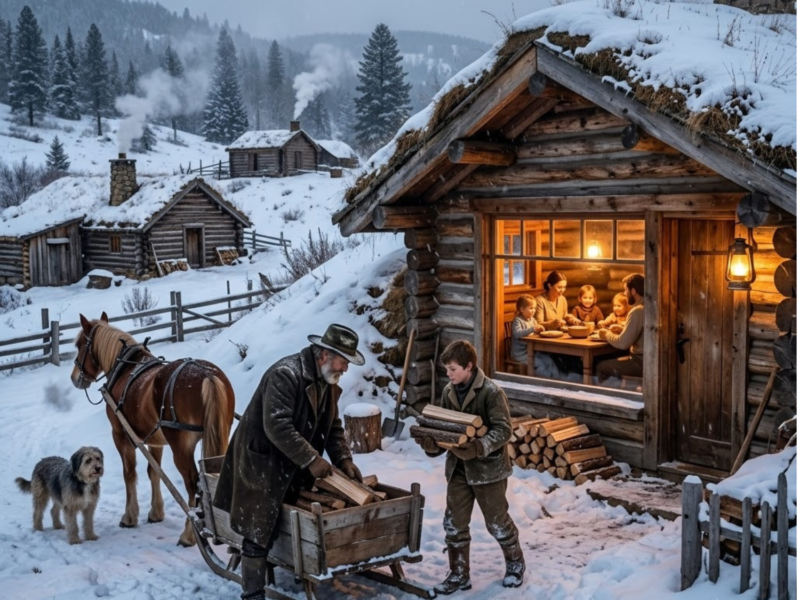
Settlers Mocked His Hillside Cabin But His Family Stayed Warm While Neighbors Froze
The Assessor's Conversion
Harmon Wickersam was out in the open when the worst of the storm hit.
It was mid-afternoon on January 13th, and he was attempting to finish his tax collection circuit, pushing hard to reach the safety of Fort Yates before the sun dropped and the temperature plummeted with it. Buffalo robes were wrapped tight around his chest, his face mask pulled up to his eyes, yet the biting cold still found its way in.
Then the sled broke.
The iron runner, made brittle by days of deep negative cold, caught a hidden frozen rut and snapped clean in half. Just like that, he was stranded on the open plains. The wind howled like a banshee. The thermometer had fallen past 30 below, and Fort Yates sat miles away across open, featureless snow.
Desperate, Wickersam looked up the slope.
The Colomatz place was barely visible—just a white, snow-draped mound against the hillside. But a thin, steady plume of gray smoke climbed cleanly from its stone chimney.
Leaving his ruined sled where it lay, Wickersam tied his shivering horse in the lee of the hill and waded through the deep snowdrifts toward the south wall. He expected to find a dark, freezing mud hole reeking of rot and desperation—a family huddled around a dying fire, exactly as his official assessment had predicted months before.
He knocked hard with a frozen mitten and shoved the heavy oak door open.
The air hit his face like a physical wall—not merely warm, but comfortably, structurally hot: a heavy, dry, enveloping 26 degrees Celsius. Within thirty seconds, Wickersam was sweating profusely, fumbling clumsily at the buttons of his heavy buffalo coat with fingers too stiff from the cold to work properly.
He stared into the room, and his rigid bureaucratic assessment died right where he stood.
Ivan and Lesia were sitting on the floor barefoot, dressed in light linen shirt-sleeves, quietly playing on dry, hard-packed earth. Oxana sat near the recessed south window, mending a garment in the natural daylight, her posture easy and unhurried. Vassel sat near the stove—not feeding it, not nursing it, but calmly whittling a small piece of oak.
And then there was the shelf.
January 13th was Malanka—Ukrainian New Year’s Eve. Sitting on a wooden shelf just three meters from the stove was a ceramic crock of holubtsi, traditional cabbage rolls in rich tomato sauce.
In Silus Vance’s cabin just a mile away, a pot of water placed a meter from the stove had frozen solid overnight. In Elias Thorne’s home, family food had to be chopped free from the pantry shelves with an axe.
Wickersam reached out and touched the crock with his bare palm. It was warm. It was soft. The ambient, radiant heat of that buried room was so perfectly even, so constant, that cabbage rolls had stayed warm on an open shelf through the height of a polar outbreak.
He stood there with his heavy coat hanging off his shoulders, sweat drying on his forehead, finally understanding that the earth itself had been holding the lethal cold at bay.
He turned to Vassel, and when he spoke, all official authority had vanished from his voice.
“You didn’t build a cabin,” Wickersam said softly. “You built a thermal anchor.”
Vassel looked up from his whittling. He did not gloat; he did not demand an apology for the threat of revoking his land title back in April. He simply gestured toward an empty wooden chair sitting by the stove.
“Sit,” Vassel said. “The cold is bad today. Eat some cabbage.”









