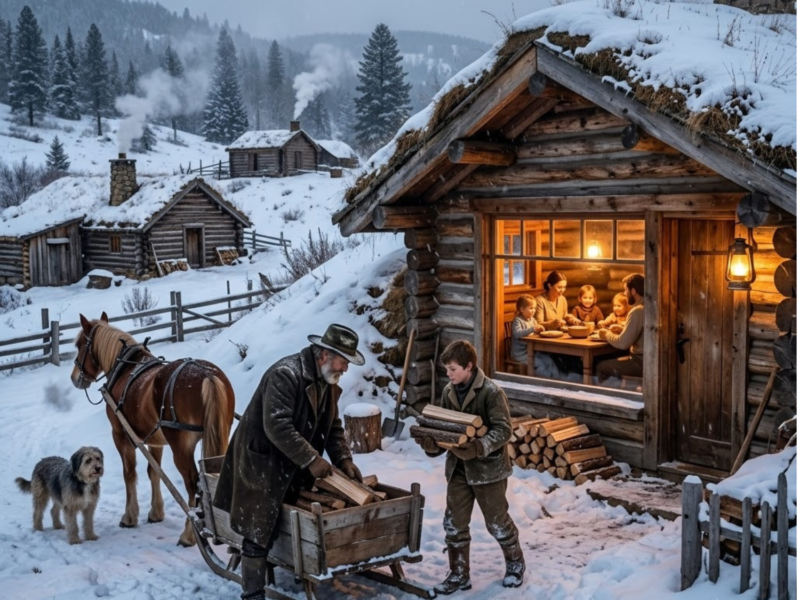
Settlers Mocked His Hillside Cabin But His Family Stayed Warm While Neighbors Froze
The Legacy of the Zlyanka
Wickersam never revoked the title. He was supposed to—that was the entire administrative point of his April inspection. But somewhere between his broken sled runner and that warm ceramic crock, the assessor stopped being a man who filed complaints and became a man who told everyone else how to survive.
All through the following spring, he rode the exact same tax circuit with the exact same leather ledger. Only now, when he stopped at a freezing shanty, he wasn’t writing citations; he was describing a hillside. He told every desperate settler in Emmens County about the family that had stayed warm through the worst winter in memory. He told it the way a man tells a secret he can no longer keep.
The frontier didn’t care about elite pedigree; it cared about survival.
By March of 1900, Ukrayinsky Holos, a Ukrainian-language newspaper published out of Bismarck, printed a full, detailed schematic of Vassel’s design: the precise measurements of the excavation, the exact thickness of the loess berms, and the critical southern exposure that allowed the low winter sun to reach deep into the interior. It was all there in print for anyone willing to copy it.
And the numbers were impossible to argue with.
While conventional prairie cabins burned through eight cords of wood in a single punishing winter, Vassel had burned just a little more than one. That was the singular figure that ended the debate once and for all—not abstract philosophy, not old-world tradition, but eight cords versus one.
By autumn, six Bukovinian families across Emmens and Logan counties walked away from their drafty, freestanding wooden shanties. They carved their own zlyankas into the south-facing terraces of the Dakotas, adopting the same hillside berms, the same thick sod roofs, and the same recessed southern windows. Across those six families, fuel savings averaged an astonishing 83 percent.
A personal survival strategy had instantly become a regional building method.
Yet the frontier at large had no idea what it had truly copied. The assessor had it completely backward in his initial ledger entry: You have dug a cellar. You have built a burrow for an animal.
Six families proved him profoundly wrong the very next winter. An 83 percent reduction in firewood usage. And the man who had filed the original complaint spent his spring telling every freezing settler in Emmens County exactly where to dig.
The engineering was never primitive. It was simply centuries ahead of the American building curve.
What the frontier dismissed as an animal’s burrow, modern building science now recognizes as high-performance earth-sheltered architecture. The principles Vassel used instinctively have formal names today: massive thermal coupling, passive solar orientation, and the utilization of the earth’s constant subterranean temperature.
Those ideas did not reach mainstream modern architecture until the global energy crisis of the 1970s—nearly eighty years later. Today, modern architects pour reinforced concrete, hang rigid foam insulation sheets, and install advanced multi-pane glazing systems to achieve precisely what Vassel reached with a wooden spade, local oak, and tons of packed loess.
The physics never changed. The earth is an infinite thermal battery. Couple a structure to it properly, and the violent, capricious swings of surface weather stop mattering entirely. That was the whole trick. It always was.
The experts of 1899 measured human progress by how fiercely they fought the sky. Vassel simply asked a hillside to act as three walls, leaving only the sunny face open to the heavens. Generational knowledge, tested and adapted through centuries of human endurance, beat institutional arrogance every single time.
The burrow kept a family alive. The ledger kept a grudge. Only one of them is still standing.









