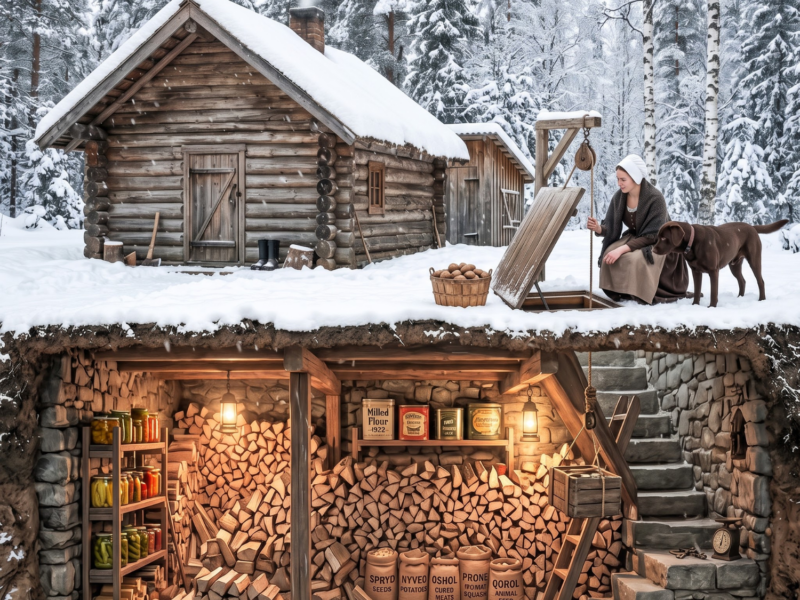
She Built a Dugout Cabin Beneath the Home — Then the Rich Neighbor Came Begging in the Storm
She Built a Dugout Cabin Beneath the Home — Then t…
The hand appeared first.
It pressed flat against the frosted rear window of a small log cabin on a brutal February night. It was a night so impossibly cold that the glass had stopped being transparent and had become something closer to opaque, frozen stone.
The hand was large. It was a man’s hand. The knuckles were split completely open, bleeding sluggishly, and the tips of the fingers were blackened with the unmistakable, necrotic stain of deep frostbite. The hand moved in a slow, rhythmic, pathetic knock against the pane. It was a knock that had absolutely nothing of urgency left in it.
It was the knocking of a man who had already spent absolutely everything he had just to reach the door. Whatever meager strength remained in his freezing body was only enough for this: One tap. A long pause. Another tap, slower and weaker than the last.
Inside the cabin, a woman sat calmly reading a leather-bound book by the dim, golden light of a single oil lamp.
The room around her was dark, and the ambient temperature was dropping fast toward freezing. She had been sitting there, listening to the shrieking wind outside for three days. She knew the difference between the sound of a tree branch, the sound of the wind, and the sound of something else entirely.
She set the heavy book down on her knee. She looked up at the ceiling, as if she could see straight through the timber joists, through the accumulated snow on the roof above, to whatever desperate creature was making that sound at her window.
She could not see him. But she knew exactly what it was. She stood up, her face a mask of practiced, unshakeable calm.
Six months before that freezing man knocked on her window, begging for his life, he had stood on the other side of a wooden fence in the bright summer sun and publicly called her a lunatic.
Tonight, he was actively dying on her doorstep. And she was the absolute only reason he still had a chance to see the morning.
Flashback: April 1885
Hazel Voss arrived in the growing settlement of Millhaven on a Tuesday morning in early April. The last of the heavy winter snowpack was just beginning to pull away from the lower slopes of the valley, and the muddy ground was showing through in wet patches the color of old, chewed tobacco.
She came riding in the back of a hired wagon, sitting beside two heavy wooden trunks of practical belongings and a large, reinforced crate of books meticulously wrapped in waterproof oilcloth. She paid the wagon driver with silver coins, offering absolutely no conversation, and stood alone in the muddy road in front of the small cabin on Blackwood Road.
She looked at the cabin the way a seasoned field doctor looks at a patient who has been severely neglected, but not yet entirely lost.
Hazel was forty-two years old. Her hair was a dark, practical brown, going a distinguished silver-gray at the temples, worn tightly in a thick braid that she had been doing herself without a mirror since she was twelve.
But her hands were the most honest, telling part of her.
They were the hands of someone who had spent fifteen years doing brutal, unforgiving work that most people did not survive long enough to master. The knuckles were thick with accumulated calcium from old breaks. The palms were heavily calloused in very specific, geographical places: from the burning grip of a hemp rope, from the wooden handle of a steel ice ax, from the particular, agonizing friction of a frozen leather bridle held for hours in sub-zero air.
A man named Colonel Hewitt, who had commanded the isolated Wyoming military garrison where she had worked as a civilian contractor for eleven years, once told a cocky new officer a profound truth about her. He told the lieutenant that the quiet woman who would be guiding their vital winter supply convoy through the mountain pass had forgotten more about extreme cold weather survival than any soldier in the regiment would ever know.
Hewitt had not been flattering her. He had been warning them.
She had left that grueling work the previous autumn. Not because she could no longer physically do it, but because fifteen years of constantly leading other, less capable people through mortal danger had left her with a deep, echoing, and quiet need to build something that was only hers. She wanted something she did not have to hand back to the quartermaster at the end of the season.
The cabin she had purchased on Blackwood Road was a rough log structure dating back to the early gold rush days of the 1860s. It sat on a slight rise at the north edge of town.
The purchase price was suspiciously low, for reasons that became apparent to Hazel very quickly upon inspection.
The foundation was nothing more than dry-stacked fieldstone, with gaps wide enough for a man to push his fist through. Beneath the drafty floorboards was an unimproved, dirt crawlspace, open to the freezing ground, smelling constantly of mineral earth and wet, old rot. The cedar shake roof had been repaired at least twice by amateurs with mismatched, inadequate materials. The wooden window frames had shrunk and worked themselves completely loose from the logs around them over decades of freeze and thaw.
In a hard, driving winter blizzard, the structure would breathe freezing cold air like a living, gasping thing, aggressively pulling the wind in through every gap, crack, and failed joint.
Hazel walked the perimeter of the cabin slowly. She rapped her hard knuckles against the exterior logs at regular intervals, tilting her head to listen intently to what acoustic resonance came back.
It was a survival method she had learned from an old Shoshone guide named Francis Two-Clouds. He had told her that every structure, whether a mountain or a house, had a voice. And that voice told you exactly where it was honest, and where it was pretending to be strong.
She finished her circuit, came back to the front porch, and stood for a moment with her hands jammed deep in her pockets, calculating the physics of the impending failure.
Then, she went inside, unfolded a piece of graph paper from her coat pocket, and smoothed it flat on the dusty kitchen table.
The first line on the paper, written in her own neat, block handwriting, read:
Dig the dugout beneath the storage room. Complete before October.
Related Articles

They Mocked the Widow’s Dirt Cellar—Then the Freeze Left Every Cabin Cold but Hers Warm
They Mocked the Widow’s Dirt Cellar—Then the Freeze Left Every Cabin Cold but Hers Warm…

A Homeless Veteran and His German Shepherd Inherited a Ridge No One Wanted — 35 Feet In, They Found
Chapter 1 / 7 A Homeless Veteran and His German Shepherd Inherit… A Homeless Veteran…

Neighbors Laughed When He Built A Cabin Inside An Old Barn—Until It Kept His Home 35 Degrees Warmer
Chapter 1 / 8 Neighbors Laughed When He Built A Cabin Inside An… Neighbors Laughed…

His Sod House Had No Woodpile in January – Until the Trains Stopped and the Town Came Begging
Chapter 1 / 10 His Sod House Had No Woodpile in January – Until t……

She Built Her Cabin Over the Woodshed and Never Burned Wet Wood Again
Chapter 1 / 8 She Built Her Cabin Over the Woodshed and Never Bu… She…

The Duke Abandoned Her on Their Wedding Day—Years Later, He Discovered What He Had Lost
Chapter 1 / 7 The Duke Abandoned Her on Their Wedding Day—Years… The Duke Abandoned…

He Wedged a Tiny A Frame Into a Crevice Before Winter and His Family Slept at 75°F While Town Hit
Chapter 1 / 7 He Wedged a Tiny A Frame Into a Crevice Before Win……

He Was Too Old to Ride—So He Bought the Ruined Ranch and Found the Room Behind the Fireplac
Chapter 1 / 5 He Was Too Old to Ride—So He Bought the Ruined Ran……

Settlers Laughed at His Underground Heat Recovery Duct — Until It Kept His Cabin 71°F Warmer
Chapter 1 / 9 Settlers Laughed at His Underground Heat Recovery… Settlers Laughed at His…

A Navy SEAL Built a Home Inside a Mountain—Then His Dog Warned Him Before the Storm
Chapter 1 / 5 A Navy SEAL Built a Home Inside a Mountain—Then Hi… A…