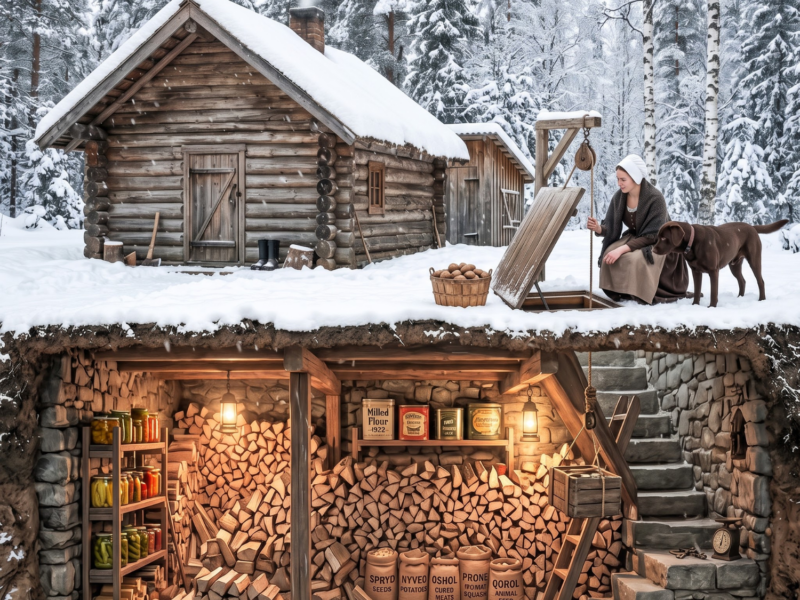
She Built a Dugout Cabin Beneath the Home — Then the Rich Neighbor Came Begging in the Storm
The Apprentice of the Earth
What ultimately saved Hazel from a particular, suffocating kind of loneliness that long, hot summer was the boy across the fence.
Tobias Crane was nineteen years old. He had come to Millhaven on a freight wagon from a failing farm outside of Cedar Rapids, Iowa, with absolutely nothing to his name except a serviceable knowledge of draft horses, and the kind of deep, physical endurance that comes from having worked since childhood without anyone ever asking whether you were tired.
He worked full-time for Cornelius Algate. Toby did all the brutal, menial labor that Cornelius needed done to maintain his grand estate, but absolutely did not want to think about doing himself: mucking out the small, pungent stable; splitting the decorative, perfectly sized firewood for the front porch pile; running trivial errands into town.
Toby was a quiet, deeply attentive young man. He observed the chaotic world around him with the incredible patience of someone who has learned the hard way that the world does not slow down to explain itself to poor boys.
The first time he stopped his work at the fence line to watch Hazel dig, he said absolutely nothing. He stood leaning on his rake for perhaps ten minutes. He watched the steady, efficient rhythm of her work. He noted the precise way she positioned the heavy pickaxe before each stroke to maximize leverage. He observed the meticulous system by which she sorted the displaced earth into wheelbarrow loads, separating the clay from the topsoil.
Then, he quietly went back to his own exhausting tasks.
He came back to the fence the following Saturday. And the one after that.
Eventually, sensing she wasn’t going to chase him away, he began to ask questions. And they were the right kind of questions. They were specific, intensely practical, and entirely without the mocking condescension that the rest of the town’s questions carried.
“Why white oak?” Toby asked one morning, leaning on the top fence rail as she stacked her underground woodpile.
Hazel set the pickaxe down and slowly straightened her aching back. She looked at the boy.
“Burns slow and even,” she said simply. “Soft wood, like pine, burns hot and incredibly fast. You get two hours from a pine log. Maybe three if you damp it down. In a long, three-day storm, when you can’t go outside to get more, that burn rate matters. You want wood that coals.”
“How long a storm are you planning for?” Toby asked.
“Long enough.”
“And the stove?” he pointed toward the open trapdoor. “Why the small one? Why not a regular, massive wood stove to heat the whole place?”
“Because in a small, completely enclosed space underground, a regular wood stove will literally cook you alive,” Hazel explained, wiping her brow. “And it consumes oxygen too fast. The parlor stove puts out exactly enough radiant heat for the small room without stripping all the breathable oxygen. The offset flue arrangement is the key. It slows the exhaust.”
Toby nodded slowly. It was the deep, processing nod of someone actively storing vital information for later use, not merely politely acknowledging it.
Hazel picked up the pickaxe again. After a moment, she paused and added, without looking at him, “Any other questions you have, ask them, Toby. Don’t just stand there looking like you’re working a difficult math problem out in your head.”
After that invitation, the questions came much more regularly. And Hazel found, to her surprise, that answering them was not a burden.
The boy listened to her. He listened the exact way she had listened to Francis Two-Clouds thirty years ago in the mountains: with the absolute whole of his attention, entirely without the male ego’s need to demonstrate that he already knew the answer.
The day the earth finally gave up its ancient secret was a sweltering Thursday in late July.
Hazel was extending the northeast corner of the dugout, carving out a small alcove, when the sharp steel edge of her pickaxe struck something that was definitively not a stone.
The sound was wrong. It was hollow, metallic, and dull.
She immediately went to her knees in the dirt and carefully cleared the surrounding earth away with her bare hands. What she uncovered was a heavy tin box, roughly the size of a large, thick book. It was sealed tightly at the seams with lead solder that had oxidized and darkened to the color of old, wet charcoal.
She carried it up the wooden stairs into the blinding light of the kitchen. She set it on the table and carefully worked the soldered seam open with a hammer and a steel chisel.
Inside, wrapped securely in an oiled cloth that had mostly survived the dampness of the earth, was a journal.
The cover was dark brown leather, heavily cracked and peeling at the spine. She opened it gently. On the inside front page, written in a careful, faded, looping hand, it read:
Ezra Whitmore. Millhaven Settlement, Montana Territory. April, 1863.
She read it that entire evening sitting at the kitchen table, moving slowly through the years of Ezra’s life. She read the mundane entries about shifting weather patterns, the struggle of spring planting, unfair trade prices at the fort, and the constant, terrifying specter of illness. It was a record of the small, daily, agonizing negotiations of a life lived at the absolute, jagged edge of viability.
Most of it was incredibly ordinary, in the specific way that frontier survival is ordinary: constant, unglamorous, and demanding absolutely everything a person has to give.
Then, she reached the final entry in the book.
The handwriting here was completely different. The letters were much larger, erratic, and far less controlled. It looked as if it had been written by desperate firelight, in a frantic hurry, or perhaps by a hand that was shaking violently with cold or fear.
February, 1868.
The storm came out of the north on the 14th, and it did not leave the valley for 17 days. The Carver family on the North Ridge… husband, wife, and three young children. All of them gone. We found them in March when the snow finally came down enough to walk. They had plenty of firewood stacked inside. But the chimney was blocked solid with ice from the blizzard, and they could not light the stove without suffocating on the smoke. They froze in their beds.
We survived because of the hole. It is always the hole that saves you.
To whoever reads this in the future: Dig deeper than you think you need. Dig deeper than seems reasonable to a sane man. The wind lies. The sun lies. The hole is the only thing on this prairie that does not lie to you.
Hazel sat alone in the kitchen with the open journal, closing her calloused hands over the faded pages for a long time. The light outside was rapidly going, and the cabin was growing dim and shadowed around her.
Then, she stood up. She lit an oil lantern, walked to the trapdoor, and went down into the dugout.
She stood in the absolute center of the half-finished dirt room. She raised the lantern and looked at the earthen walls, the cedar ceiling, and the stove alcove she had just begun cutting into the east wall.
She set the lantern down on a crate. She picked up the heavy iron pickaxe.
And she dug for another two agonizing hours in the dark, going eighteen inches deeper into the earth than her original, calculated plan had called for.









