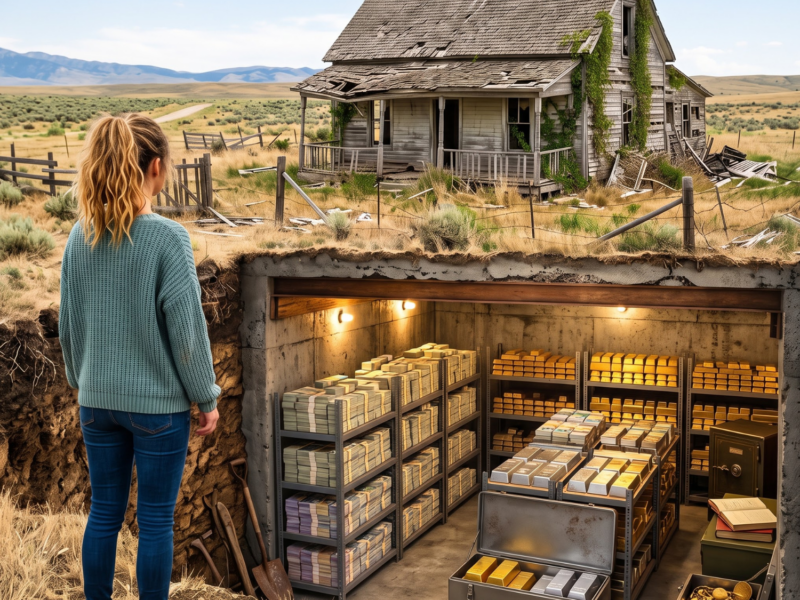
She Inherited a Broken Ranch Nobody Wanted — Then Found Millions Hidden Beneath the Floor
The Hollow Thud
The night was entirely without peace.
The house didn’t just settle; it actively argued with the wind. Every gust off the high plains made the roof joints scream like wounded animals, and the window panes rattled like loose teeth in a skull. Sadie slept on a relatively clean patch of the living room floor, wrapped tightly in a nylon sleeping bag she’d kept in her trunk.
By 5:00 a.m., the desert cold had seeped upward through the floorboards and deep into her joints. She woke up stiff, shivering, covered in a thin film of grit, and severely craving a cup of coffee she didn’t have.
The pale morning sun cast a harsh, unforgiving light on the squalor. Sadie stood up and stretched, her lower back popping in protest. Granger was right. The place was a liability. There was no redeeming this rot.
But a stubborn streak—one she heavily suspected she had inherited from the very man who ruined this house—kept her from driving to town and picking up the phone right away. She wanted to clear out Arthur’s bedroom. If there was a family Bible, a photograph, or even a few hidden twenty-dollar bills stuffed in the pocket of an old winter coat, she was going to find it before she handed the keys over to a man who wore khakis in the desert.
Arthur’s bedroom was at the back of the house, situated at the end of a narrow, dark hallway that smelled of old dog and dust.
The door was stuck, the frame warped by moisture and time. Sadie shoved her shoulder against the wood, driving her weight into the panel until the swollen door popped open with a loud, splintering crack.
The smell hit her instantly. It was the sharp, medicinal scent of camphor, stale pipe tobacco, and closed-in desperation.
The room was surprisingly sparse compared to the hoarded madness of the rest of the house. A bare, stained mattress sat on a metal frame. A single wooden dresser leaned heavily to the left, missing its bottom two drawers. The floor was covered in an ugly, faded linoleum rug—a cheap floral pattern from the sixties—that curled upward at the edges, revealing the raw pine subfloor beneath.
Sadie started with the closet. Empty wire hangers clattered together like wind chimes. A pair of stiff, mud-caked leather work boots sat in the corner. She moved to the dresser. The remaining drawers held nothing but moth-eaten wool socks and a single, rusted pocketknife. She tossed the knife into her jeans pocket.
Useless, she thought. All of it.
She walked toward the window to pry it open and let some fresh air into the tomb. As she stepped off the edge of the linoleum rug and onto the bare pine near the foot of the bed, her boot came down hard.
Thud.
Sadie stopped.
She took a step back. She stepped forward again, bringing the heavy heel of her boot down on the exact same spot.
Thud.
It was hollow.
It didn’t sound like solid wood hitting a structural joist. It sounded like wood hitting empty, cavernous space.
She frowned, dropping to her knees and looking down. The floorboards in this specific corner of the room didn’t span the entire length of the wall. Three distinct pine boards were cut short, terminating in a jagged, hand-sawn line about two feet from the baseboard. They were nailed down, but as she ran her fingers over them, she noticed something. The nail heads weren’t rusted flush like the rest of the floor. They looked relatively new. They were scratched and shiny in places, as if they had been violently pulled and hammered back into the wood multiple times.
Sadie’s heart did a strange, slow roll in her chest.
She knelt closer, blowing the dust away from the seam. A faint, imperceptible draft of cool, earthy air was seeping up from the narrow gap.
She stood up quickly, left the bedroom, and went out the back door to the collapsed structure that used to be a tool shed. She dug frantically through piles of rusted logging chains and brittle plastic tarps until her fingers closed around the heavy, cold iron of a flat-headed crowbar.
Back in the bedroom, Sadie wedged the sharp lip of the crowbar into the seam of the first cut board. She leaned her weight back. The old wood groaned, resisting fiercely. She braced her boot against the floor and pulled harder, the muscles in her forearms burning.
With a loud, violent screech of metal against wood, the nails tore free. The board popped up, hitting her hard in the knee. She winced, grabbed it, and tossed it aside.
Beneath the board was a layer of thick, heavy black plastic sheeting. It was covered in a layer of dead spiders and dry dirt.
Sadie wedged the crowbar under the next two boards, leveraging them up one by one until a two-by-three-foot rectangular hole was exposed in the floor. She dropped the crowbar. It clattered loudly in the quiet room.
Sadie knelt by the hole. Her hands were shaking slightly. She grabbed the edge of the black plastic sheeting and pulled it back. It crinkled loudly, stiff and brittle with age.
Beneath the plastic was a deep cavity nestled between the heavy floor joists. It wasn’t just dirt. Arthur had dug out the earth beneath the crawl space and poured a rough, makeshift concrete tub to seal off the moisture from the ground.
Inside the concrete depression sat four heavy, olive-drab metal boxes. Surplus military ammunition crates. They were covered in a fine layer of white oxidation, the heavy latches secured with thick brass padlocks.
Sadie reached down into the hole and grabbed the canvas handle of the first crate. She pulled up.
It didn’t move. It felt like it was bolted to the earth.
She planted both hands on the handle, braced her knees against the edge of the jagged floor hole, and heaved with everything she had, gritting her teeth. The crate cleared the hole and slammed onto the linoleum rug with a heavy, metallic SLAM that rattled the window panes. It had to weigh at least sixty pounds.
She stared at the brass padlock. She pulled the rusted pocketknife she’d found earlier from her jeans, opened the stiff blade, and wedged it into the keyhole, trying to force the mechanism. The brittle blade snapped instantly, the tip flying across the room.
Frustrated, adrenaline surging, she grabbed the crowbar. She brought the heavy iron head down on the brass padlock. Once. Twice. On the third strike, the brass shackle bent. On the fourth, it cracked open.
Sadie pulled the broken lock away, her chest heaving. She flipped the metal latch on the side of the crate. It popped with a sharp hiss, breaking a vacuum seal that had held for God knew how long.
She grabbed the heavy metal lid and threw it back.
Sadie stopped breathing.
The air left the room. The silence became absolute. She stared down into the crate, her mind completely and utterly failing to process what her eyes were seeing.
She didn’t find old letters. She didn’t find a family Bible. She didn’t find stacks of moldy cash.
She reached into the crate, her fingers trembling so violently she could barely control them, and pulled out a heavy, dull yellow brick.
It was the size of a thick paperback book, wrapped tightly in a rotting layer of wax paper. The wax paper flaked away as she touched it, falling like snow, revealing the cool, heavy, unmistakable gleam of solid gold. Stamped into the center of the metal was a serial number and a purity mark: 999.9 FINE GOLD.
Beneath it lay another. And another. Neatly stacked, packed tight, heavy enough to break the floorboards, cold to the touch.
Sadie looked from the gold bar in her hands to the three remaining sealed crates sitting quietly in the darkness beneath the floor.
Five thousand dollars. Granger had offered her five thousand dollars. She was currently holding more than that in her left hand.









