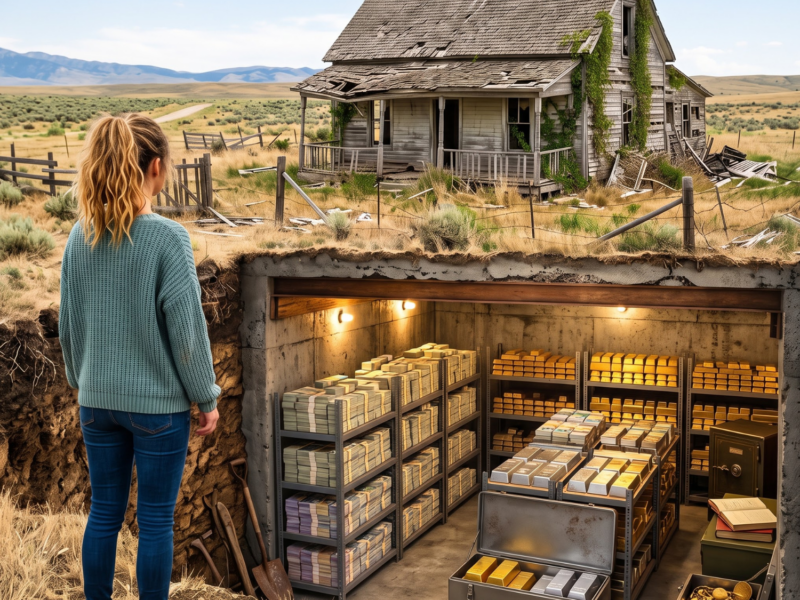
She Inherited a Broken Ranch Nobody Wanted — Then Found Millions Hidden Beneath the Floor
The Siege
A sharp, sudden flash of white light swept across the bedroom wall, cutting through the gap in the curtains.
Sadie killed her flashlight instantly. The bedroom plunged back into pitch black. She held her breath. The light swept past the window again.
Headlights. A vehicle was coming up the long gravel driveway. It wasn’t driving fast. It was crawling, the engine idling low and quiet, minimizing the sound of the tires on the dirt.
She crept out of the bedroom, keeping her back pressed flat against the hallway wall, and moved toward the living room. She crouched behind the barricaded sofa and peeked through a crack in the dusty window panes.
The dark sedan was parked fifty yards from the house, its headlights cutting through the swirling dust. The engine cut off. The headlights died. The ranch was swallowed by the darkness once more.
Then she heard it. The heavy, unmistakable thud of a car door closing softly. Then another.
Footsteps crunched on the gravel. Slow, methodical, moving toward the front porch. They were spreading out.
Sadie tightened her grip on the heavy iron crowbar in her right hand, her knuckles turning white in the dark. The siege had begun.
The wooden stairs of the front porch groaned under heavy boots. Sadie remained crouched behind the sofa, barely daring to draw a breath. She counted two distinct sets of footsteps. They moved with terrifying patience. There was no hurried scrambling, no whispered arguing. This was a clinical approach.
The handle of the front door clicked. Someone was testing the latch. The door didn’t budge.
A heavy shoulder slammed against the wood. The frame shuddered, sending a cascade of dry dust raining down from the ceiling, but the thick steel screws and the heavy-duty padlock she had just installed held firm.
“Locked tight,” a voice murmured outside. It was a deep, raspy baritone, muffled slightly by the thick door. “New hardware. Hasps are bolted in.”
“Check the back,” a second, smoother voice replied. “She’s in there. I saw her car.”
Footsteps retreated down the porch stairs and crunched along the side of the house.
Sadie didn’t wait. She abandoned the window, staying low to the ground, and scrambled back toward the kitchen. She bypassed the kitchen entirely and headed straight for the hallway closet where she had seen Arthur’s emergency supplies earlier that day.
Her hands flew over the shelves in the dark, knocking over empty cardboard boxes and a hardened paintbrush until her fingers bumped against heavy, cold metal. It was a five-gallon jerry can.
She unscrewed the cap. The sharp, volatile fumes of old kerosene hit her face, burning her nostrils and making her eyes water. It was half full. She grabbed the heavy can by the handle and dragged it down the hallway, back into Arthur’s bedroom.
Outside, a heavy thud shook the rear of the house. They were kicking the back door.
“Come on,” the raspy voice grunted.
A metallic scraping sound followed. They were trying a pry bar on the back hinges. The old wood splintered loudly, but the steel padlock Sadie had installed held the frame together.
Sadie knew it was only a matter of time. Locks merely bought minutes against men who didn’t care about making noise. If they couldn’t get through the doors, they would eventually just shatter a window and climb through the glass. She couldn’t fight two grown men with a crowbar. She needed leverage, and she needed it immediately.
She tipped the jerry can.
The clear, oily kerosene sloshed out, splashing across the dry, rotting floorboards of the bedroom. She poured it generously over the linoleum rug that hid the loose boards. She splashed it onto the mattress, against the drywall, and pooled it near the bedroom doorway. The fumes rapidly filled the small, suffocating space, turning the air toxic and heavy.
Sadie tossed the empty can aside, pulled a box of wooden strike-anywhere matches from her jeans pocket, and stepped out into the hallway.
CRASH!
The sound came from the living room. The shattering of heavy glass. They had given up on the doors. Someone had taken a tire iron to the picture window right above the sofa she had used as a barricade.
“Clear the glass,” the smooth voice ordered calmly.
Sadie walked down the hallway until she stood in the arched entryway between the hall and the living room. She couldn’t see them clearly, but she could see the massive silhouettes of two large men climbing over the back of her floral sofa, their boots crunching on broken glass.
One of them held a long, heavy tactical flashlight. The beam clicked on, sweeping the room, illuminating the towering piles of garbage.
The light hit Sadie and stopped.
She squinted against the blinding glare. She didn’t raise her hands. She stood perfectly still, holding a single wooden match in her left hand, the matchbox in her right.
“Ms. Miller,” the smooth voice said. The man holding the flashlight stepped down from the sofa. He wore a dark jacket and moved with practiced, lethal ease. “You’ve been busy today.”
“Stop right there,” Sadie said. Her voice didn’t shake. The sheer terror had burned away, leaving nothing but a cold, cynical adrenaline.
The man took another step forward. “We aren’t here to hurt you. We’re here to retrieve company property your grandfather absconded with. Assets that do not belong to his estate. We know it’s in this house. Show us where it is, and you can get in your car and drive away, just like Granger offered.”
“I know what’s in the floor,” Sadie said loudly, ensuring her voice carried over the wind howling through the broken window. “I found the crates.”
The flashlight beam dipped slightly, betraying the man’s sudden interest. “Then you know how heavy they are. You can’t take them. Be smart, Sadie.”
“I also found the ledger,” she lied, twisting the truth just enough to make it a weapon. “The little black book. The one where Arthur wrote down the dates, the shaft numbers, and the names of the corporate officers moving unregistered bullion to dodge federal oversight.”
The room went dead silent. The wind seemed to hold its breath.
The second man, the raspy one, shifted his weight, crushing glass under his boot. “She’s bluffing.”
“Am I?”
Sadie struck the wooden match against the box. It flared to life with a sharp hiss, casting a flickering orange glow over her face.
The man with the flashlight raised a hand, stopping his partner. “Put the match out. Take a deep breath.”
“No, you take a deep breath,” Sadie commanded.
The men paused. The wind blew through the house, carrying the heavy, suffocating stench of kerosene from the back hallway straight into the living room. The smell was overpowering.
“I poured five gallons of it over the bedroom floor,” Sadie said, holding the burning match steadily. It was burning down toward her fingers. “I poured it over the crates. I poured it over the ledger.”
“Gold doesn’t burn, you idiot,” the raspy man sneered, taking a half-step forward.
“No, it melts,” Sadie shot back, her voice ringing with absolute authority. “It melts into a giant, unrecoverable slab of slag buried under the ashes of a house fire that is going to bring every fire engine, state trooper, and federal investigator in the county straight to this exact GPS coordinate.”
The men froze.
“And the ledger,” Sadie continued, stepping closer to the hall. “The book that proves your bosses are running an illegal vault? That will burn. It will be gone forever. Which means you’ll have absolutely nothing to show your boss except a smoking crater and a massive federal investigation.”
The match burned her thumb. She dropped it on the floorboards, inches from a pile of old newspapers, and immediately struck another one. It flared bright in the dark.
“Wait,” the smooth-voiced man said sharply. He lowered the flashlight completely, aiming it at the floor. “What do you want?”
“I want out,” Sadie said. “And I want a severance package for Arthur.”
“How much?”
Sadie looked at the two men standing in the ruins of her grandfather’s miserable, hoarded life. They had millions buried thirty feet away, and they thought they could just take it because she was small and poor.
“One crate,” Sadie said. “I take one crate. You take the other three. You leave tonight, and you never come back to this property. If I see a dark sedan, a man in khakis, or a shadow out of place anywhere I go, I mail the ledger to the IRS.”
The man in the dark jacket stared at her for a long time. The wind howled through the broken window, rattling the trash on the floor. He was doing the math. Losing one crate was a severe penalty. Explaining an inferno and a federal raid was a death sentence.
“One crate,” he finally agreed, his voice tight with suppressed rage. “We take the rest now.”
“I’ll carry mine out first,” Sadie said, holding the match high. “And you better hope I don’t trip in the dark.”









