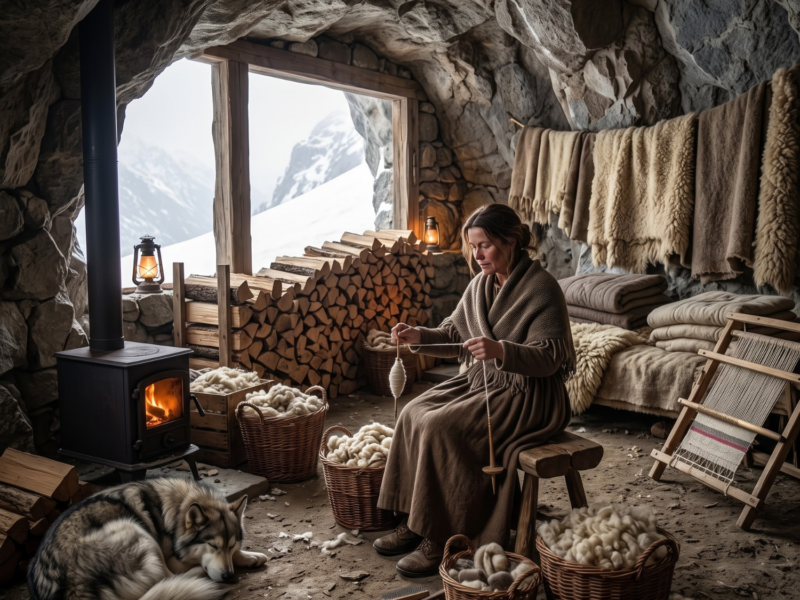
She Stocked a Cave With Wool and Firewood — Then an 17-Day Blizzard Buried the Valley
THE WEIGHT OF A ARITHMETIC
By first light, the sheep had not moved an inch from the base of the crack in the hillside.
They stood pressed together like grey boulders, breath rising in short, uniform white clouds in the sub-zero dawn. None of them looked toward the empty pen below.
Elen Voss climbed up the steep, glazed grade after them, hauling a length of hemp rope she did not end up using. When she reached the flock, she expected them to scatter or press away from her approach. Instead, they parted just enough to let her through, their sides warm against her wool skirt, their breathing unusually rhythmic and calm.
That was the detail that stayed with her longest. Not that they had refused the gate—animals were skittish things, sensitive to barometric shifts humans missed—but that they seemed to already understand something she was only beginning to suspect.
The opening in the rock was barely taller than a man’s shoulder, half-hidden behind a heavy fold of limestone and an ancient, skeletal stand of white birch whose roots clutched the stone like arthritic fingers. Elen had passed it a hundred times while hunting stray lambs or gathering fallen branches. It had never held water in the spring. It had never smoked from smoldering brush fires or subterranean peat. It had never so much as dripped during the wettest autumns anyone in the valley could remember.
It was simply there, unremarkable until the day it was everything.
She crouched at the narrow entrance, setting the lantern aside, and pressed her cheek toward the dark opening. She felt the air moving against her face. It was cold, yes, but it was remarkably dry—bone-dry—and it carried none of the heavy, sulfurous, damp-earth smell she expected from a hole cut into a limestone rib.
Somewhere behind that dryness was an answer she did not yet have words for.
Her son, Anders, arrived fifteen minutes later, out of breath and sliding on the crusted snow, certain something catastrophic had happened to the flock overnight. When he saw his mother kneeling at the mouth of the fissure with her palm pressed flat against the ancient, grey stone, he stopped dead. He did not ask what she was doing.
In the fourteen months since his father died on the river ice, Anders had learned a quiet, defensive wisdom: some of his mother’s silences were structural. They were load-bearing walls. You did not lean on them unless you wanted the ceiling to come down.
Old Scog trotted up behind the boy, but he refused to cross an invisible threshold five feet from the mouth. He sat down in the frost, his eyes fixed on the dark seam, watching the black interior the way he used to watch a pantry door when he knew a slice of smoked pork was sitting just out of reach.
Elen stood, brushed the frozen crust from the knees of her wool trousers, and looked out over the valley far below.
From this height, the homesteads looked small and defenseless against the immense, white bowl of the hills. Smoke was beginning to rise from a dozen chimneys down along the creek. Every family for miles was stacking wood, hauling water, and battening down the hatches of lives built on predictable rhythms.
Then she looked back at the crack, and at the sheep standing shoulder-to-shoulder, waiting.
The warning had come down from the trading post three days earlier, carried by a mail rider whose horse was flecked with gray foam. The rivers to the north had frozen a full month early. The migratory birds that usually lingered into the first hard frost had vanished all at once in a single, silent morning, as if a firing squad had given a signal no human ear could catch.
Old men in the valley—men who measured time by timber blights and livestock slumps—said this winter had the feel of the iron years. The kind that came once in a generation and stayed until the floorboards were burned for heat.
For most families, a hard winter meant discomfort, thin soup, and cramped quarters. For Elen Voss, it meant a terrifying countdown.
Her husband, Peter, had died the previous winter. Not from illness or a tavern brawl, but from a single, uncharacteristic misstep on the black ice of the lower bend while hauling green timber home in the pitch dark. The valley had absorbed his death the way it absorbed most grief: with respectful silence, a casserole left on the porch, and shoulders that grew slightly more rounded.
What Peter left behind was a widow with two children—Anders, fourteen, and Ingrid, nine—a massive flock of sheep that produced more raw wool than she could sell in a depressed market, and a woodpile that had never quite recovered its old bulk.
Elen sat at the wooden kitchen table that evening, running her thumb along its scarred edge, doing the cruel arithmetic of survival. Wood divided by days. Wool that could trap heat against a body, but could not by itself keep two children breathing through sub-zero nights. A cabin with cedar-shake walls that had never been insulated against anything worse than a mild October draft.
For the first time since the funeral, she allowed herself to consider a terrifying possibility: the ordinary preparations, the ones every neighbor was making at that exact hour, were not going to be enough.
Not against seventeen days of a storm that had already arrived a month early.









