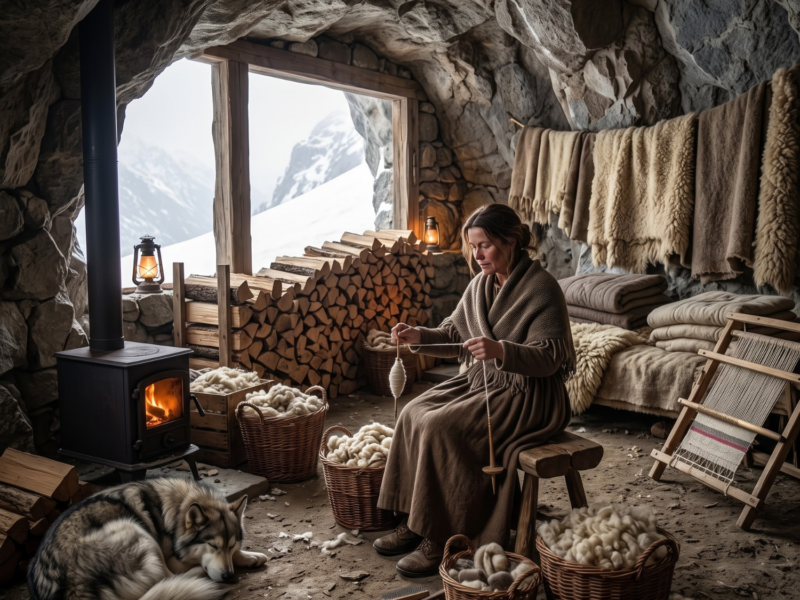
She Stocked a Cave With Wool and Firewood — Then an 17-Day Blizzard Buried the Valley
THE TRADING POST LAUGH
The trip into town to sell the remaining un-requisitioned wool clip had been booked a month prior. Elen saw no reason to cancel it. She needed the silver coin for spring seed, and pretending life was normal was sometimes the only shield a widow had against the pity of merchants.
She should have expected word had beaten her there.
Marta Linkfist was leaning against the counter of the trading post when Elen pushed the heavy oak door open. Marta was draped in a dark red wool coat trimmed with imported fox fur—a garment that cost more than a healthy milk cow. She was surrounded by a small cluster of local wives and farmers who fell instantly, awkwardly silent the moment the bell above the door jingled.
Marta turned slowly, a tight, thin-lipped smile playing at the corners of her mouth.
“Well, if it isn’t the mountain hermit,” Marta said, her voice carrying easily across the crowded room. “I hear you’ve found a magnificent new parlor for your sheep, Elen. A bit lower than your own roof, though. Must be cozy sleeping with the crickets.”
A ripple of suppressed laughter ran through the group of men near the stove.
Elen felt the familiar, hot prickle of shame rise up her neck, painting her cheeks. She was tired. Her shoulders ached from two days of hauling heavy grease-wool up a vertical sheet of ice, and her boots were caked in dried manure. It would have been so easy to lower her head, take the coin for the wool, and slink back to the cabin like a whipped dog.
Instead, she walked straight to the counter, dropped two heavy burlap sacks of fleece onto the oak planks with a dull, satisfying thud, and looked Marta dead in the eye.
“The crickets don’t charge interest, Marta,” Elen said, her voice steady and clearly audible in the quiet room. “And they don’t laugh at people who are trying to keep their children from turning blue.”
The silence in the trading post changed texture. The amusement died out of the farmers’ eyes, replaced by something heavier and more uncomfortable.
The buyer, an old man with ink-stained fingers named Thorson, stepped forward, flipped open the top sack, and plunged his hand deep into the lanolin-rich wool. He pulled out a handful, rubbed it between his thumb and forefinger, and looked up at Elen with a strange, appraising squint.
“This is clean clip,” Thorson muttered, counting out her silver coins with deliberate slowness. “Dry, too. Unusual for this time of year, Mrs. Voss. Most folks’ wool is damp from the river fogs before they even shear.”
“I keep it high,” Elen said, scooping the heavy coins into her leather purse.
She turned and walked out of the store without looking at Marta again. But as she stepped back into the freezing air, she noticed one of the men who had laughed loudest—a burly timber-cutter named Miller—lingering by the window, watching her go with a look not of mockery, but of deep, unsettled wonder.









