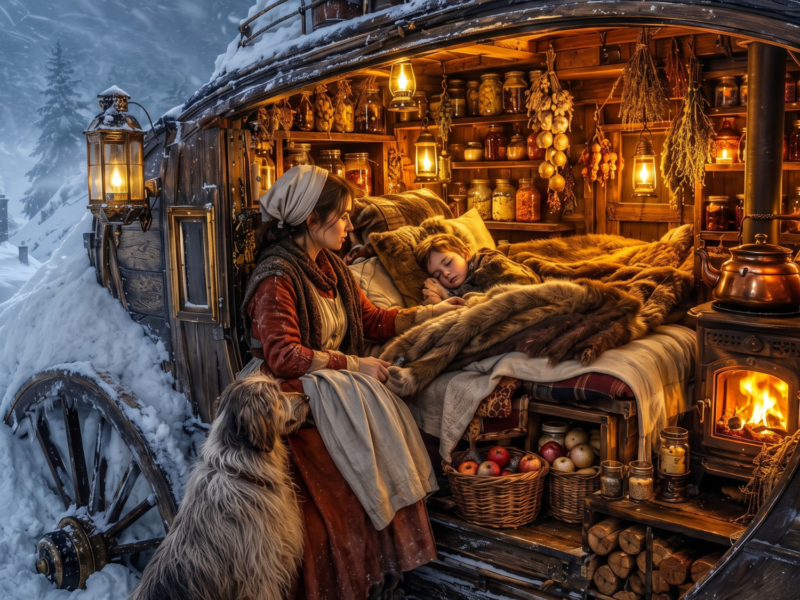
She Turned an Old Stagecoach Into Her Bedroom—Then the Worst Blizzard in 80 Years Buried the Town
THE WHITE WALL
It began on the 12th of January.
The morning was unusually mild, a deceitful warmth that lured farmers out of their cabins. By noon, the sky turned a bruised, sickly yellow. By one o’clock, the temperature plummeted fifty degrees in less than three hours.
Then, the world disappeared.
It was a horizontal avalanche of ice and wind. The Schoolhouse Blizzard, they would later call it. A storm of such violent ferocity it snapped the ridgepoles of timber homes and froze cattle standing up in the fields.
Inside the stagecoach, Alice sat in perfect, absolute quiet. The ten feet of snow that drifted over the draw acted as a final, impenetrable layer of insulation. The wind was a distant, muffled roar. Her earthen walls radiated a steady, comforting heat. She sat by the glow of her oil lamp, drinking hot tea, reading an old book of her father’s.
She was the only person in Custer County who wasn’t fighting for her life.
On the third day of the whiteout, there was a lull. The screaming wind dropped to a low moan. Alice was adding a piece of wood to the stove when she heard it—a desperate, frantic scratching at her door.
She unlatched the heavy wood and pushed against the snowdrift. A man spilled into the room, collapsing onto the clay floor. It was Eric Larson, the neighbor from the ridge. Trailing behind him was his wife, Inga, clutching a bundled mass of blankets to her chest.
They were covered in a thick crust of ice. Eric’s lips were blue, his eyes glassy with hypothermia.
“Chimney collapsed,” Eric gasped, his teeth chattering so violently he could barely speak. “House is… a grave.”
Alice pulled them inside and slammed the door. She helped Inga unwrap the bundle. Inside was their four-year-old son, Peter. The boy was gray, unresponsive.
“Get him to the wall!” Alice commanded.
Inga looked around in a daze, expecting a roaring fire. Instead, she saw dark mud. But as Alice pressed the boy’s back against the curved clay wall of the coach, Inga gasped.
“It’s hot,” Inga wept, placing her own frozen hands flat against the earth.
“Thermal mass,” Alice said, stripping the frozen clothes off the boy and wrapping him in her own dry quilt. “It holds the heat.”
Within an hour, the boy’s color returned. He drank hot broth, safely cocooned in the warmth of the Shaw walls. Eric Larson sat on the floor, staring at Alice with a mixture of awe and profound respect.
“They said you were crazy,” Eric whispered. “They said you’d be dead by Thanksgiving. You’re the only one who knew what was coming.”
“I knew,” Alice said quietly. “And I know what’s coming next.”









