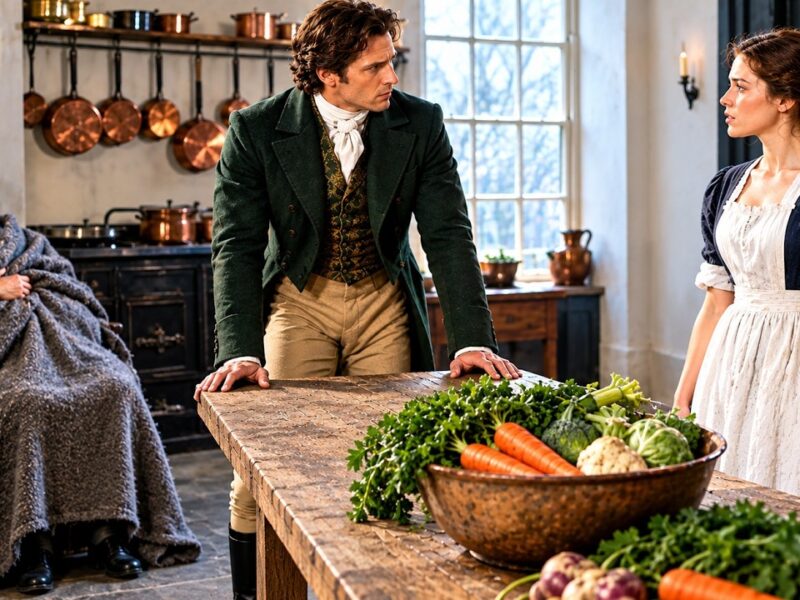
The Duke’s Chef Fell Ill the Day of the Dinner — “I Can Cook,” Said the Girl Who Scrubbed the Pots
GRIEF IN THE STOMACH
That night, the dishes came back to the kitchen.
Lilas was exhausted to her bones, scraping uneaten food into the slop buckets. As she reached for the head of the table’s china, she stopped.
The Duke’s plate was almost full. The beef had barely been touched. The vegetables were pushed to the side. The bread had only a small corner missing. He had eaten the soup, and nothing else.
She turned to Dolly, one of the younger maids carrying a stack of plates. “Has His Grace always eaten so little?”
Dolly looked around nervously and nodded. “Yes.”
“How long?”
“Since the old Duke died. He just drinks that awful whiskey in his study until he falls asleep in the chair.”
Lilas looked toward the dark corridor leading upstairs. She remembered something her mother used to say, back when Lilas was a child sitting on the flour sacks, watching her mother orchestrate this very kitchen. Grief sits in the stomach, lily-flower. It takes up all the room. You can’t force a feast into a house that’s already full of ghosts.
Lilas looked at the extravagant, heavy food headed for the bin. She washed her hands, tied her apron back on, and went to the pantry.
She made something simple. She took the bones of a roasted chicken and simmered them with fresh carrots, celery, and a pinch of salt. She roasted the marrow from a beef bone and spread it thinly over a piece of toasted, rustic bread. Nothing elaborate. Nothing French. Just food meant for someone who was hurting.
She gave it to a footman to take upstairs. She expected never to hear about it again.
But shortly before midnight, when the kitchen was empty and Lilas was on her hands and knees scrubbing the stone floor, heavy footsteps sounded on the wooden stairs.
Lilas looked up, her brush freezing in her hand.
The Duke stood in the doorway. He had taken off his jacket and his cravat was untied. In his large hand, he held the empty wooden bowl and the empty plate.
For several agonizing seconds, neither spoke. The only sound was the dying embers in the great stove.
“Did you make this?” he asked. His voice was rough, like gravel.
“Yes, Your Grace.”
He looked down at the empty bowl. “It was the first thing I’ve finished eating in three years.”
Lilas slowly stood up, wiping her wet hands on her apron. She didn’t know what to say.
The Duke stepped into the kitchen. He set the bowl on the prep table. He looked at her, his eyes tracing the exhaustion in her posture, the burn on her hand. “Where did you learn to make it?”
She lowered her eyes. “My mother.”
“Who was your mother?”
Lilas hesitated. If she told him, he might realize who she was. He might realize her mother was Marguerite Ashley, the former head chef who had been accused of stealing from the estate and fired in disgrace four years ago, dying in a slum a month later.
“She was a cook, Your Grace. That is all.”
A long silence followed. Tristramm didn’t push. Instead, he walked over to the long wooden table where the servants ate their meals. He pulled out a heavy oak chair.
And he sat down.
Lilas stared at him. “Your Grace?”
“Keep cleaning,” he said quietly, leaning his head back against the stone wall and closing his eyes. “I just… I don’t want to go back upstairs yet.”
And for the first time since his brother’s death, the Duke of Pembertry stayed in the kitchen long after dinner was over.
Neither of them knew it yet, but the girl who had spent four years scrubbing his pots had just become the only person in the household who could see the man behind the title.









