The Duke’s Chef Fell Ill the Day of the Dinner — “I Can Cook,” Said the Girl Who Scrubbed the Pots
THE FRENCH LEDGER
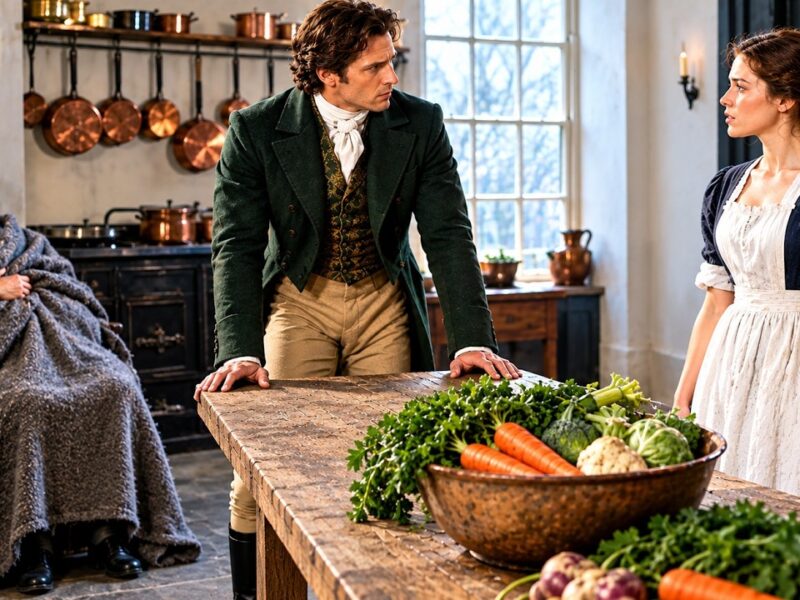
The Duke remained seated at the kitchen table long after the broth was gone. Lilas continued working, scrubbing the last of the copper pans. She didn’t know what to do with a duke sitting three feet away from her.
Eventually, he opened his eyes. “You don’t seem frightened of me.”
“I am,” she said, not looking up from the sink.
That surprised him. He tilted his head. “Are you?”
She looked at him over her shoulder. “I’m simply trying not to show it.”
For the first time that evening, Tristramm, the broken Duke of Pembertry, smiled. It was small, fleeting, almost unwilling. But Lilas saw it, and the heavy, terrifying air between them shifted into something fragile.
After that night, he began returning.
Always late. Always alone. Sometimes he wanted food; sometimes he didn’t. Sometimes he simply sat at the end of the kitchen table with a glass of water while Lilas prepared the dough for the morning bread.
Slowly, in the quiet hours between midnight and dawn, he began telling her things he had never told anyone else.
“I was never supposed to be the Duke,” he said one night, watching her knead bread. “Arthur was the heir. He was brilliant. Charismatic. He knew every tenant’s name. I was the second son. I was meant to join the military and disappear.”
He traced the grain of the wooden table. “Then came the accident. A horse slipped on a wet road. A snapped neck. And everything changed. The estate became my responsibility. Briar looks at me and sees a usurper. The relatives wait to see if I will fail.” He looked up, his eyes shining with a dark, bitter grief. “I wake every morning wondering whether I am becoming the man my brother was, or if I’m just playing a part until I break.”
Lilas stopped kneading. She wiped the flour from her hands. “Do you want to be the man your brother was?”
“No.”
“Then perhaps you won’t.”
He looked at her, his brows knitting together. “You make everything sound very simple.”
She turned toward him, her scarred hands resting on the floured wood. “It isn’t simple. But it is still possible.”
Weeks passed. The Duke began eating again. Not because Lilas forced him, but because she understood that food was sometimes the safest way to approach a wound. She made him baked apples with cinnamon, rich beef broths, fresh bread with salted butter—simple, grounding dishes that reminded him of quieter days.
In return, he began asking about her. He learned about Farbrook House, the small village she grew up in. He learned about her mother.
One evening, when the kitchen was entirely empty, Lilas brought down her mother’s old cookbook from her tiny attic room. The leather was cracked. Several pages were stained with grease and wine. She held it as carefully as though it were made of glass.
The Duke leaned over the table, looking at the faded ink. “You can read this?”
“Yes. French. My mother’s kitchen French.”
He smiled, a genuine, warm expression that reached his eyes. “Read it to me.”
So she did. And for nearly an hour, the Duke listened. Not to a servant. Not to a cook. To Lilas.
As she read a recipe for coq au vin, her finger traced a margin note. She stopped. She frowned, squinting at the faded ink. It wasn’t a recipe. It was a list of dates. And next to the dates were numbers. Sums of money. And beside the money was a single initial: B.
Lilas quickly turned the page, her heart skipping a beat. She realized, with a sudden, icy dread, that her mother hadn’t just been writing down recipes. She had been keeping a ledger.
The household eventually noticed the late-night meetings. Whispers began to slither through the corridors like smoke. The Duke was spending too much time in the kitchen. With a scullery girl.
One afternoon, Mrs. Gable cornered Lilas in the pantry. The housekeeper’s face was pinched with disapproval. “You must understand your position, Lilas.”
Lilas kept her eyes on the sacks of flour. “I do.”
“You are becoming too familiar with His Grace. The Duchess has noticed. You are playing a dangerous game.”
“I have never asked him to come downstairs,” Lilas replied, her voice steady.
Mrs. Gable had no answer for that, but the gossip only intensified.
Then, one evening in late November, the Duke found Lilas alone in the kitchen. He looked unusually serious. The air around him was crackling with a nervous, intense energy.
“I want to ask you something,” he said, stopping a few feet away from her.
She put down the paring knife. “Yes, Your Grace.”
“Will you marry me?”
Lilas stared at him. The kitchen seemed to tilt on its axis. The roar of the stove faded into a high-pitched ringing in her ears. For one terrible moment, she thought she had misunderstood him.
“You don’t mean that,” she breathed.
“I do.”
“Because you are grateful.”
“No.”
“Because I helped you eat.”
“No.”
“Because you are lonely.”
His expression changed. The vulnerability hardened into a desperate, raw honesty. “No.”
She looked away, her chest heaving. “Then why?”
He closed the distance between them. He didn’t touch her, but he was close enough that she could feel the heat radiating from him. “Because when I am with you, Lilas, I am not thinking about what I lost. You are the only thing in this house that feels alive.”
Lilas’s eyes filled with tears. A single tear escaped, cutting a clean track down her flour-dusted cheek.
“That isn’t enough,” she whispered.
The Duke went completely still. “What?”
She looked up at him, her heart breaking. “I don’t want to become the woman you remember only because I helped you survive your grief. What happens when you are healed, Tristramm? Will you look at me and see the scullery girl who fed you when you were broken? Or will you see a Duchess?”
“Lilas—”
“You cannot promise that,” she said, her voice cracking. “And I will not be your nursemaid wearing a crown.”
He had no answer. He stood there, devastated, the truth of her words hanging between them like a blade. And that was why she refused him.









