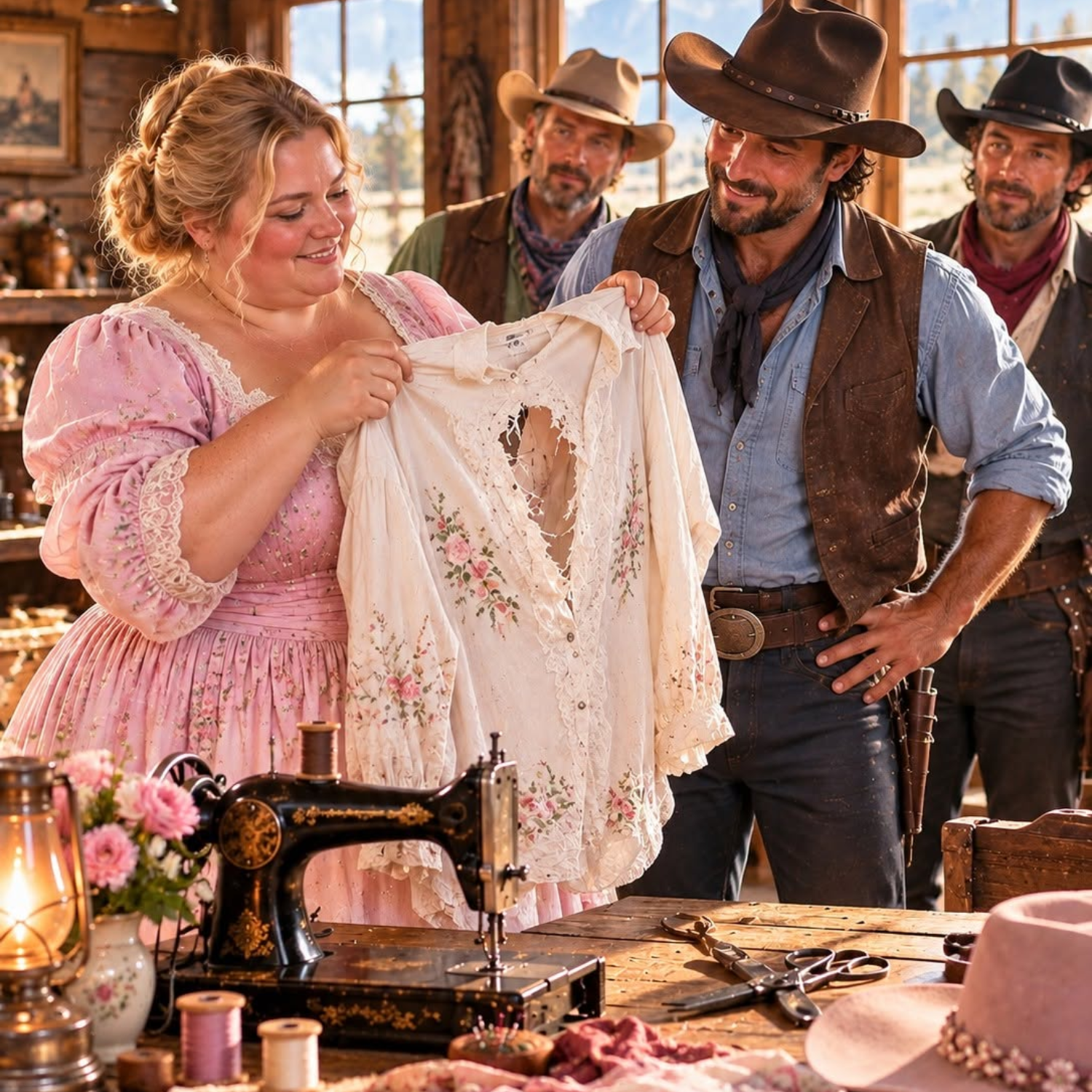
The Resilient Seamstress Standing Firm Amidst Storms and Crimson Fire in the Wild West
The Resilient Seamstress Standing Firm Amidst Stor…
The Resilient Seamstress Standing Firm Amidst Storms and Crimson Fire in the Wild West
.
.
Chapter 1: The Weight of a Trunk
The platform at Abilene smelled of fried mutton, stale whiskey, sunburned wool, and the unmistakable, earthy musk of five thousand head of cattle crammed into the holding pens down by the Muddy Creek. It was the summer of 1873, a season when the whole of central Kansas seemed to have been placed inside an iron baker’s oven and left to bake until the air crackled with dry heat.
The women on the platform laughed before my trunk even touched the rough pine planks.
It was a small, high-pitched sound—the kind of fluttery noise made by ladies who had never spent a day of their lives sweating through their shifts. One man, a cattle buyer with a silver-plated watch chain looping across a waistcoat that was already stained with tobacco juice, leaned against a freight crate and spat a brown stream into the dust.
“Look at that,” he muttered to a clerk. “They’re sending us the whole darned furniture store this time. Might break the floorboards of any dry-goods shop that hires her before she even unloads her trunks.”
I did not turn my head. I kept my spine straight, my shoulders squared, and my fingers hooked firmly into the leather straps of my father’s heavy carpetbag. The words followed me through the dust, clinging to my skirts like burrs.
A large woman. A heavy woman. A giantess of the needle.
They saw a woman who stood five feet ten inches tall, broad-shouldered, with thick wrists and a waist that had never known the mercy of a French whalebone corset. They saw someone who weighed nearly a hundred and seventy pounds, all bone, muscle, and stubborn endurance.
They did not see the iron machine inside the wooden crate currently being unloaded by a sweating baggage handler. They did not see the forty pounds of tempered steel, polished brass, and decades of family pride packed tightly in grease and oil.
I was Martha Thorne. And I had come to Kansas to begin again because the world I knew had already burned down around me.
The Panic of 1873 had not arrived in St. Louis with a trumpet fanfare; it had arrived with empty ledgers and the sound of iron shutters being pulled down on Fourth Street. My father had spent thirty-four years turning plain cotton, wool, and heavy duck cloth into strong coats, fine shirts, and work trousers that lasted through ten winters of coal-shoveling and river-hauling.
“Measure twice,” he told me every morning while the tallow candle still flickered on the workbench. “Cut once. And never, Martha, let the world see you unravel.”
He taught me the weight of a true seam. He showed me how to tension a shuttle so the stitch would hold even when a horse pulled against the hem. He taught me the architecture of clothing—that a garment was not merely something to cover the skin, but a second skin designed to protect a man or woman from the harshness of the earth.
When the banks failed, the tailor shop went with them. The creditors took the bolts of imported wool, the brass buttons, the oak cutting tables, and the last of our savings.
Then illness took my father. It was not a dramatic end; he simply grew tired, laid his head down upon an unbleached linen remnant, and did not wake up to see the sunrise over the Mississippi.
All I had left in the world was his heavy iron Wheeler & Wilson sewing machine, three wool dresses, a silver thimble worn paper-thin at the tip, and the uncompromising skill in my hands.
Abilene was hot, loud, and bursting at the seams.
The Chisholm Trail had turned the town into a roaring den of gamblers, drovers, gun-toters, and cattle buyers. Saloons blared tin-pan pianos into the night. Wagons crowded the rutted streets, their wooden wheels throwing up choking plumes of yellow alkali dust that coated everyone’s teeth and eyelashes.
I was twenty-eight years old. By the standards of polite society in the East, I was an old maid, too tall for my own good, and entirely too loud in my movements.
Before the sun had even dipped below the flat western horizon, people had already christened me.
“The giantess of the needle.”
I heard it near the station. I heard it outside the Drovers’ Hotel. I heard it whispered behind my back as I dragged my heavy trunk down Front Street toward the only lodging I could afford: a narrow, drafty room above a livery stable at the edge of town.
The rent was three dollars a week. The floor shook every time a restless stallion kicked against its stall downstairs. The air tasted permanently of timothy hay, ammonia, and horse liniment.
I did not complain. I hauled my father’s iron machine up the narrow wooden stairs—straining every muscle in my back until my vision swam with white spots—and set it upon a scarred oak table near the small, grease-stained window.
Then I took a piece of scrap pine, dipped a brush in black paint, and hung a small sign outside the horse-fly-speckled glass:
Martha Thorne, Seamstress.