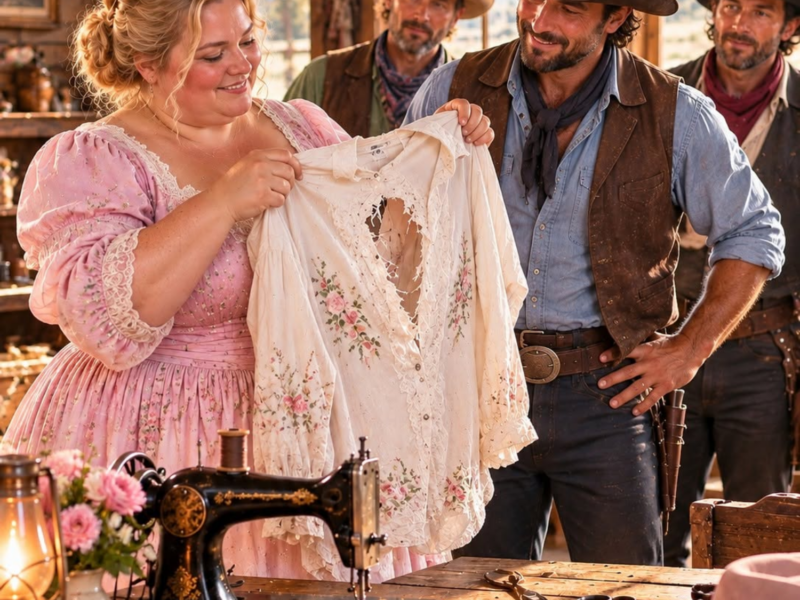
The Resilient Seamstress Standing Firm Amidst Storms and Crimson Fire in the Wild West
The Canvas Trade
I began spending my evenings down at the stockyards and the freight depots.
I did not go to flirt with the cowboys or drink warm beer in the saloons. I went to look at the gear. I touched the torn canvas wagon tilts flapping in the wind. I inspected the split leather seams of abandoned saddlebags lying in the mud behind the livery. I talked to the wagon-masters whose tents had leaked through the terrible spring downpours, ruining their flour and bacon supplies.
Fine dresses were not the future of my shop. Survival equipment was.
I spent my savings in one afternoon at the mercantile, buying fifty yards of heavy No. 8 cotton duck canvas, several hides of thick harness leather, three spools of waxed hemp cord, and a box of heavy sailmaker’s needles that could pierce leather without snapping.
My first saddlebag design was an unmitigated disaster.
I cut the canvas too large, misjudged the drop over the saddle cantle, and used iron rivets that rusted the first time I tested the bag with a bucket of water. When I filled it with twenty pounds of horseshoes and swung it over a wooden sawhorse, the entire bottom seam blew out with a dry pop.
I did not throw it away. I unpicked every stitch, studied the stress points where the leather reinforcement met the fabric, and redesigned the pattern with a double-gusset bottom and copper-reinforced eyelets.
My second attempt held longer, but a hard rain test in a zinc tub revealed that moisture still wicked through the upper flap seam.
I boiled linseed oil, turpentine, and beeswax in a lard tin over my small iron stove, painting the mixture onto the heavy canvas until the fabric darkened to the color of wet cedar and became as stiff as a board. Water beaded on the surface like mercury on glass.
When Silas Vance returned on Thursday afternoon, I handed him the third prototype.
“Test it on the trail,” I said, laying the dark, oiled-canvas saddlebag upon the table. “Tie it behind your saddle. Drag it through the brush. Fill it with gravel.”
Silas hefted the bag, testing the weight, running his calloused thumb over the copper-riveted corners and the heavy harness-leather straps.
“What do I owe you for this?”
“Nothing yet,” I said. “Bring it back in two weeks. I want the truth. If the stitching rots or the leather cracks in the sun, tell me where it failed.”
He carried it through three weeks of driving cattle north toward the railhead—through dust storms that choked the horizon, torrential downpours that turned the prairie into a quagmire, and the bruising, bone-weary labor of the trail.
When he climbed my stairs again in August, he looked thinner, his face burned dark by the sun, but he was carrying my saddlebag by its leather handle as though it were newborn gold.
He tossed it onto the center of my table. It landed with a dull, heavy thud.
“I tied it behind a stampeding steer in the middle of a creek crossing,” Silas said, a rare, slow grin breaking through his beard. “Then I filled it with twenty pounds of salt pork and my blacksmithing kit. It stayed underwater for ten minutes. Nothing inside got wet. The stitching didn’t even fray.”
“The oil held?”
“Like a turtle’s shell.”
That afternoon, Silas did something that changed the entire course of my life in Abilene. He did not just walk out; he took me down to the cattle pens where three hundred drovers were encamped beneath the blazing sun.
He dropped my oil-canvas saddlebag right in front of a burly trail boss named MacIntyre—a man who looked as though he had been carved out of an old hickory stump and marinated in bad whiskey.
“Mac,” Silas said, pointing a finger at me. “This here is Martha Thorne. She builds gear that don’t quit when the weather turns foul. If you’re tired of buying new saddlebags every time you hit the Kansas line, talk to her.”
One of the cowboys laughed—a high, mocking sound. “What does a big woman like her know about trail work? She looks like she belongs in a bakery.”
I did not raise my voice. I did not flinch. I reached into my carpetbag, pulled out a spare canvas tent patch I had reinforced with cross-stitching, and dropped it into the dusty mud between the cowboy’s boots.
“Try to tear it with your bare hands,” I said.
The mocking cowboy stepped forward, grinning broadly. He grabbed the heavy canvas with both hands and gave a violent heave. His face turned the color of a beet. The veins in his neck bulged until I thought his collar would snap.
The fabric did not tear. The waxed linen thread held firm.
The cowboy stumbled backward, dropping the canvas into the dirt as though it were a live coal.
The laughter around the corral died instantly, replaced by the heavy silence of men who recognized true craftsmanship when they felt it.
By sunset, I had ten orders for saddlebags and waterproof bedrolls. By the end of the week, I had fifty.









