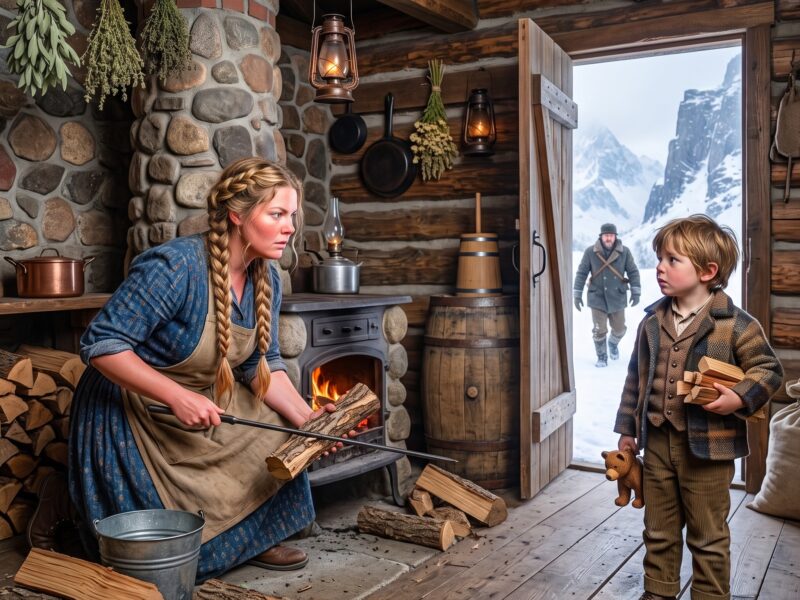
They Bet the Widow Would Freeze by Spring—Then They Saw What She Built Under Her Floor
The Price of Winter
The wind came down off the Bitterroots that August morning the way it always did: slow at first, then meaner. It carried the scent of pine sap and something colder underneath, a skeletal chill that had no business breathing in the air of late summer.
Ingred felt it on the back of her neck. She was standing on the rise above the creek, where the ground stayed dry all winter. It was where they buried the ones who mattered. Her hand rested on a wooden marker that had been in the earth for three months.
Hacken Swenson. Born 1849. Died June 2, 1881.
That was all it said. She had wanted more. She had wanted the marker to say that he was the kind of man who carried his son on his shoulders, who sang in Norwegian when he thought nobody was listening, who had learned to spell his own name in English at the age of thirty because he was too proud to sign an ‘X’ on a Montana land deed. But the man who cut the letters charged by the character, and Ingred had exactly thirty-four dollars to her name. So, the marker said what it said.
Torbin stood beside her. He was six years old, wearing boots that were a size too big because Hacken had bought them in April, swearing the boy would grow into them by the autumn frosts. Torbin was holding a yellow wildflower he’d pulled from the ditch behind the mining office.
“Mama?” “Yes, min lille.” “Is Papa cold under there?”
It was the question. It had always been the question. A six-year-old boy does not care about theology, heaven, or the resurrection of the dead. He cares whether his father is shivering in the dark.
Ingred opened her mouth to answer, but nothing came out. She had not cried yet. Not at the funeral. Not at the reading of the deed in Helena. Not in the long, hollow nights when Torbin crept into her bed because his own was too big and the silence was too loud. Three months, and no tears.
She looked at her son, at the crushed yellow flower in his small fist. “Papa is not cold,” she whispered. “Papa is at home now.”
Torbin nodded. He laid the flower on the dirt. They walked down the hill together, and Ingred Swenson did not know it yet, but she was walking toward the worst conversation of her life.
Blackpine Hollow was copper country. Men came to make a stake and leave, but Montana had a way of getting under a man’s skin. Hacken had taken a shift down in the copper shaft to bring in cash for the coming winter. He lasted eleven weeks. The mine collapsed on a Wednesday afternoon. Fourteen men went down; nine came up. Hacken was not one of the nine.
Winter was ninety days away. Ingred needed seven cords of firewood to keep her son alive until April. And there was only one man in Blackpine Hollow who sold firewood in volume: Rutgar Howerin.
She walked to the sawmill on a Tuesday. Rutgar was thirty-eight, a man who dressed better and spoke softer than his neighbors, always looking at you as though he were listening to something you hadn’t said yet. He sat in a wooden chair outside the scale house, watching her approach the way a hunter watches a doe step into a clearing.
“Eleven dollars a cord this year,” Rutgar said smoothly, gesturing to the stacked wood. “Cut and delivered.”
Ingred did the arithmetic in her head. Seven cords. Seventy-seven dollars. She had thirty-four.
“Mr. Howerin, that is a considerable increase from last year.” “Hauling costs, ma’am. And the timber is thinning on the near slope.” Rutgar leaned forward, the shadow of a smile playing on his lips. “I am not without sympathy for your situation. You have twenty acres on the east side of your parcel. Timothy meadow. Sits right up against my north lot line. I would offer you sixty dollars for it. That gives you enough for seven cords, and something left over for lamp oil.”
Ingred stood perfectly still.
“Or,” Rutgar added softly, “I take it as trade. You sign over the deed on the twenty, I give you eight cords. You go into winter without worry.”
Ingred Swenson understood in that precise moment what she was standing in front of. Rutgar Howerin didn’t want twenty acres. He wanted the whole eighty. This was how the bleeding started. First the twenty, then next year the thirty, and by the time Torbin was old enough to remember any of it, they would be tenant farmers on the land Hacken had died to buy.
She looked at Torbin, who was watching a barn cat stalk a mouse in the woodpile.
“I will let you know,” Ingred said.
She took Torbin’s hand and walked away. Rutgar smiled, because in his fourteen years of business, a woman who said she would let you know was a woman already halfway to yes.
He was wrong about that. But he did not know it yet.









