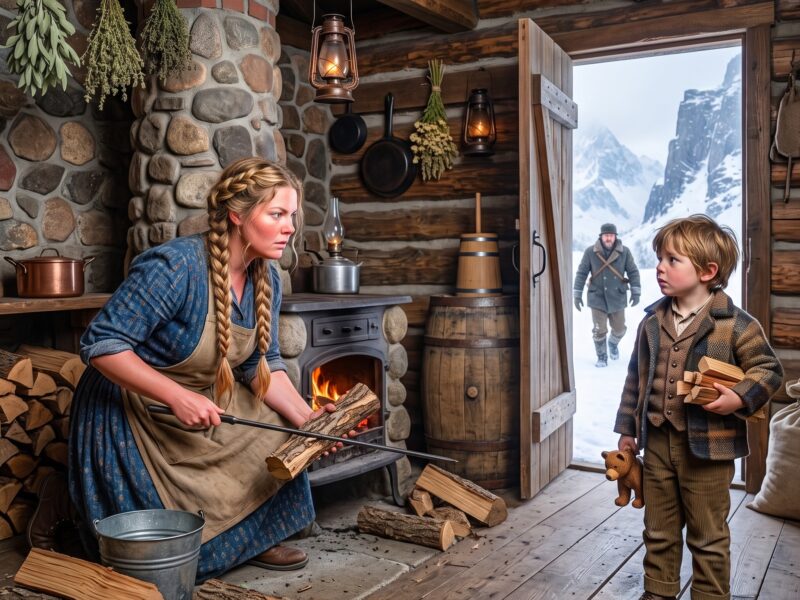
They Bet the Widow Would Freeze by Spring—Then They Saw What She Built Under Her Floor
The Ghost in the Trunk
That night, the red glow of coals seeped through the seam in the stove door. Ingred could not sleep. She had thirty-four dollars. She could sell the milk cow, but then Torbin would have no milk. She could sell the laying hens, but then they would have no eggs. None of it added up to seventy-seven dollars.
She lit the lamp, turning the wick down low to save oil. She walked to the corner of the room where Hacken’s heavy wooden trunk sat. It had crossed the Atlantic in the hold of the Angeline. She had not opened it since June. She had told herself she would open it when she was ready, but tonight, she needed to know what he had left her.
She knelt. She lifted the heavy lid.
The smell came up and struck her like a physical blow. Cedar and wool. The faint, bitter scent of the pipe tobacco Hacken smoked on Sundays. And beneath it all, preserved in the fibers, the smell of her mother’s kitchen in Bergen from twelve years ago.
Ingred clamped a hand over her mouth. Something inside her chest—a dam built of grief and sheer, stubborn survival—finally cracked. She pulled out his wool coat. She pulled out the pouch of eleven silver dollars she already knew was there. And then, at the very bottom, wrapped in oilcloth, she found a small book bound in dark green cloth.
Handwritten on the cover in careful, elegant strokes: Sigrid Hacken Swenson. Bergen, 1847.
Ingred stopped breathing. Sigrid was Hacken’s grandmother. She had baked bread in Bergen for fifty-one years. Ingred opened the fragile pages. Recipes for flatbread, crumb cake, rye with caraway. It was the voice of a ghost, preserved in ink.
Three-quarters of the way through, on a blank right-hand page, was a drawing. It was not a recipe for bread. It was a cross-section of an oven.
Ingred held the lamp closer, her heart hammering against her ribs. Sigrid had drawn the firebox, the chimney, the heavy iron doors. But beneath the oven, she had drawn a pit. A deep bed of closely packed stones. Running through the stones was an iron pipe, snaking back and forth five times before exiting up the chimney flue.
Above the drawing was the word Ovn. Oven. But beneath it, written in Norwegian, were five words that would change the history of the Montana territory:
Ilden slukker. Sten husker alt.
Ingred whispered it aloud in the freezing, empty room. “The fire goes out. The stone remembers everything.”
She slumped to the floor, the book in her lap, and finally, for the first time since her husband was buried, she wept. She wept for Hacken, and she wept for an old woman who was reaching across the ocean and the grave to hand her granddaughter a way to stay alive.
The stove did not hold fire. It held heat. They were two entirely different things. And every soul in Blackpine Hollow had spent every winter of their lives confusing them.
Ingred wiped her eyes. She needed iron pipe. She needed four tons of glacial stone. And she needed a blacksmith.









