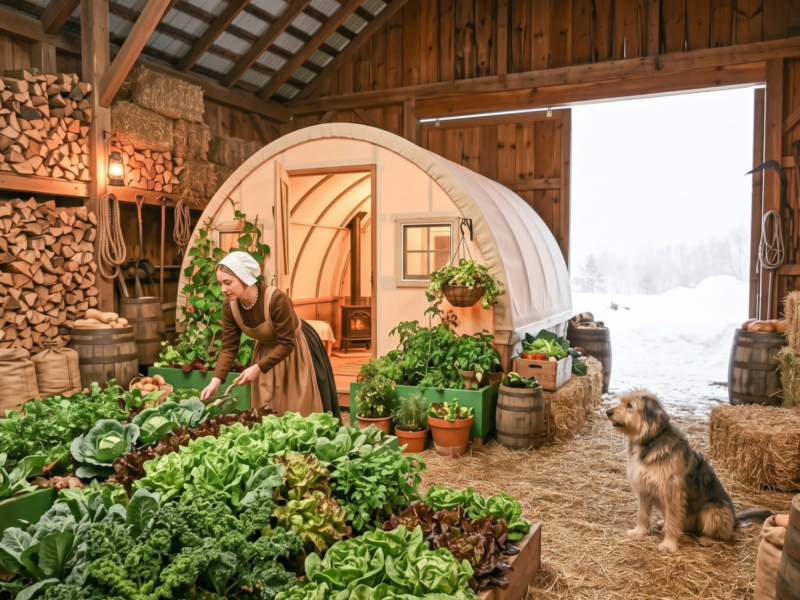
They Called Her Barn Shelter Crazy—Until Her Daughters Survived the 40° Cold
The Town Below
Down in the valley, Calder’s Bend went about its business with the bustling optimism of a town built on silver dreams and thin air.
Silas Dunore watched the smoke rising from the cliff face through a brass spyglass from his second-floor bank window. He lowered the glass, a faint, amused smirk playing across his lips.
“Still up there?” asked Arthur Vance, the town registrar, shuffling papers on the desk.
“Still up there,” Silas replied, tapping the brass barrel against his palm. “Playing pioneer. She’ll freeze out by November. Nobody survives a high-altitude winter in a glorified badger hole.”
“It’s county property if she abandons it,” Arthur noted.
“She’ll abandon it,” Silas said with absolute finality. “Desperation has a short shelf life.”
But Silas did not understand the architecture of stubbornness.
Up on the ridge, Marin was not starving, nor was she freezing. She had constructed a rudimentary smoking rack for the trout she caught in the icy creek. She had lined her sleeping quarters with thick layers of pine boughs and stolen sheep’s wool she’d traded for with a sympathetic rancher ten miles down the pass—a man named Virgil Oaks who remembered her father with quiet respect.
Virgil had ridden up the trail on a raw Tuesday in late October, leading a pack mule laden with three sacks of dried beans and a heavy cast-iron skillet.
“Your dad helped me pull a wagon out of a mud bog back in ’78,” Virgil said, avoiding her eyes as he dropped the heavy sacks near the cave entrance. “He never asked for a cent. Just told me to buy a better team next time. Figured I’d square the ledger with his girl.”
“You don’t owe us anything, Mr. Oaks,” Marin said.
“Maybe not,” Virgil spat into the dirt, swinging back up onto his saddle. “But winter don’t care about ledgers. Keep your stove pipe clean, girl. That’s where they usually mess up.”
He rode away without waiting for thanks.
Marin hauled the beans inside. She added them to her growing stores on the pine shelves. The cave was becoming a pantry, a bedroom, and a fortress all at once.
Every afternoon, she and Emmett practiced their letters and numbers by the firelight. Emmett used a flat slab of slate and a piece of soapstone. He was a quiet boy, but observant—he watched the way the wood smoke curled toward the natural fracture in the ceiling, never once spilling back into the room.
“Why doesn’t the smoke come down, Mama?” he asked, pointing his soapstone.
“Because the mountain wants it out,” Marin told him, tracing his small shoulder. “We just gave it a road to travel.”









