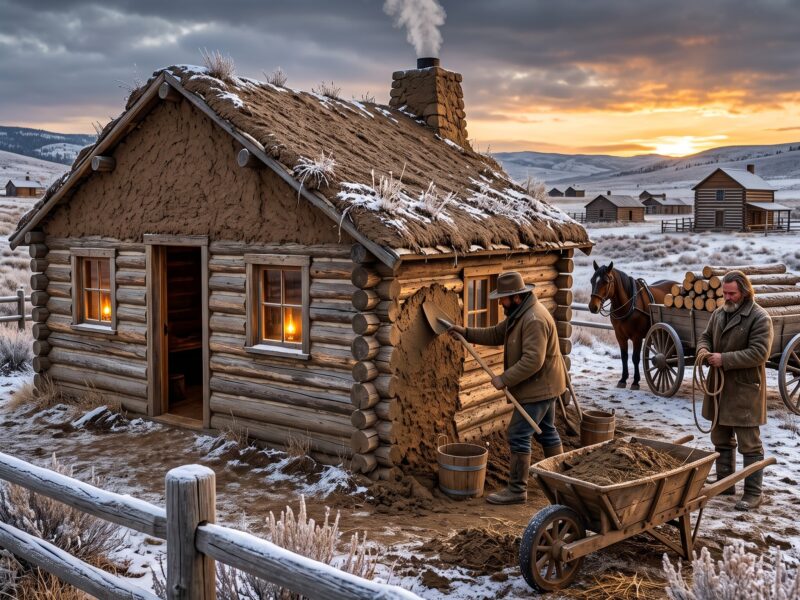
They Called His Mud-Coated Cabin “The Hill”—Then the Coldest Winter in Years Set In. AI
THE DRAFT
Inside the cabin, the heat from the cast-iron stove was suffocating near the hearth, yet bitterly cold sixteen feet away near the west wall.
Mara stood by the washbasin, her hands submerged in warm water, but her shoulders were drawn tight. She was a woman who carried an elegant, quiet grace, entirely unsuited for the brutal Montana frontier. But she had adapted, because survival demanded it.
Eleven-year-old Nell dragged her wooden stool closer to the stove, holding her hands out to the iron. Toby, seven, had left his boots near the west wall; the leather was already stiffening from the draft creeping between the floorboards.
Fletcher entered, shutting the heavy door quickly against the wind.
Mara looked up, her dark eyes locking onto his. “Elias was out there a long time.”
“He was just passing,” Fletcher said, stripping off his muddy coat.
“You don’t believe that,” she whispered, drying her hands on a towel. She stepped closer, her voice dropping so the children wouldn’t hear. “He was asking questions at the general store yesterday, Fletch. About where we came from. About New Mexico.”
Fletcher froze. “What exactly did he ask?”
“He asked Owen Keter if we received any freight from a man named Silas Vance.”
The name hit Fletcher like a physical blow. Silas Vance. The mining baron of the Zuni Mountains. The man Fletcher had worked for as a master mason and accountant. The man whose ledger—currently buried beneath three feet of Montana mud—contained the names of every judge, sheriff, and politician Vance had bought, alongside the maps to his illegal, unregistered silver veins.
Vance owned people. When he found out Mara had seen the ledger, he ordered his men to burn their house down with them inside. They had barely escaped with their lives, taking the ledger and a cache of uncut silver to buy a new existence.
“They tracked us,” Mara breathed, reading his face. “Elias isn’t a millwright, is he?”
“I don’t know yet,” Fletcher said quietly. “But the weather is turning. If Vance sent him, Elias has a problem. He can’t make a move until he knows exactly where the ledger is. He knows if he kills me without finding it, he goes back to Vance empty-handed. And Vance doesn’t tolerate failure.”
“So what do we do?”
Fletcher looked at the walls of the cabin. The thin pine logs that stood between them and the brutal winter. Between them and Elias.
“We keep building the wall,” Fletcher said. “If we run, we die in the cold. We bunker down. We make this place impenetrable.”
The next morning, Jonas Pel stopped his wagon outside. Jonas was a loud, cheerful homesteader, his wagon piled ten feet high with freshly cut cottonwood.
“Fletcher!” Jonas laughed, leaning over the reins. “You’re turning your house into a badger hole! Why not spend this time cutting wood? My pile’s as tall as my roof!”
Fletcher walked up to the wagon, leaning a muddy shovel on his shoulder. “Wood burns, Jonas. And then the cold comes back.”
“Dirt doesn’t burn at all!” Jonas chuckled, snapping the reins. “Good luck to you, neighbor. When you start freezing, come on by. I’ll lend you a cord.”
Fletcher watched him go. He didn’t have the luxury of a massive woodpile. He didn’t have the time to fell trees. He had to pack the earth. The mass would slow the transfer of heat, keeping the cabin warm. But more importantly, three feet of packed earth, gravel, and clay would stop a .44 caliber bullet dead in its tracks.









