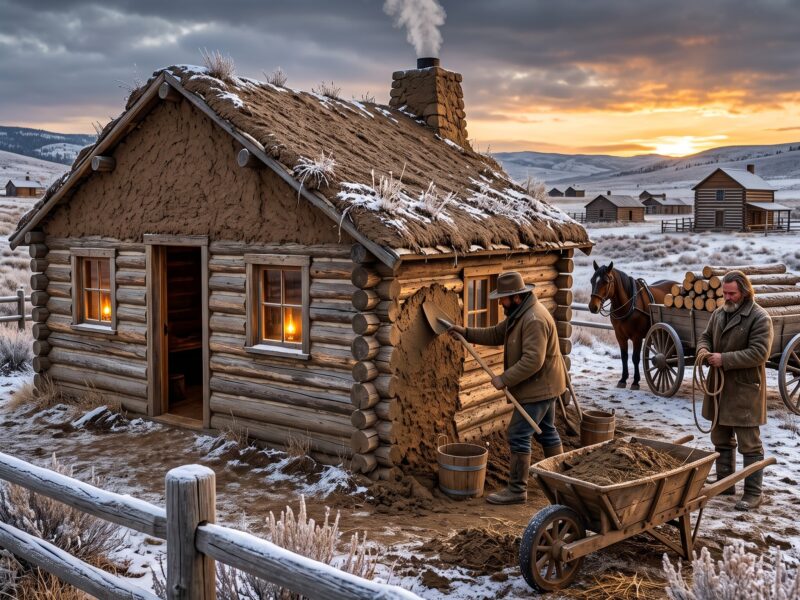
They Called His Mud-Coated Cabin “The Hill”—Then the Coldest Winter in Years Set In. AI
THE LANDMARK
Spring softened the prairie.
The frozen ground released its hold slowly. Meltwater ran off the northwest corner of the Row cabin, shedding perfectly down the corrected grade, leaving the timber sill dry and secure.
The Federal Marshals had come and gone. They took Elias, the ledger, and the silver. In exchange, they granted Fletcher and Mara full immunity and the title to the homestead, free and clear of Vance’s reach. Silas Vance was arrested three weeks later in New Mexico.
The threat was gone.
The neighborhood’s perception of Fletcher Row had changed entirely.
Jonas Pel stopped his wagon out front one afternoon in May. He didn’t have a massive load of wood this time. He just leaned on the reins, looking at the massive earthen berm.
“How thick did you say the north side was, Fletcher?” Jonas asked, pulling off his hat.
Fletcher smiled, wiping the mud from his hands. “Seven feet, three inches at the base, Jonas. Why? You looking to play in the mud?”
Jonas chuckled. “I burned near four cords of wood in January alone. You burned what, two?”
“A little less.”
“I got a root cellar that needs shoring up,” Jonas admitted, scratching his beard. “Figure you might want to show me how you mix that clay.”
Fletcher looked at the cabin. The hill.
He hadn’t invented the principles of thermal mass, moisture control, or insulation. He had simply carried an ancient idea north, corrected his own failures, and built a sanctuary that protected his family from both the wrath of nature and the ghosts of his past.
As Jonas rode away, Nell walked out of the cabin, holding a piece of chalk. She walked over to the shed post, looked at the hundreds of little white tally marks she had made for every wheelbarrow load her father had hauled, and carefully drew a box around them.
The work was done.
Fletcher stood on a ladder near the upper west corner, packing a fresh layer of chinking into the logs where the frost had penetrated during the coldest night. He was still improving. Still learning.
Out on the Montana prairie, a man’s survival was usually measured in cords of split wood. But the Hill stood as a monument to something far stronger.
It was proof that a foundation built on mud, grit, and the fierce need to protect one’s family could weather any storm the world threw at it.









