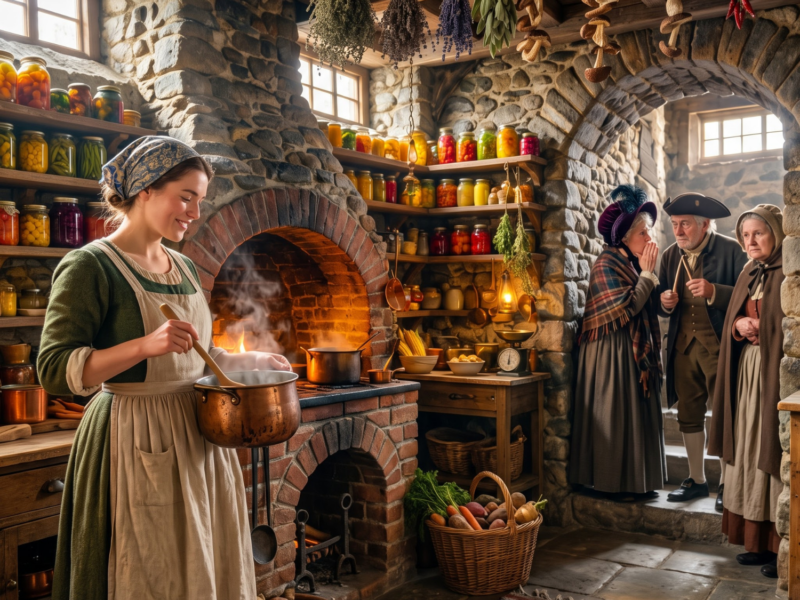
They Gave Her the Abandoned Kitchen — She Fed the Estate Through Winter
They Gave Her the Abandoned Kitchen — She Fed the…
They Gave Her the Abandoned Kitchen — She Fed the Estate Through Winter
October of 1878 began with a heavy silence on the porch of the cabin, broken only by the rhythmic thud of a heavy boot against timber, and then, the unforgiving bite of the Wyoming wind.
A girl stood in the main house doorway, holding a soup tureen against the cold, watching across the courtyard. Through wet snow ticking on the copper serving covers, she saw the steward walk a woman toward the black mouth of the kitchen no one used. He pressed something into her hand—an iron key, dark with cold—and the woman closed her fingers around it. She did not argue.
Behind the girl, in the lit dining room of the Alderwick estate, servants scraped barely touched plates of roasted meat and heavy breads into a slop tub for the pigs. The clatter of fine silver against porcelain was a sharp contrast to the desolation outside.
The steward’s voice carried back across the snow, thin and absolute. There was nothing to spare. Not a bed, not a meal, not a place beneath the same roof as the gentlemen and ladies.
The water on the floor of the ruined kitchen was black, and it did not move.
Rosalie Crawl stood in the doorway with the iron key still freezing in her fist and looked at the floor she had been given. Snowmelt pooled beneath a cracked brick oven, skinned with a fragile layer of ice along its edges. This was the place. This was the whole of it.
She had crossed an ocean and half a continent for a warm kitchen and a cousin who would speak for her. The cousin, she had just learned, was three weeks in the ground. Pneumonia, the steward had said, folding her employment letter along its worn crease and handing it back the way a man returns a worthless thing dropped in the dirt.
Alderwick had no work for a woman no one had hired.
Rosalie had three dollars and eighty cents. The stage to Rock Creek cost more than that, and the North Road was already white, its deep ruts filled and smoothed under the first real snow of the season. She had no family nearer than Chicago. She had no husband. Joseph was six months dead in an Omaha railyard, crushed between two freight cars that should not have rolled.
She carried a carpetbag, a dead woman’s letter, and the key to a building the estate had abandoned nine years before.
The steward, whose name was Edwin Chalmers, had told her she could shelter in the ruin for twelve days. On the thirteenth, the season’s last freight wagon would come for supplies and take her back the way she had come, to wherever a widow with no money went when the frontier had finished with her.
Behind her, across the courtyard, the main house of Alderwick burned light from every window. She could hear the dinner bell, small and bright through the falling snow, and under it, the scrape of chairs and the low murmur of people who had never once wondered where their next meal came from. Twelve fireplaces, the driver had told her on the ride in. Twelve in one house.
The kitchen where she stood had none that drew.
She set the carpetbag on the driest stone she could find. She did not take off her heavy wool coat. First, she would learn the room. Her mother had taught her that, long ago in Bohemia. Before you mend a thing, you must know exactly how it is broken.
She pried off her soaked leather shoes, because wet leather told her nothing, and crossed the floor in her stocking feet until the cold climbed her ankles. She felt where the stone dipped, where the water gathered, and where a low door stood shut in the far wall. She worked the iron pump handle at the sink. It shrieked, fought her, and finally surrendered a thread of rust-colored water.
She walked to the massive brick oven. She laid her palm flat against the belly of it and found it stone cold. Its mouth was gap-toothed where bricks had fallen away; the throat above it was packed with something her fingers could not quite reach.
Then, she opened the low door in the far wall. A different cold breathed out at her. Older. Drier. Steady. A cellar. She would come back to the cellar.
She had not finished counting the room’s wounds when a lantern swung across the doorway and Edwin Chalmers stepped in out of the snow. He held the light high and turned it slow, the way a man appraises a horse he has no intention of buying. He was a narrow man in a good, expensive coat, and he wore the estate’s account books the way other men wore a pistol.
“I trust the accommodation meets your expectations,” Chalmers said, his voice dripping with refined cruelty.
“I asked only for work,” Rosalie said. Her English came out flat and careful. Each word set down like a stone across a rushing stream.
“There is no work.” He moved the lantern toward the oven. “That has not drawn since before I came to this estate. Nine years. The mouth has lost half its brick. The flue is choked, and no one living remembers what choked it.”
He swung the light to the low door. “The cellar floods every spring when the creek rises. Whatever the water leaves, the rats finish. The bins are gone to them already.” He let the beam fall to the floor, to the black ice. “You are standing in the reason no servant on this estate will cross the yard to help you. They call it the sour house. They will not thank you for reminding them it exists.”
Rosalie said nothing. She had learned long ago that silence costs less than the wrong words.
“You will not enter the main house,” Chalmers went on, his tone dictatorial. “Except when you are summoned, which you will not be. You will not draw on the household’s coal or lamp oil. You will not trouble the head chef’s staff.” He paused at the door and looked back at her, and for the first time, something like satisfaction moved in his narrow face. “Twelve days, madam. Then the wagon.”
The lantern went with him, and the room fell back into a darkness that smelled of wet stone and old smoke.
She stood in it a long moment. Then, she knelt at the mouth of the oven and reached deep into the throat with two fingers. There, where the guidelines of soot broke away, she found something hard and clean. A knot of charcoal. Bone dry. Sheltered from nine years of damp by the very brick that had failed.
Someone, once, had known how to make this room burn. The knowledge had left, but it had been here.
Related Articles

They Mocked the Widow’s Dirt Cellar—Then the Freeze Left Every Cabin Cold but Hers Warm
They Mocked the Widow’s Dirt Cellar—Then the Freeze Left Every Cabin Cold but Hers Warm…

A Homeless Veteran and His German Shepherd Inherited a Ridge No One Wanted — 35 Feet In, They Found
Chapter 1 / 7 A Homeless Veteran and His German Shepherd Inherit… A Homeless Veteran…

Neighbors Laughed When He Built A Cabin Inside An Old Barn—Until It Kept His Home 35 Degrees Warmer
Chapter 1 / 8 Neighbors Laughed When He Built A Cabin Inside An… Neighbors Laughed…

His Sod House Had No Woodpile in January – Until the Trains Stopped and the Town Came Begging
Chapter 1 / 10 His Sod House Had No Woodpile in January – Until t……

She Built Her Cabin Over the Woodshed and Never Burned Wet Wood Again
Chapter 1 / 8 She Built Her Cabin Over the Woodshed and Never Bu… She…

The Duke Abandoned Her on Their Wedding Day—Years Later, He Discovered What He Had Lost
Chapter 1 / 7 The Duke Abandoned Her on Their Wedding Day—Years… The Duke Abandoned…

He Wedged a Tiny A Frame Into a Crevice Before Winter and His Family Slept at 75°F While Town Hit
Chapter 1 / 7 He Wedged a Tiny A Frame Into a Crevice Before Win……

He Was Too Old to Ride—So He Bought the Ruined Ranch and Found the Room Behind the Fireplac
Chapter 1 / 5 He Was Too Old to Ride—So He Bought the Ruined Ran……

Settlers Laughed at His Underground Heat Recovery Duct — Until It Kept His Cabin 71°F Warmer
Chapter 1 / 9 Settlers Laughed at His Underground Heat Recovery… Settlers Laughed at His…

A Navy SEAL Built a Home Inside a Mountain—Then His Dog Warned Him Before the Storm
Chapter 1 / 5 A Navy SEAL Built a Home Inside a Mountain—Then Hi… A…