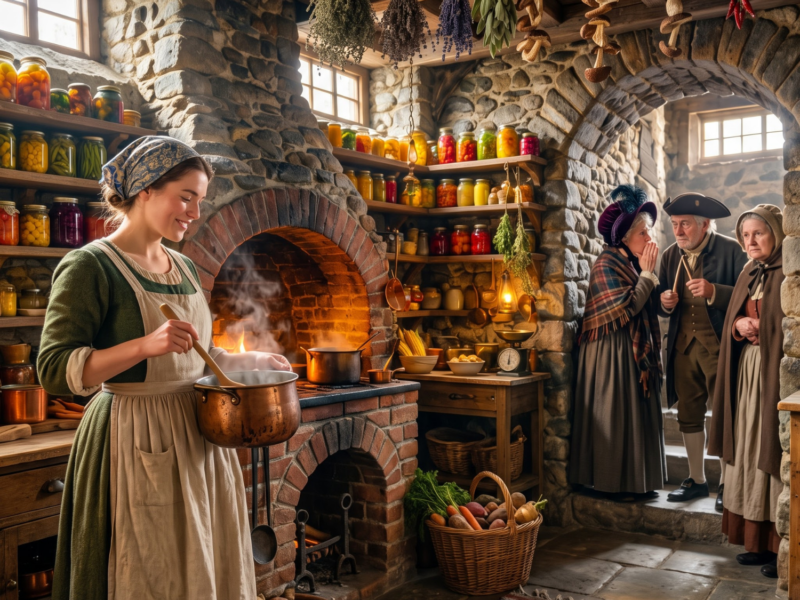
They Gave Her the Abandoned Kitchen — She Fed the Estate Through Winter
The Architecture of Waste
In the morning, the cold was a physical weight on her chest. She went to the main house to ask for food in exchange for labor, and there she met the second man who would decide her winter.
Lucien Marot ran the Alderwick kitchen the way a cavalry colonel runs a fort. He had been hired out of a grand New York hotel, and he had brought New York with him to the Wyoming territory. The copper pans hung by size, gleaming in the firelight; the imported tins stacked in perfect rows; the coffee, the white flour in clean barrels, the wine laid down in a room kept at one strict temperature.
He listened to Rosalie’s offer with his arms folded and a small, condescending smile that did not reach his eyes.
“You wish to cook,” Marot said, his French accent rolling over the English words.
“To preserve,” said Rosalie. “Cabbage, roots, bones. What the house throws to the pigs.”
“Ah.” The smile widened. Behind him, two undercooks stopped chopping vegetables to listen. “You have no French technique. You have no references any gentleman would read. You have, forgive me, an English that a guest could not follow through a single course.”
He unfolded one arm and gestured at the ranks of tins, the coffee, the white flour, as though presenting evidence to a judge. “This is a civilized table. Do you understand? Preserving scraps may keep a peasant family alive through a bad year in the old country. It cannot feed a household such as this one.”
An undercook laughed and poorly disguised it as a cough.
Rosalie looked past Marot at the kitchen behind him. A scullery boy was currently scraping plates into a massive wooden tub. Bread ends. The thick fat from a roast. The outer leaves of three cabbages. A heap of carrot tops still bright and green. It was enough food for a family, going out to the wagon that fed the hogs.
She looked at it the way a thirsty person looks at a river running past a locked gate.
“Thank you,” she said, and left before her face could betray the desperation clawing at her throat.
She did not eat that day. She spent it learning the cellar.
That evening, a woman crossed the courtyard against every unwritten custom of the estate, carrying a covered tin can. Hester Vale ran the dairy. She was thirty-eight and built like a woman who had lifted heavy things all her life. She set the can down on the cold hearth of the sour house without ceremony.
“Milk,” Hester said. “It will turn before morning in this cold, so drink it now.” She looked around the ruined room and did not soften her face for it. “You mean to fill this place with food?”
“I mean to try.”
“Then you should hear the truth of where you have landed.” Hester sat heavily on the one sound bench. “This estate is beautiful, and it is broke. Mr. Chalmers buys everything down from Rock Creek. The tins, the coffee, the wine, the fine flour. And the bill has run past three thousand dollars this year alone. The garden gave more than we could eat this autumn. Squash to the fence line, cabbage by the hundredweight, apples we could not pick fast enough.”
Her mouth tightened into a bitter line. “And Mr. Chalmers ordered half of it plowed under. Because saving it would take hands, and hands take wages, and it was cheaper on his books to buy it back in a tin come January.”
Rosalie set down the milk. “He plowed it under?”
“He did.” Hester stood up, brushing her skirts. “So when you offer to save his rubbish, understand you are not only asking for cabbage. You are telling him his whole system is waste. He will not forgive that.”
She walked to the door, but paused, looking at the black water on the floor, the ruined oven, and back at Rosalie’s hollowed face. “The garden’s not all in the ground yet. There’s a week, maybe two, before the hard frost takes the rest. If you’re fool enough to want it, it’s out there.”
The offer Rosalie brought to Chalmers’s immaculate office the next day was mathematically simple. Let her keep whatever the household threw away, and she would stay until spring and be no cost to him. She would draw no wage. She would take no first-quality food. She would burn no household fuel and trouble no one’s staff. Anything she stored would remain the legal property of the estate.
Chalmers agreed at once. That was how she knew he fully expected her to fail, and likely die trying.
He had her sign a legal paper to that effect. She took the pen and wrote her name—her true name, Brana Kraviva—in the old Bohemian letters. Because in that moment, she wanted one thing in this brutal country that was still entirely her own. Her hand was unsteady with the biting cold and the gnawing hunger. She watched the ink shake on the parchment and she thought: He believes he is watching me dig my own grave. Let him watch.









