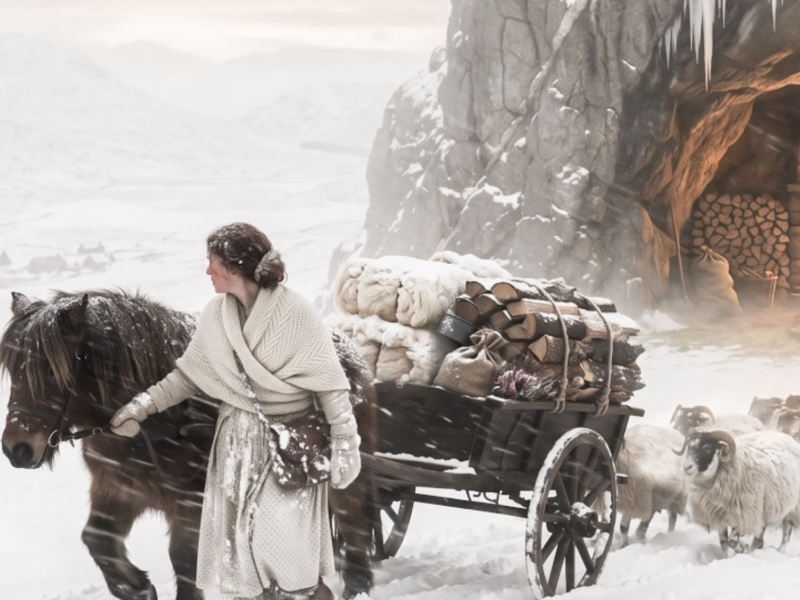
They Laughed at Her Firewood Cave Until the Blizzard Left Their Homes Freezing
THE WIDOW’S WALL
Two Months Earlier — October 1884
The wind slid down from the northern shoulders of the Absaroka range long before the first hard snow ever touched the valley floor. In Fenmore Bend, everyone understood the language of that wind. Nobody said the word storm out loud. Saying it didn’t stop it from coming, and speaking it aloud only wasted breath a family might need later.
Behind a small cabin at the bend of Willow Fork, a woman was carrying stones.
She carried them one at a time when they were heavy, two at a time when she could balance them against her chest. Her boots pressed the morning frost into a dark, muddy ribbon on the yellow grass as she walked the same short path between the creek bank and the low mouth of a half-finished cave in the hillside.
Neighbors passing along the wagon road saw her at that work and did not stop. Some tipped their hats. Some looked away, as though the sight of a widow working alone with stones was a private, shameful thing. Nobody asked her what the stones were for.
Her name was Marigold Thorne, though everyone called her Goldie. At thirty-five, she was thin through the shoulders, her brown hair pinned back in a plain twist the wind was already loosening.
Six months earlier, in the last cold week of April, she had buried her husband, Elias, beneath a young cottonwood at the edge of the clearing. He had left her three children, 160 acres of stony grass, and a crushing debt at the Vance Mercantile that made her throat close every time she looked at the ledger.
Goldie set a heavy, flat river stone on the packed earth floor of the cave. She wiped the sweat from her brow, ignoring the burning in her lower back.
“Ma, folks are talking.”
Goldie didn’t turn around. Her fourteen-year-old son, Silas, stood at the mouth of the cave with an armload of split cottonwood. He was tall for his age, carrying the same quiet anger that had settled over the cabin since April.
Goldie fitted the stone into the row and pressed her palm flat against it, testing whether it would rock. It did not. “Folks are always talking, Silas. That is their winter crop.”
Silas shifted the wood. “They are saying you aren’t right in the head since Pa.”
Goldie stood up straight. She could see Elias in the shape of her son’s jaw. She could also see the deep, burning shame he was carrying on her behalf. “Do you believe them?”
Silas looked down at the wood. “No.”
“Then help me set the next row, and let the talkers freeze in their own opinions.”
The corner of his mouth twitched. He stepped into the cave and began laying the firewood against the stones. Goldie stopped him, showing him how to leave a finger’s width of air between every piece.
“Does it really matter?” Silas asked.
“The difference between dry wood and wet wood in January is the difference between a warm child and a sick one,” she said quietly.
A sharp, rhythmic rattling interrupted them.
Goldie stepped out of the cave. Coming up her lane was a heavy wagon pulled by a matched pair of tall bay geldings. Only one man in the valley drove a team like that.
Ephraim Vance.
Vance was a barrel-chested man in his fifties, impeccably dressed in a black Chicago-cut wool coat. He owned the mercantile. He owned the freight contracts. He owned half the town.
Vance set the brake and climbed down, walking with the flat, patient stride of a man who owned the very dirt he stepped on. He stopped ten paces away and touched the brim of his hat.
“Mrs. Thorne,” Vance said. His eyes swept over the cave, the stacked stones, and finally settled on her. “I did not want to send a clerk on this errand.”
“Then say it standing, Mr. Vance,” Goldie replied, wiping her dusty hands on her apron.
Vance reached into his coat and drew a folded paper. The debt.
“The sum is not going to shrink through the winter, ma’am,” Vance said, his voice soaked in a terrifying gentleness. “I have carried it as long as any storekeeper in this territory would. Sign the cabin over to me. I will put a tenant in it come spring, give you rooms above the store through the cold months. Your boy can clerk for me. Your girls will be warm.”
Goldie stared at him. She thought of Elias, sweating on his knees in this very cave, promising her they would never bow to the company store.
“No,” Goldie said.
Vance didn’t blink. “I heard you the first time.”
“This cabin was raised by my husband’s hands. It will not be signed away from my children while I am standing.”
Vance’s eyes narrowed. The gentility vanished, leaving something cold and reptilian in its wake. “I will speak plain, then. There is not a merchant in Fenmore Bend who will extend you credit against my word. There is not a freighter who will haul you a cord of wood. What you put by before the snow is what you will have. I hope you have counted carefully.”
“I have counted, Mr. Vance. Thank you for your visit.”
Vance looked at the cave one last time, a smirk touching his lips. He turned and drove away.
Goldie stood in the yard, her heart hammering against her ribs. Fear was a familiar companion, but this was different. Vance hadn’t just come to collect a debt. He had come to ensure she knew she was trapped.
That night, after Silas, ten-year-old Prudence, and six-year-old Ren were asleep in the loft, Goldie sat by the dim light of a kerosene lamp. She opened a small, cracked leather-bound book.
It had belonged to her father, a Leadville miner. The pages were filled with assay notes and timber schematics. She turned to a page marked by a piece of dyed cotton. Her father had drawn a cross-section of a winter mining drift.
Beside it, in a hurried, slanting hand, he had written: Stone laid in the floor of a workings holds the heat of a man’s body and his lamp, and gives it back through the long shift. A crew can work at twenty below and never feel the cold reach their bones.
Goldie stared at the words: give it back.
She closed the book. She wasn’t just going to build a root cellar. She was going to build a lung. And she was going to survive Ephraim Vance.
But as she closed the book, a loose piece of paper slipped from the binding and fluttered to the floor. Goldie frowned. She picked it up. It wasn’t her father’s handwriting. It was Elias’s.
It was a hand-drawn map of their property, but the creek line was crossed out. In the corner, Elias had written: Vance lied. The runoff is tainted. It’s coming from the high ridge. My lungs burn. Don’t drink from the deep well.
Goldie’s breath hitched in her throat. Elias hadn’t died of consumption.
Ephraim Vance had poisoned him.









